
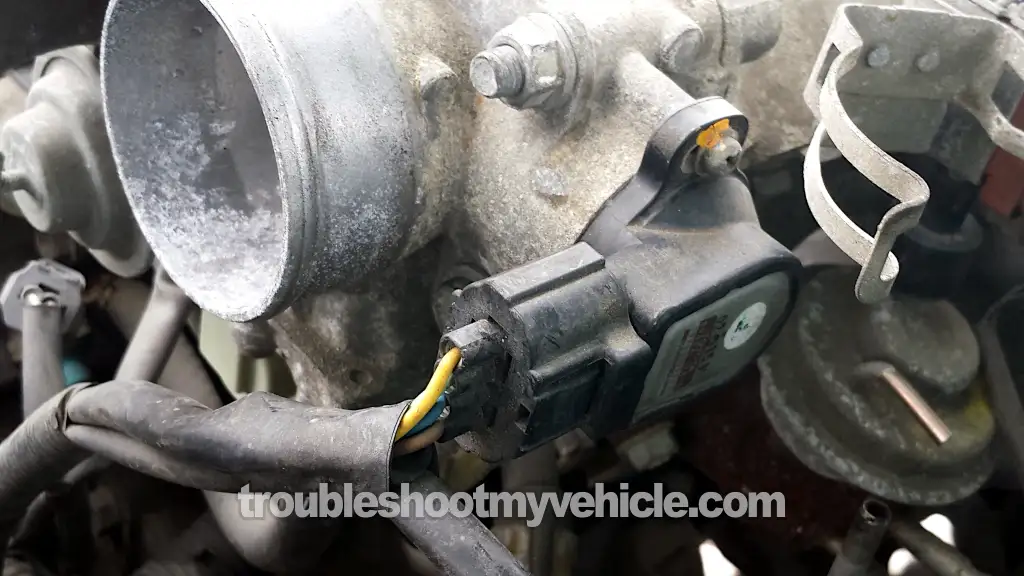
In this tutorial, I'm gonna show you how to check the throttle position sensor (TPS) on the 1993-1997 1.8L Toyota Corolla using just a multimeter -no scan tool required.
With your multimeter test results, you'll quickly and easily figure out if the TPS is faulty or working fine.
NOTE: The throttle position sensor assembly used on the 1993-1997 Toyota Corolla (and the 1993-1997 Geo Prizm) has two parts. One side is the TPS itself, while the other is an idle switch. Here, we're only focusing on testing the TPS.
If you need to test the idle switch part of the TPS, this tutorial will help: TPS Idle Switch Multimeter Test (1.8L Toyota Corolla).
Contents of this tutorial:
- What Does The Throttle Position Sensor Do?
- Symptoms Of A Bad Throttle Position Sensor.
- Where To Buy The Throttle Position Sensor And Save.
- TEST 1: Testing The Throttle Position Sensor Voltage Signal.
- TEST 2: Verifying Throttle Position Sensor Has Power.
- TEST 3: Verifying Throttle Position Sensor Has Ground.
- More 1.8L Toyota Corolla Tutorials.
APPLIES TO: This tutorial applies to the following vehicles:
- 1.8L (7A-FE) Toyota Corolla: 1993, 1994, 1995, 1996, 1997.
- 1.8L Geo Prizm: 1993, 1994, 1995, 1996, 1997.
What Does The Throttle Position Sensor Do?
The throttle position sensor (TPS) is a key part of your Corolla's engine management system. It tells the fuel injection computer how much the throttle plate is opening or closing. This information is crucial for adjusting fuel injection and ignition timing as the engine runs.
This particular TPS is a bit unique because it also has an integrated idle switch. This switch tells the ECM when the throttle is fully closed, helping regulate idle speed and fuel delivery when the engine is idling.
Here's a breakdown of what the TPS does:
- Idle Position: The idle switch inside the TPS signals the ECM that the throttle is fully closed. This helps control idle speed and fuel mixture for smooth idling.
- Part-Throttle: As you press the gas pedal, the TPS sends a varying voltage signal to the ECM, letting it know how much air is entering the engine. The ECM then adjusts fuel injection and ignition timing accordingly.
- Wide Open Throttle (WOT): When you floor the gas pedal, the TPS signals the ECM that maximum acceleration is needed. This triggers more fuel injection and adjusts ignition timing for better performance.
In short, the TPS helps ensure smooth acceleration, efficient fuel delivery, and stable idling. If it malfunctions, you might experience rough idle, poor acceleration, or even a check engine light.
Symptoms Of A Bad Throttle Position Sensor
Your 1.8L Toyota Corolla (or Geo Prizm) comes with either an OBD I or OBD II fuel injection system, depending on its year. Both On-Board Diagnostic (OBD) systems are built to trigger a TPS trouble code when the sensor stops working.
Here's a quick rundown of the symptoms you might notice when it fails:
- Check engine light (CEL): The CEL will illuminate when the fuel injection computer detects a throttle position sensor (TPS) issue and registers a diagnostic trouble code (DTC).
- A stored TPS trouble code in the PCM's memory:
- Code 41: (OBD I) Throttle Position Sensor Circuit Malfunction.
- P0120: (OBD II) Throttle Position Sensor Circuit Malfunction.
- Bad gas mileage: A failed TPS triggers "limp-in" mode, disabling the fine-tuning of the air/fuel mixture. As a result, more fuel is injected into the cylinders, reducing fuel efficiency.
- Hard to start: The engine takes longer to crank before it finally starts.
- Black smoke: A bad TPS often causes a rich air/fuel mixture, leading to excess fuel burning in the cylinders. This results in black smoke coming from the exhaust.
- Hesitation: When you step on the gas, the engine may momentarily lose power before accelerating.
Where To Buy The Throttle Position Sensor And Save
You can buy it at your local auto parts store but it's gonna cost a whole lot more. I suggest taking a look at the price of the TP sensor in the following links and compare:


Disclosure: As an Amazon Associate, I earn from qualifying purchases. If my tutorials help you, using these links is an easy way to support the site at no extra cost to you. Thank you!
Not sure if the above TP sensor fits your particular 1.8L Toyota? Don't worry, once you get to the site, they'll make sure it fits by asking you the particulars of your vehicle. If it doesn't fit, they'll find you the right one.
TEST 1: Testing The Throttle Position Sensor Voltage Signal
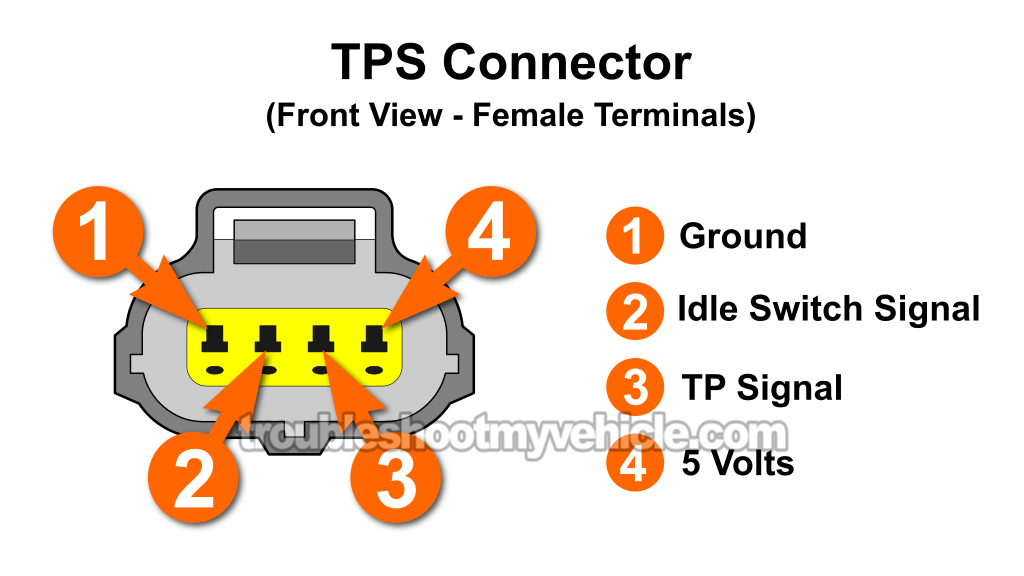
The TP sensor's job is to measure the angle of the throttle plate as you step on or release the accelerator pedal. As the throttle angle changes, the TPS converts it into a voltage signal.
Here's how it works:
- Signal voltage increases: This output happens only when you step on the accelerator pedal and the throttle plate opens.
- Signal voltage decreases: This happens when you step off the accelerator pedal and the throttle plate closes.
This predictable voltage change makes it easy to test the TPS with a multimeter and confirm whether it's working properly.
Here's what we're looking for:
- Good TPS: Voltage signal increases/decreases as the throttle plate opens/closes.
- Bad TPS: Voltage signal does NOT change as the throttle plate moves.
IMPORTANT: This test has to be done with the TPS connected to its electrical connector. To access the signal within the wire, you'll need to use a back probe or a wire-piercing probe. You can see an example of this tool here and where to buy it: Goupchn 4mm Banana to Banana Plug Test Leads Kit (Amazon affiliate link).
This is what we need to do:
- 1
Set your multimeter to Volts DC mode.
- 2
Take the red multimeter test lead and connect it to the middle wire on the sensor's connector.
This wire corresponds to the pin #3 in the illustration above. - 3
Attach the black multimeter test lead to the battery's negative (-) terminal.
- 4
Ask your helper to turn the key to the ON position, but don't start the engine (this powers up the TP sensor).
- 5
Your multimeter should show a voltage between 0.2 and 0.9 Volts DC. If it doesn't, don't stress over it yet —just move on to the next steps.
Part 2
- 6
Slowly open the throttle by hand (from the engine bay) and keep an eye on the voltage readings.
For an accurate test, make sure to move the throttle manually instead of using the gas pedal inside the car. - 7
Watch as the voltage increases when the throttle opens.
The voltage rise should be steady, with no sudden drops or gaps. Once the throttle is fully open, your multimeter should read somewhere between 3.5 and 4.5 Volts DC. - 8
Slowly close the throttle. As it shuts, the voltage should decrease smoothly, landing back at the exact reading you got in step 5, with no glitches or skips.
Part 3
- 9
Gently tap the throttle position sensor with a screwdriver handle (or something similar —remember, just a light tap) while slowly opening and closing the throttle. Keep an eye on the multimeter.
If the TPS is faulty, tapping it will cause voltage readings to jump around or momentarily disappear. If it's in good shape, tapping won't affect the voltage at all. - 10
Do step 9 a few times to confirm your test results.
Let's go over what your test results mean:
CASE 1: The voltage went up when you opened the throttle and dropped when you closed it. That means the TP sensor is working fine and isn't faulty.
CASE 2: The voltage didn't change when you moved the throttle plate. This points to a problem with the throttle position sensor (TPS) on your Corolla.
Before deciding the TPS is junk, you've gotta make sure it's getting both power and Ground. To check if power is reaching the sensor, head over to: TEST 2: Verifying Throttle Position Sensor Has Power.
CASE 3: The multimeter didn't show any voltage at all. This doesn't automatically mean the TP sensor is bad.
Why not? Because the issue might be a missing power or Ground connection. Your next step is to confirm whether the TPS is getting power. Go to: TEST 2: Verifying Throttle Position Sensor Has Power.
TEST 2: Verifying Throttle Position Sensor Has Power
Chances are, the reason you got a signal performance issue in TEST 1 is that the TPS isn't receiving power.
Your Corolla's throttle position sensor needs 5 Volts DC from the fuel injection computer to get powered and generate its voltage signal.
The wire responsible for delivering this voltage connects to terminal 4 of the TPS engine wiring harness connector (see the diagram above).
Alright, let's get this test started:
- 1
Set your multimeter to Volts DC mode.
- 2
Attach the black multimeter test lead directly on the negative (-) battery terminal.
- 3
Disconnect the TPS from its 4-wire connector.
- 4
Turn the key to the ON position without starting the engine.
This powers up the TP sensor's connector. - 5
Use the red multimeter test lead to probe the TPS connector female terminal 4.
IMPORTANT: Be careful when testing the female metal terminal on the TPS connector. The multimeter test probe could damage it and then you'll have to replace the connector. - 6
Your multimeter should read between 4.5 and 5 Volts.
Let's break down what your test results mean:
CASE 1: Your multimeter showed a reading between 4.5 and 5 Volts. This confirms that the throttle position sensor (TPS) is receiving power from the fuel injection computer.
The next (and final) step is checking whether the TPS is also getting Ground from the PCM. To do that, head over to: TEST 3: Verifying Throttle Position Sensor Has Ground.
CASE 2: Your multimeter didn't show 4.5 to 5 Volts. Double-check your connections and run the test again.
If your multimeter still doesn't detect 4.5 to 5 Volts DC, that means the TPS itself isn't the problem. Without power, it can't send a throttle angle voltage signal and the reason why you're getting a TPS trouble code.
Your next step is to find out why this voltage is missing and restore them to the circuit.
TEST 3: Verifying Throttle Position Sensor Has Ground
For this final test, we're gonna make sure the throttle position sensor is getting Ground.
Your Corolla's fuel injection computer provides this Ground. The wire delivering it connects to terminal 1 of the TPS engine wiring harness 4-wire connector (see the connector illustration above).
IMPORTANT: Be extra careful checking for Ground in this circuit —don't accidentally or intentionally short this circuit to battery voltage, or you'll end up frying your Corolla's fuel injection computer.
Here's how to run the test:
- 1
Disconnect the TPS from its electrical connector.
- 2
Switch your multimeter to Volts DC mode.
- 3
Connect the red multimeter test lead to the battery's positive (+) terminal.
- 4
Turn the key to the ON position, but don't start the engine. This powers up the fuel injection computer.
- 5
Use the black multimeter test lead to probe the TPS connector female terminal 1.
NOTE: Be careful not to damage the female terminal when probing it with the multimeter test lead. - 6
If the BLK wire is supplying Ground to the TPS, your multimeter should read between 10 and 12 Volts.
Let's break down what your test results mean:
CASE 1: Your multimeter displayed 10 to 12 Volts. That confirms the throttle position sensor (TPS) on your Toyota is getting Ground from the computer.
You can conclude that the TPS is bad and needs to be replaced if you have confirmed:
- The TP sensor isn't generating a changing voltage signal when you manually open the throttle plate (TEST 1).
- The TP sensor is receiving 5 Volts DC (TEST 2).
- The TP sensor is getting Ground (this test section).
After installing the new TPS, you'll need to adjust it properly. You can find the steps in this tutorial:
CASE 2: The multimeter didn't show 10 to 12 Volts. Double-check that you're testing the right terminal on the connector and try again.
If the voltage still doesn't appear, that means there's likely an open-circuit between the TP sensor harness connector and the fuel injection computer's harness connector. In rare cases, the computer itself might have an internal issue.
Although diagnosing these two possibilities is outside the scope of this tutorial, you now know that the throttle position sensor (TPS) on your 1.8L Toyota isn't the root of the problem or the reason for the TPS trouble code triggering the check engine light.
More 1.8L Toyota Corolla Tutorials
There are several more 'how to' tutorials that I've written that are 1.8L Toyota Corolla specific, that may be of further help. You can find them here:
Here's a small sample of the tutorials you'll find in the index:
- How To Test Engine Compression (1993-2008 1.8L Toyota Corolla).
- How To Test For A Blown Head Gasket (1993-2008 1.8L Toyota Corolla).
- Misfire Codes: How To Troubleshoot And Repair Them (1996-2008 1.8L Toyota Corolla).
- How To Test The Fuel Injectors (1993-1997 1.8L Toyota Corolla).

If this info saved the day, buy me a beer!
