
Testing for a blown head gasket on your Dodge Neon (or Cirrus, Stratus, Voyager, Caravan, PT Cruiser) can be done in several ways.
In this tutorial, I'm going to present to you four of the most effective techniques I've used over the years and that have helped me to nail down a blown head gasket problem.
Two of these tests are done with absolutely no tools at all, one is done using an engine compression tester, and the other requires a combustion leak tester (commonly known as a block tester). I'm gonna' explain all four in detail and in step-by-step fashion.
Contents of this tutorial:
- Symptoms Of A Blown Head Gasket.
- TEST 1: Is The Oil The Color Of ‘Coffee With Too Much Creamer’?
- TEST 2: Exhaust Gases Escaping Through The Radiator.
- TEST 3: Checking Engine Compression.
- TEST 4: Using A Chemical Block Tester (Combustion Leak Tester).
- Saving Money On The Head Gasket.
- Related Test Articles.
ES  You can find this tutorial in Spanish here: Cómo Probar El Empaque De La Cabeza (Chrysler 2.0L, 2.4L) (at: autotecnico-online.com).
Symptoms Of A Blown Head Gasket
The most common cause of a blown head gasket is that the engine overheated due to: 1) A bad radiator fan 2) No coolant in the engine due to a leak somewhere in the coolant system 3) Bad thermostat.
The most common symptoms a blown head gasket are:
- Your car or mini-van is overheating. You know it's not the fan or thermostat.
- White smoke is coming out of the tail-pipe and it smells like anti-freeze being cooked.
- The car or mini-van won't start.
- You have already verified it's not an ignition system problem because you have spark coming out at all of the spark plug wires.
- You know it's not a lack of fuel, because you have verified that the fuel pump is delivering fuel to the fuel injectors.
- The engine oil is thick and tan to off-white color.
TEST 1: Is The Oil The Color Of ‘Coffee With Too Much Creamer’?
Before you start, I want to let you know that you don't have to do all of the 4 tests if one of them proves to you that the head gasket is blown.
Also, one test may prove inconclusive and yet another (of the four) may prove beyond a shadow of a doubt that the head gasket is burned. This is normal, since a blown head gasket condition may not present all of the symptoms that the tests are testing for.
OK, to get this show on the road, this is what you need to do:
- 1
Open the hood of your vehicle.
- 2
Pull the engine oil dipstick out of the engine.
- 3
Now, take at the oil is sticking to the dipstick. You'll see one of two things:
1.) The oil is the color of coffee with too much cream or a milky white/tan color.
2.) The color of the oil is its normal color.
Take a look at the following interpretations to find out which one best fits what you have observed of the color of the oil:
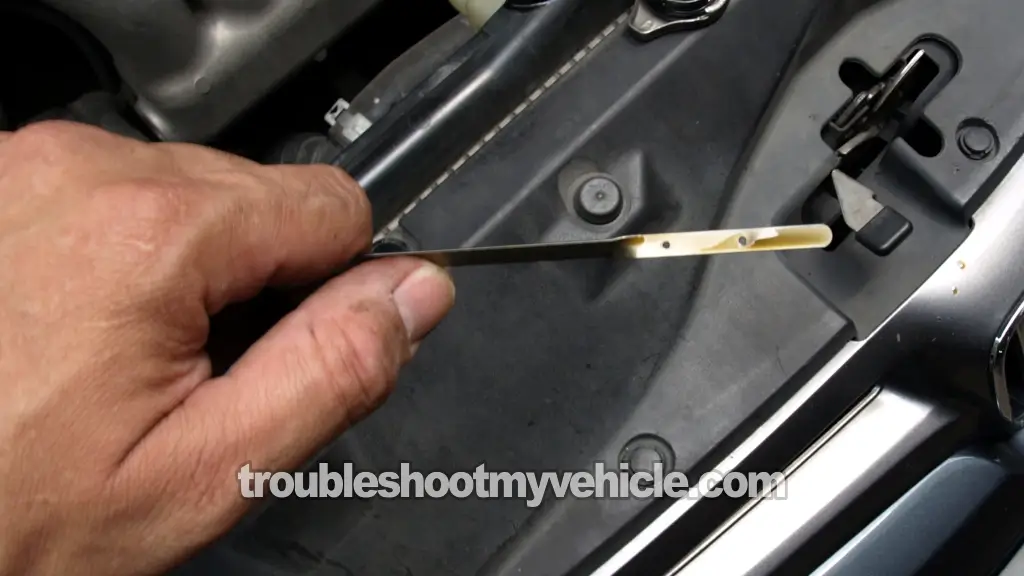
CASE 1: The color of the oil is a light tan, like coffee with too much creamer. This confirms that the head gasket is blown. No further testing is required, since this confirms beyond a shadow of a doubt that the cylinder head gasket is blown.
If you're wondering why does the oil look like this? There are 3 main reasons:
1.) The engine overheated and caused the cylinder head to warp and the head gasket to burn.
2.) This in turn causes the head gasket to stop sealing the oil and coolant ports in both the engine block and the cylinder head.
3.) This leads to the coolant entering the engine oil pan and mixing with the oil. As both of these mix, the resulting oil gets thick and turns to an off-white color.
CASE 2: The color of the oil is its normal color. Although this is a good result, it does not confirm the condition of the head gasket yet, go to: TEST 2: Exhaust Gases Escaping Through The Radiator.
Here's why: You would think that every time a head gasket gets blown, it would let the coolant mix with the engine oil but this is not always the case. So, further testing is required to make sure that the reason your vehicle is not starting, or overheating is not due to a blown head gasket.
TEST 2: Exhaust Gases Escaping Through The Radiator
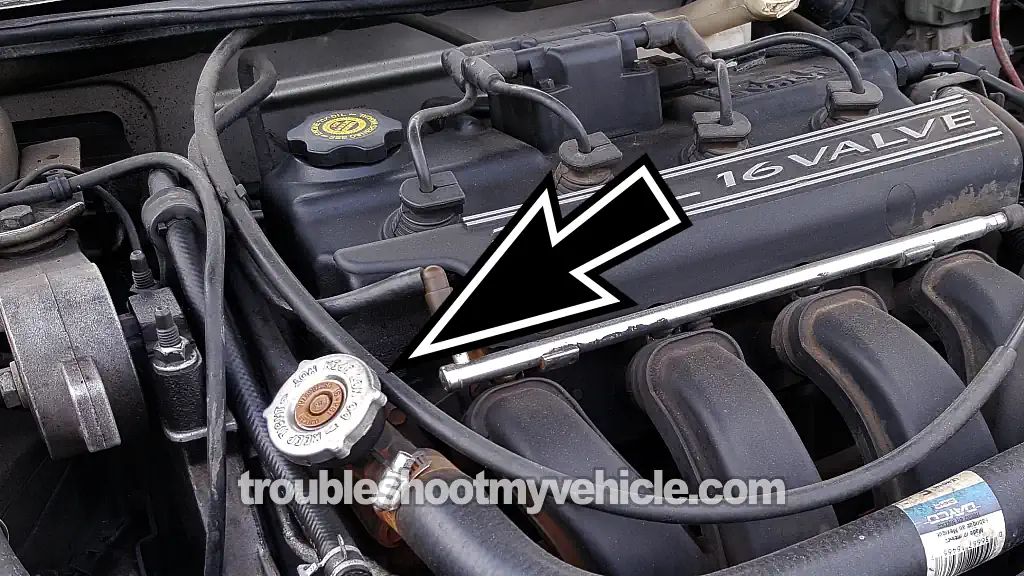
The second most common test, to see if the head gasket has blown or not, is to remove the radiator cap and then crank and/or start the car.
What this test will confirm is if the head gasket is letting engine compression into the cooling system (radiator) or not.
IMPORTANT: If the engine in your Stratus (or Neon, Caravan, Breeze, Avenger) has been running for a while and it's hot, let it cool down for about an hour, since a radiator cap should never be removed with the engine hot. Please take all necessary safety precautions.
If your 2.0L or 2.4L Dodge car or mini-van doesn't start, well this will not be an issue since the coolant will be cold.
Alright, this is what you need to do:
- 1
Remove the radiator's cap. If the radiator does not have any coolant, add some water (for this test, you can add just water and not anti-freeze).
- 2
Have a helper crank the engine while you observe the open radiator from a safe distance.
- 3
You'll see one of two things:
1.) The water or coolant inside the radiator will shoot up and out of the now open radiator.
2.) The coolant will not be disturbed. In other words, cranking the engine will have no effect on the level of the Water or coolant in the radiator.
OK, now that the testing part is done, let's take a look at what your results mean:
CASE 1: The coolant bubbled out or shot out from the radiator. This is not good and indicates beyond a shadow of a doubt that the head gasket is blown on your PT Cruiser (or Neon, Stratus, Cirrus, Sebring, etc.).
No further testing is required. Now, in case you're wondering why this is happening: Well, the head gasket's job is to seal both the coolant and engine oil and also the engine compression/combustion process happening inside each engine cylinder. When the head gasket gets blown, one of the most common after-effects is the engine compression/combustion gases escaping into the cooling system, since it's not sealing effectively anymore.
So, by removing the radiator cap and cranking and/or starting your car or mini-van, you can physically see if this is happening or not.
CASE 2: The coolant DID NOT bubble out NOR shoot out from the radiator. This is the correct and expected test result.
Two out of the four tests indicate that the head gasket is OK, but we need to continue:
- If the engine cranks but does not start, your next step is to perform an engine compression test. Go to: TEST 3: Checking Engine Compression.
- If the engine starts and runs but overheats within minutes for no apparent reason, your next step is to go to: TEST 4: Using A Chemical Block Tester (Combustion Leak Tester).
TEST 3: Checking Engine Compression
It does happen that a head gasket can get blown without causing the coolant to mix with the engine oil and without causing combustion gases from entering the cooling system. I have seen this enough to know that one more test has to be done.
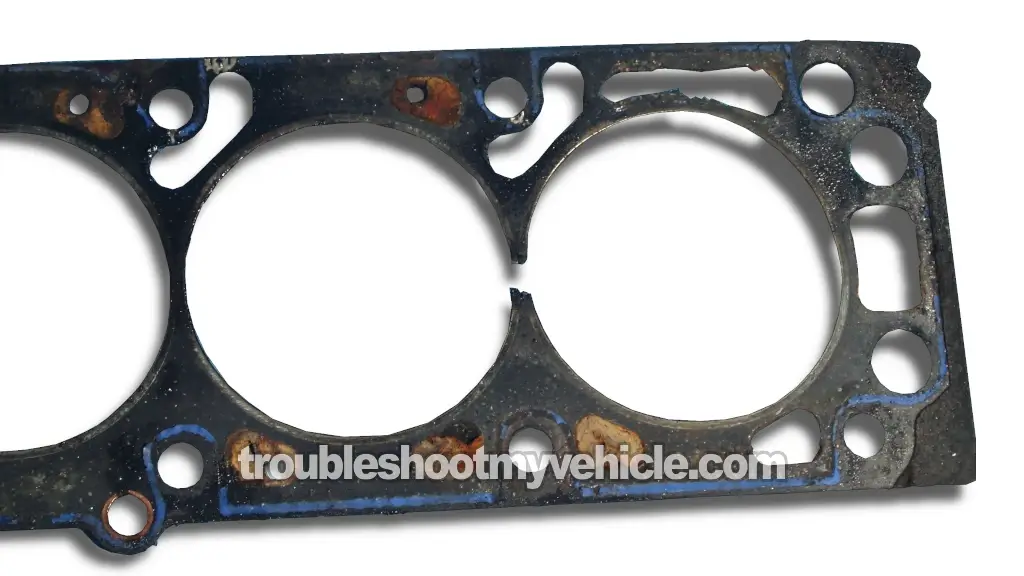
In these cases, the head gasket will get burned between two cylinders, causing a gap that will let the compression/combustion of one cylinder to leak into the other and vice-versa (see the photo at the beginning of this tutorial). If this happens, in a 2.0L or 2.4L Chrysler equipped car or mini-van, the engine is not going to start.
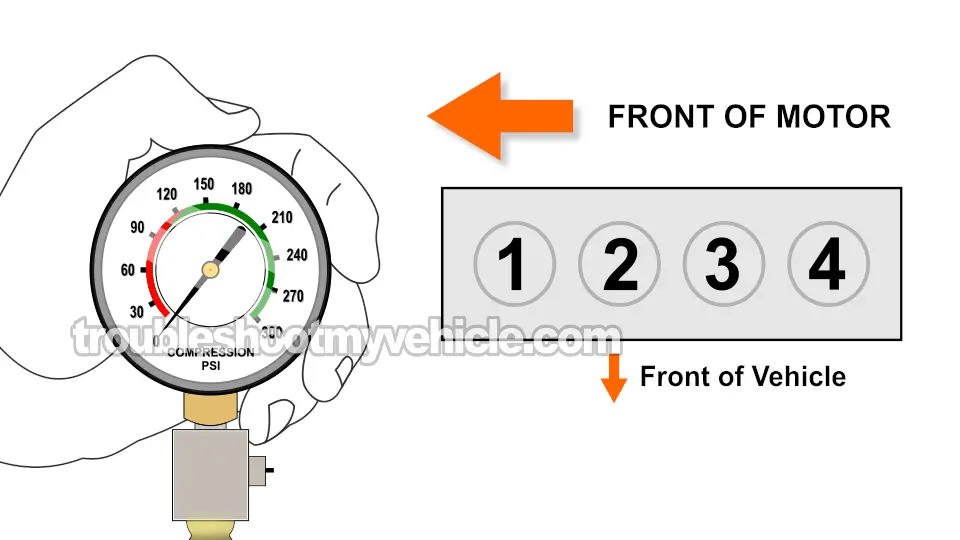
To be a bit more specific: If the head gasket has burned at a location between 2 cylinders, you're going to have 2 good compression readings and 2 compression readings that will be 0 PSI.
Here's a simple example of this:
- Cylinder #1 = 175 PSI
- Cylinder #2 = 165 PSI
- Cylinder #3 = 0 PSI
- Cylinder #4 = 0 PSI
As you can see from the above compression readings, cylinders #3 and #4 have 0 PSI readings. And this is a clear indication that the head gasket has burned at the point between them both.
Now, in your specific case (and if it applies), you may not see those exact same cylinders with 0 PSI readings. It may be #1 and #2 or it may be #2 and #3, the main idea is that whatever cylinders are affected, they will always be side by side.
NOTE: You can find a detailed explanation of the engine compression test in this tutorial: How To Test The Engine Compression (Chrysler 2.0L, 2.4L).
Let's get testing:
- 1
Disconnect the ignition coil pack and the fuel injectors. This will disable the ignition system and fuel system. This first step is important.
- 2
Disconnect the spark plug wires from the spark plugs.
- 3
Remove all four spark plugs.
- 4
Thread in the compression tester on the first spark plug hole you're gonna start with.
- 5
Have a helper crank the engine while you observe the compression tester's needle.
- 6
Once the needle on the gauge stops climbing, have your helper stop cranking the engine.
- 6
Write down the reading and what cylinder it applies to.
- 7
Repeat the above steps in the remaining 3 cylinders.
Let's interpret your particular test results:
CASE 1: All cylinder compression readings where normal. This tells you that the head gasket is OK.
If your vehicle starts and runs and you still suspect a blown head gasket, go to: TEST 4: Using A Chemical Block Tester (Combustion Leak Tester).
CASE 2: Two side by side cylinders had 0 PSI compression. This engine compression reading confirms that the head gasket is burned thru' at the point between those two cylinders.
TEST 4: Using A Chemical Block Tester (Combustion Leak Tester)
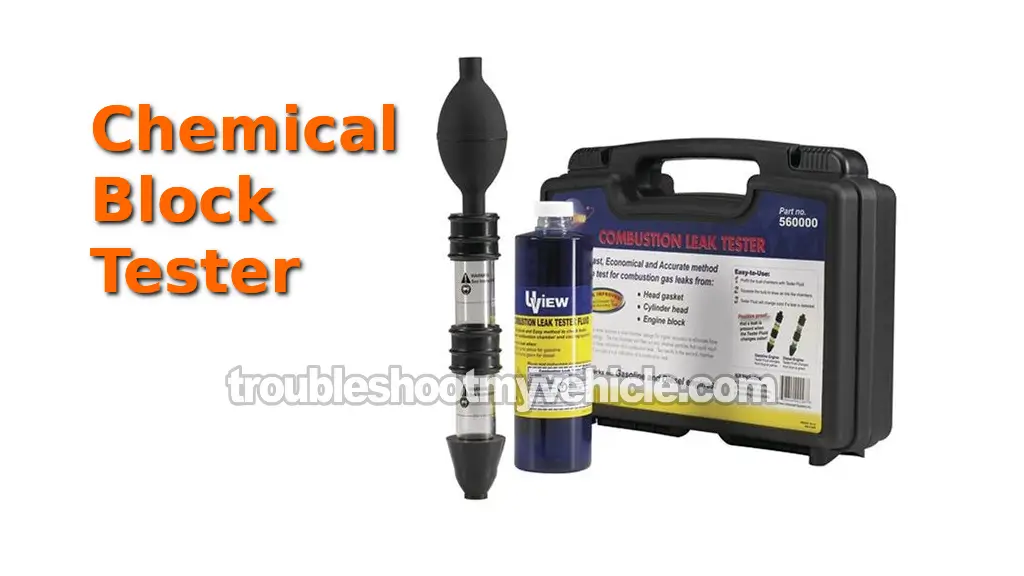
One of the problems I've encountered is a failed head gasket that causes the engine to overheat after a few minutes of starting it.
Usually, in these cases, the engine oil isn't mixed with coolant and the compression gases are not escaping into the cooling system.
This also means that the head gasket failure can not be pinpointed by the 3 previous tests. The test of last resort, is a block test with a combustion leak detector.
This is how the combustion leak detector test (block test) works:
- The combustion leak detector tester is filled with a blue liquid chemical (see photo above).
- The radiator cap is removed (you may have to drain some of the coolant in the radiator since this tool needs to ‘gulp’ some of the air inside the radiator).
- The engine is started.
- The tester is then placed on the open radiator neck.
- The rubber bellow is then squeezed to suck in the air up through the two fluid-filled chambers. As the air bubbles up through the fluid, it will cause a chemical reaction.
- If the blue chemical turns yellow (for gasoline engines), combustion gases are entering the radiator. This result confirms a head gasket failure, a cracked block, or a cracked cylinder head issue.
- If the blue chemical doesn't change color, you can conclude that you don't have a head gasket failure, a cracked block, or a cracked cylinder head issue.
You can shop for a block tester here:


Disclosure: As an Amazon Associate, I earn from qualifying purchases. If my tutorials help you, using these links is an easy way to support the site at no extra cost to you. Thank you!
Saving Money On The Head Gasket
In case you do need to buy the head gasket and related parts, the following links may help you to comparison shop and hopefully save some money on the repair:
2.0L SOHC Gasket Set:


2.0L DOHC Gasket Set:


If you're not sure if the above head gasket sets fit your particular 2.0L or 2.4L engine, don't worry, once you get to the site they'll make sure it fits (and if it doesn't fit, they'll find the right one for your particular vehicle).
Related Test Articles
I've written several more tutorials that may be of interest to you. These are specific 2.0L (SOHC, DOHC), 2.4L (DOHC) Neon, Stratus, Breeze, Caravan, Voyager, basically all Chrysler vehicles that use these two engines at: Chrysler 2.0L, 2.4L Index Of Articles.
Here's a sample of the tutorials you'll find in the index:
- How To Test The Fuel Pump (Chrysler 2.0L, 2.4L).
- How To Test Misfire Codes (Chrysler 2.0L, 2.4L).
- How To Troubleshoot A No Start (Chrysler 2.0L, 2.4L).
- How To Test The Camshaft Position Sensor (Chrysler 2.0L, 2.4L).
- How To TEST 2.0L (SOHC, DOHC) and 2.4L (DOHC) Coil Packs Chrysler, Dodge, Eagle, Plymouth and Mitsubishi. This article will help you to diagnose the ignition coil pack/ ignition system.

If this info saved the day, buy me a beer!


