
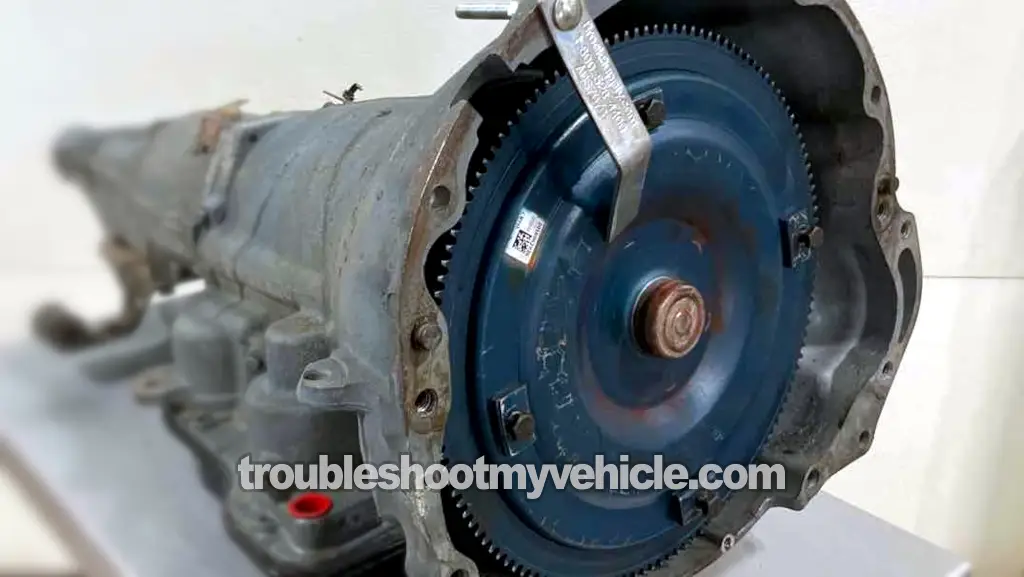
The 1996-2001 Dodge Ram full-size pickups equipped with the 3.9L V6 gasoline engine came with the 42RE four-speed automatic transmission.
This transmission is electronically controlled, which means that when something goes wrong, the issue could stem from either the internal mechanical components or the electronic system that handles shifting and operation.
In this tutorial, I'll walk you through how to identify the most common causes of transmission problems in these trucks.
I put this guide together to help you cut through the guesswork and zero in on the real problem —whether you're tackling the repair yourself or handing your transmission guy the key info he needs to get your Ram back on the road.
Contents of this tutorial:
- 42RE Automatic Transmission Basics.
- The Most Common Transmission Failures.
- Throttle Valve Cable Adjustment.
- How Can I Tell If It's Just A Solenoid Failure?
- How Can I Tell If It's Internal Transmission Damage Requiring An Overhaul?
- Transmission With Both Solenoid Failure And Internal Damage.
- In Conclusion.
- More 3.9L V6 Dodge Ram Pickup Tutorials.
ES  You can find this tutorial in Spanish here: Cómo Saber Si La Transmisión Automática Ya Falló (1996-2001 3.9L V6 Dodge Ram Pickup) (at: autotecnico-online.com).
APPLIES TO: This tutorial applies to the following vehicles:
- 3.9L V6 Dodge Ram 1500 Pickup: 1996, 1997, 1998, 1999, 2000, 2001.
- 3.9L V6 Dodge Ram 2500 Pickup: 1996, 1997, 1998, 1999, 2000, 2001.
42RE Automatic Transmission Basics
As I mentioned at the beginning, your V6 Dodge Ram pickups is equipped with the the 42RE automatic transmission and used between 1996 and 2001.
If you're a DIYer or home mechanic, here's the least you need to know to make sense of how this transmission behaves when things go wrong:
- It uses an electronically controlled governor pressure system for gear selection and line pressure regulation.
- Shift timing is handled by a set of solenoids in the valve body, all managed by the vehicle's onboard computer.
- It has onboard diagnostics —you can pull trouble codes directly from the PCM (or TCM, depending on the setup).
- This is a 4-speed automatic that includes an overdrive gear for highway efficiency.
- Found in 3.9L V6 Ram trucks from 1996 through 2001.
The Most Common Transmission Failures
If you're trying to get to the bottom of a transmission issue, here's the most important thing to understand: automatic transmissions typically fail in a few predictable ways.
- Slipping or soft shifts: If the engine revs but the truck doesn't move with the power you'd expect —or shifts feel weak and sluggish— you're likely dealing with:
- Low transmission fluid (check for proper level and condition).
- Internal wear or damage within the transmission.
- NOTE: If fluid level is OK, slipping is the biggest red flag that something inside the transmission —like the clutches or bands— is failing mechanically.
- Harsh or delayed gear changes: If shifting feels rough, jolts the truck, or there's a noticeable pause before Drive or Reverse engages, the usual suspects include:
- Low fluid due to a leak somewhere in the system.
- A misadjusted throttle valve (TV) cable, also called a kickdown cable.
- Internal transmission damage.
- Stuck in one gear/won't upshift: If you put the truck in Drive, hit the gas, and it starts out in 3rd gear —without shifting— the transmission has gone into “limp mode.” This is usually triggered by:
- Wiring or transmission sensor problems.
- A faulty shift solenoid.
- Internal mechanical failure.
- No overdrive or missing 4th gear: If your truck never seems to hit its final gear —or the "OD Off" button does nothing— check for:
- Problems with the overdrive solenoid (also known as the 3-4 shift solenoid).
- Internal mechanical issues preventing the shift.
- No torque converter lock-up: The torque converter is designed to "lock" at cruising speeds (in 3rd or 4th gear) to boost fuel economy. When it fails to lock, the likely reasons are:
- Transmission fluid running low.
- A faulty torque converter clutch (TCC) solenoid.
- A malfunctioning throttle position sensor (TPS).
Throttle Valve Cable Adjustment
NOTE: Always begin your diagnosis by checking the transmission fluid level —low fluid can lead to delayed gear engagement and odd shift behavior.
After that, take a close look at the throttle valve cable (also known as the kickdown cable). It's designed to do the following:
- Signal the transmission how much throttle you're applying.
- Help the transmission decide whether to hold a gear longer, rather than upshifting too soon —especially under heavy throttle.
- Tell the transmission when to downshift, so it can deliver more torque and power when you need quick acceleration (like when you're stomping on the gas to beat the yellow light).
Since this cable plays such a critical role in shift timing and performance, inspect it for any visible wear or damage, and make sure it's securely connected to the throttle linkage at the throttle body.
The cable should glide smoothly and have proper slack. When the throttle plate is fully closed, the cable should have a slight bit of give —it should begin to move as soon as the throttle starts opening.
If the cable is too tight, you'll get firm, delayed shifts. Too loose, and the transmission may shift too early and too softly.
Adjusting the kickdown (TV) cable is pretty straightforward —just press the locking tab on the adjuster and slide it to set.
But don't skip the proper procedure —correct adjustment is key to making sure your truck shifts at the right time when you press the accelerator.
This video breaks it down clearly:
- Jasper Engines & Transmissions - How to Video - Dodge Throttle Valve Cable Adjustment (at: youtube.com).
How Can I Tell If It's Just A Solenoid Failure?
The 42RE transmission is electronically controlled and depends on multiple internal solenoids and sensors to function correctly.
These components are managed by the Powertrain Control Module (PCM), or in some setups, a separate Transmission Control Module (TCM). The module constantly monitors and adjusts shifting behavior based on data from these systems.
If any of these solenoids or sensors fail —or if the Transmission Relay that powers them fails— the transmission enters what's called 'Limp-In Mode', a backup mode that restricts normal shifting and limits driveability.
In Limp Mode, the transmission locks itself into 3rd gear —no upshifts, no downshifts— even when starting from a complete stop. It's designed to protect the transmission from further damage while still allowing you to limp the vehicle to a repair shop.
A strong indicator that the problem is electronic rather than mechanical is the lack of slipping between gears.
In electrical or solenoid-related failures, the transmission typically won't slip. Instead, it may stop shifting altogether, get locked into a single gear, or remain in second or third gear —all classic symptoms of Limp-In Mode. This behavior makes it easier to pinpoint the root cause as an electrical or control-related fault.
Here are some common signs that point to a solenoid malfunction or an electrical system failure:
- The check engine light (CEL) is ON, and a diagnostic trouble code (DTC) related to a shift solenoid has been stored. Transmission-related codes typically follow the generic OBD II format and begin with P07XX, where the final two digits identify the specific issue.
- You'll see one or several of the following transmission diagnostic trouble codes:
- P0700: Transmission Control System Malfunction.
- P0711: Transmission Fluid Temperature Sensor Circuit Range/Performance.
- P0712: Transmission Fluid Temperature Sensor Circuit Low Input.
- P0713: Transmission Fluid Temperature Sensor Circuit High Input.
- P0720: Output Speed Sensor Circuit Malfunction.
- P0740: Torque Converter Clutch Circuit Malfunction.
- P0743: Torque Converter Clutch Circuit Electrical.
- P0748: Pressure Control Solenoid Electrical.
- P0753: Shift Solenoid A Electrical.
- P0783: 3-4 Shift Malfunction.
- You may see one, or several, of the following Manufacturer Specific DTCs:
- P1756: Governor Pressure Not Equal To Target At 15-20 PSI.
- P1757: Governor Pressure Above 3 PSI When Request Is 0 PSI.
- P1762: Governor Pressure Sensor Offset Improper Voltage.
- P1763: Governor Pressure Sensor Voltage Too High.
- P1764: Governor Pressure Sensor Voltage Too Low.
- P1765: Trans 12 Volt Supply Relay Control Circuit.
- The speedometer does not work and you might have one of the following trouble codes:
- P0500: Vehicle Speed Sensor Malfunction.
- P0501: Vehicle Speed Sensor Range/Performance.
- P0502: Vehicle Speed Sensor Low Input.
- P0503: Vehicle Speed Sensor Intermittent/Erratic/High.
- Your 42RE transmission remains in 'Limp-In Mode', which usually means it's locked in 3nd gear —no matter how fast you're driving.
- When accelerating from a stop, the truck feels sluggish —that's because it's trying to move from a standstill in 3nd gear instead of 1st.
- Once you get above 35 MPH, you'll hear the engine revving unusually high. This happens because the transmission isn't shifting out of 3nd gear, which has a low gear ratio.
So, how do you know if the problem inside your transmission is electrical or solenoid-related?
- You'll see one or more transmission-specific diagnostic trouble codes —sometimes even an output speed sensor code —when you scan the system.
- The transmission never slips, no matter how many test drives you take.
- The truck remains locked in 3nd gear, showing classic signs of Limp-In Mode.
Now let's take a closer look at what it means when the issue isn't electrical —but instead points to real internal damage inside the transmission. That's what we'll cover on the next section.
How Can I Tell If It's Internal Transmission Damage Requiring An Overhaul?
The most obvious red flag that your Dodge Ram's automatic transmission is has a serious internal mechanical problem is when it begins to slip —in other words, the engine revs up, but the power doesn't reach the wheels the way it should.
Below are some clear indicators that it may be time for a rebuild or replacement:
- The fluid level is normal, but the transmission fluid looks very dark or black and gives off a strong burnt odor —both signs of overheating and worn-out clutch packs.
- You might pull one or more "gear ratio error" codes from the PCM. These show up when the computer detects a difference between what the transmission should be doing and what it's actually doing —often caused by slipping clutches or damaged internals:
- P0730: Incorrect Gear Ratio (general).
- P0731: Gear 1 Incorrect Ratio.
- P0732: Gear 2 Incorrect Ratio.
- P0733: Gear 3 Incorrect Ratio.
- P0734: Gear 4 Incorrect Ratio.
- These codes are the PCM's way of saying: "I tried to engage a gear, but the output speed doesn't line up —something inside the transmission isn't holding as it should".
- While accelerating, the transmission suddenly acts like it popped into neutral —this is a textbook example of "slipping".
- No 1st gear engagement: You put the truck in Drive and rev the engine, but it just sits there. This typically points to a failed forward clutch pack.
- The transmission hesitates to drop into 1st gear after stopping, and then slams into gear with a hard jolt.
- Normally, it should downshift into 1st smoothly before the vehicle comes to a complete stop.
- A delayed response like this can indicate problems in the valve body or worn clutch components.
- No Reverse gear at all, even though Drive still works. That's often a sign the reverse band or the direct clutch has worn out.
- When you pull the transmission pan, you find black sludge or gritty sediment —that's the worn friction material from the clutches and bands inside the unit.
- Metal shavings mixed in with the debris at the bottom of the pan suggest internal hard part damage, like a broken planetary gear or worn thrust washer.
At the end of the day, dropping the transmission pan is one of the most reliable ways to confirm internal damage.
If you spot dark sludge, worn clutch material, or metal fragments in the pan, that's a solid indication the transmission is due for a rebuild or replacement.
Transmission With Both Solenoid Failure And Internal Damage
It's worth knowing that your 42RE-equipped Dodge Ram pickup can have both a bad solenoid or sensor And internal mechanical damage at the same time.
This overlap is particularly common when the internal damage involves the clutch packs for 1st, 2nd or 4th gear.
What usually hides the slipping is that the transmission is stuck in Limp-In Mode —so it never even tries to engage the damaged gears.
In other words, the transmission may seem to be working fine —not because it's actually okay, but because it's being restricted from using the gears that are already shot.
From my own hands-on experience, I've run into several cases where a vehicle showed a sensor or solenoid trouble code —like a bad governor pressure sensor or shift solenoid. After replacing the part, the truck began shifting again… and that's when the real trouble showed up: serious slipping in 1st or 4th gear that had been hidden by Limp Mode all along.
If you're in the process of replacing a solenoid or sensor, here are a couple of smart checks to catch deeper issues early:
- When dropping the transmission fluid pan, take a close look for excessive clutch dust, black sludge, or metal debris. These are red flags —even if you haven't felt any slipping yet.
- After swapping the part and clearing the trouble codes, do a road test. Pay attention to how it shifts from 1st all the way to 4th —especially under light throttle. Slipping here could mean hidden internal damage is finally showing itself.
In Conclusion
Hopefully, this guide has helped you zero in on whether the problem with your 42RE transmission is:
- Electrical —like a faulty solenoid, sensor, or wiring issue, or
- Mechanical —such as worn-out clutch packs or bands, which usually means it's time for a rebuild or replacement.
If you're still on the fence after fixing an electrical issue, the best next move is to clear Limp-In Mode and take the truck for a careful road test. That's often when the truth comes out —you'll quickly see if the transmission can still hold its gears or if deeper internal problems are lurking.
More 3.9L V6 Dodge Ram Pickup Tutorials
I've written several more tutorials for the V6 Dodge Ram pickups that may be of interest to you that you can find in this index:
Here's a sample of the tutorials you'll find in the index:
- How To Test The Crankshaft Position Sensor (1998-2001 3.9L V6 Dodge Ram Pickup).
- How To Test The Fuel Injectors (1992-1999 3.9L V6 Dodge Ram Pickup).
- How To Test The Ignition Coil (1992-2001 3.9L V6 Dodge Ram Pickup).
- How To Test For A Blown Head Gasket (1989-2001 3.9L V6 Dodge Ram Pickup).

If this info saved the day, buy me a beer!
