
Even though the 2004-2007 3.0L V6 (OHV) Ford Taurus or Mercury Sable doesn't come with a Schrader valve on the fuel injector rail to check fuel pressure, we can still check fuel pressure with a fuel pressure test gauge.
In this tutorial, I'm going to show you where you can connect your fuel pressure test gauge and the adapter you're going to need to do so.
All of the test steps are explained step by step so that you can easily and quickly check the fuel pump's pressure with a mechanical fuel pressure test gauge.
I'll also explain how to check an engine no-start issue caused by a lack of fuel with starting fluid.
Contents of this tutorial:
APPLIES TO: This tutorial applies to the following vehicles:
- 3.0L V6 (OHV) Ford Taurus: 2004, 2005, 2006, 2007.
- 3.0L V6 (OHV) Mercury Sable: 2004, 2005.
1990-2003 FUEL PUMP PRESSURE TESTS:
- How To Test The Fuel Pump (1990-1999 3.0L V6 Ford Taurus, Mercury Sable).
- How To Test The Fuel Pump (2000 3.0L V6 Ford Taurus, Mercury Sable).
- How To Test The Fuel Pump (2001-2002 3.0L V6 Ford Taurus, Mercury Sable).
- How To Test The Fuel Pump (2003 3.0L V6 Ford Taurus, Mercury Sable).
ENGINE NO-START DIAGNOSTICS:
Symptoms Of A Bad Fuel Pump
The fuel pump in your Ford Taurus or Mercury Sable is going to fail in one of two ways:
- Complete failure —In this scenario, the fuel pump simply stops working, doesn't deliver fuel to the fuel injectors anymore, and the engine doesn't start.
- Failing fuel pump —When this happens, the fuel pump still functions and delivers enough fuel to get the engine started. But once you stick the transmission in Drive and step on the gas, you're going to have all sorts of engine performance issues.
Since the fuel pump is such a critical component of the engine management system, when it begins to fail —or kicks the bucket completely— you're going to see one or more of the following engine performance problems:
- Engine cranks but won't start.
- Lean air/fuel mixture trouble codes.
- Rough idle.
- Engine starts after extended cranking.
- Lack of power when accelerating the vehicle down the road.
- Back-fires thru' the intake manifold when accelerating your vehicle down the road.
One of the issues that complicates a fuel pump diagnostic on the 2004-2007 Ford Taurus or Mercury Sable is that they come equipped with a Fuel Pump Driver Module (FPDM). This is the component that's in charge of activating the fuel pump and controlling how much fuel pressure it sends to the injectors.
The FPDM can be checked fairly easily to see if it's behind an engine no-start issue, but the very first step in troubleshooting it is to check fuel pressure with a mechanical gauge —and that's what I'm going to show you in this tutorial.
FPDM DIAGNOSTIC TESTS: Fuel Pump Driver Module Tests (2000, 2002-2007 3.0L V6 Ford Taurus, Mercury Sable).
Where To Buy A Fuel Pressure Test Gauge
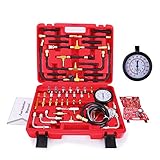
As I mentioned at the beginning of the tutorial, the 2004-2007 3.0L V6 Ford Taurus and Mercury Sable don't have a Schrader valve on the fuel injector rail. So, to check the fuel pump's pressure with a mechanical fuel pressure test gauge, we need to use a Ford Spring-Lock Coupling Adapter between the fuel pressure line and the fuel injector rail.
Below, you'll see two links to fuel pressure test gauge kits that include this Ford Spring-Lock Coupling Adapter, so you can quickly and easily check the fuel pump's pressure output:

Disclosure: As an Amazon Associate, I earn from qualifying purchases. If my tutorials help you, using these links is an easy way to support the site at no extra cost to you. Thank you!
Fuel Pressure Specifications
The fuel pressure specifications with the key on engine off (KOEO) and key on engine running (KOER) are:
| Year | KOEO | KOER |
|---|---|---|
| 2004-2007 | 30-55 PSI | 26-45 PSI |
TEST 1: Checking Fuel Pressure With A Fuel Pressure Gauge
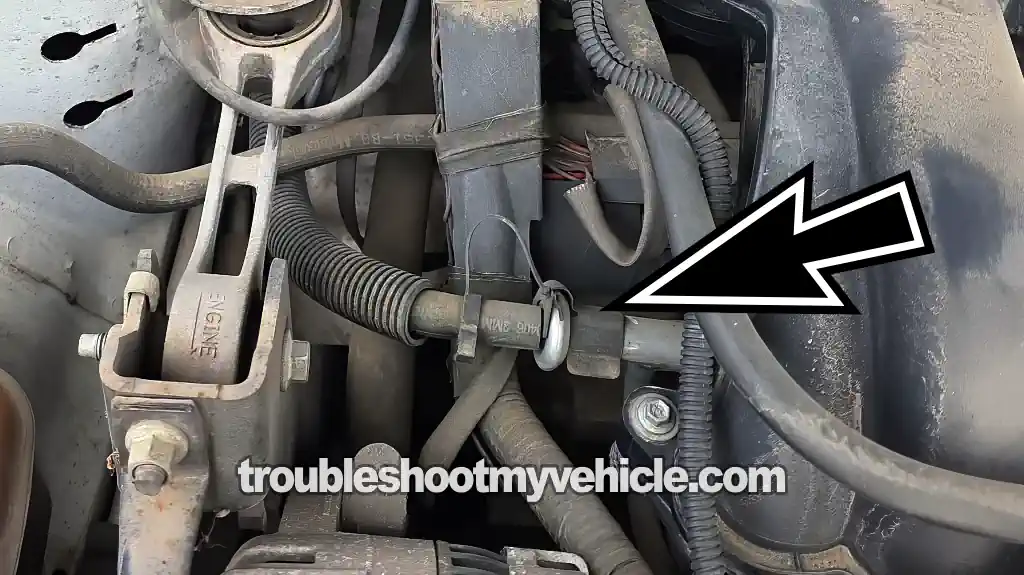
To check the fuel pump pressure on your Ford Taurus or Mercury Sable, the Ford repair manual says you need a bi-directional scan tool to activate the fuel pump and check its fuel pressure.
The repair manual also wants you to check fuel pressure not with a mechanical test gauge, but by reading the pressure that the Fuel Rail Pressure (FRP) sensor reports (on that bi-directional scan tool).
If you've got one, that's awesome! In the test instructions below, I'm including steps on how to activate the fuel pump with a bi-directional scan tool.
If you don't have one, no worries, we can still very easily check fuel pressure without it, and I explain how.
One last thing before we get started: to disconnect the fuel line from the fuel injector rail, you're going to need a quick-disconnect tool. These must be designed for spring-lock coupling connections. If you don't have one, I'm listing two kits below that will help you disconnect the fuel line:
- Lisle 39400 Angled Disconnect Tool (Amazon affiliate link).
- AUPREX Disconnect Removal Tool (Amazon affiliate link).
FUEL PUMP INERTIA SWITCH: Before you start, there's one more thing you need to check —make sure the fuel pump inertia switch hasn't been tripped. If it has, the fuel pump driver module won't get power, which means it won't activate the fuel pump.
FUEL PUMP PRESSURE SPEC: Key On Engine OFF (KOEO) → 30-55 PSI. Key On Engine Running (KOER) → 26-45 PSI.
Alright, here are the test steps:
- 1
Release the fuel pressure in the fuel line.
See this section for the procedure: Fuel Pressure Release Procedure. - 2
Disconnect the fuel supply line at the fuel injector rail.
- 3
Install the fuel pressure test adapter to the fuel injector rail's fuel supply inlet.
This is the same port where you just disconnected the fuel line.
NOTE: Be sure to follow your test kit's instructions to avoid any issues during setup. - 4
Connect the fuel supply line to the adapter.
- 5
Connect your fuel pressure gauge to the adapter.
- 6
Have your helper cycle the key ON and OFF several times —but don't crank the engine.
This will prime the system. Watch closely for leaks.
If no leaks, you're good to go.
If you see fuel leaking, stop and fix the leak before continuing.
KOEO Test (No Scan Tool): Engine doesn't start
- 7
Have your helper crank the engine, then release the key.
NOTE: After cranking, the key should stay in the RUN position. If your helper turns it all the way to OFF, the test won't work —you'll need to do it again. - 8
The fuel pressure gauge should show the fuel pressure within spec.
KOER Test (No Scan Tool): Engine starts and stays running
- 7
Have your helper start the engine and let it idle.
- 8
The fuel pressure gauge should show the fuel pressure within spec.
KOEO Test (No Scan Tool): Engine starts, but you need KOEO results
- 7
Disconnect the ignition coil pack from its 4-wire electrical connector.
- 8
Have your helper crank the engine, then release the key.
NOTE: After cranking, the key should stay in the RUN position. If your helper turns it all the way to OFF, the test won't work —you'll need to do it again. - 9
The fuel pressure gauge should show the fuel pressure within spec.
KOEO Test (With Scan Tool):
- 7
Connect your bidirectional scan tool to the OBD II diagnostic connector.
- 8
Turn the key to its RUN position but don't start the engine.
NOTE: The fuel pump activation (with the bidirectional scan tool) is done with the engine OFF. - 9
Enter component tests and activate the fuel pump.
NOTE: Consult your scan tool's user manual for exact steps on how to access the fuel pump activation feature —the process can vary depending on the brand and model. - 10
The fuel pressure gauge should show the fuel pressure within spec.
Let's take a look at what your results mean:
CASE 1: Gauge reads 0 PSI. This fuel pressure test result confirms that the fuel pump isn't supplying fuel to the engine and is behind the no-start issue you're troubleshooting.
Before you run out and buy a fuel pump, there's one more thing you've got to do —and that's to check the Fuel Pump Driver Module (FPDM) to make sure it's actually activating the pump. Testing the FPDM module isn't difficult, and I've written a step-by-step tutorial that'll show you how. You can find it here:
CASE 2: The fuel pressure below spec. This low fuel pressure test result generally tells you that the fuel pump is failing and needs to be replaced.
If your Ford Taurus or Mercury Sable doesn't have any Fuel Pump Driver Module trouble codes stored, then you're definitely looking at a fuel pump replacement to solve the issue.
If FPDM module or fuel pressure sensor codes are registered in the PCM's memory, you'll need to diagnose those codes first before condemning the fuel pump as bad.
CASE 3: Fuel pressure gauge within spec. This is the correct and expected test result and tells you that the fuel pump itself and the Fuel Pump Driver Module (FPDM) are working exactly as they should.
If you're troubleshooting an engine no-start issue, this result rules out both the fuel pump and the FPDM module as the culprit. You'll need to continue your troubleshooting efforts in other systems to pinpoint the cause of the no-start problem.
TEST 2: Using Starting Fluid To Confirm Lack Of Fuel
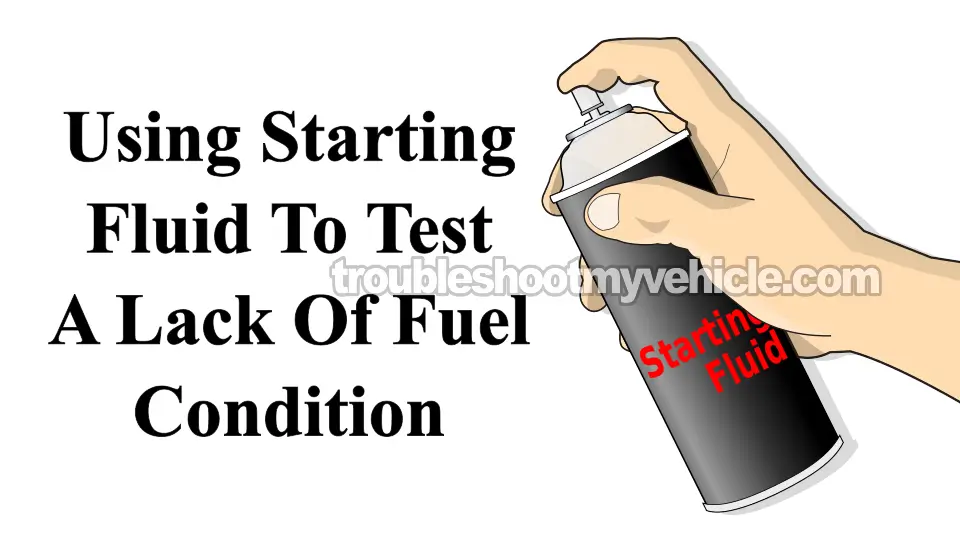
One of the tests I've used quite a bit over the course of my automotive repair career when diagnosing an engine no-start issue is the starting fluid test.
After I've checked to make sure the engine is getting spark —by checking for spark at a spark plug wire with a spark tester— I spray a little starting fluid into the throttle body, crank the engine, and see what happens. I'm going to see one of two things:
- The engine starts: This means a lack of fuel is causing the engine not to start, since the starting fluid got it to fire up and run for a few seconds.
- The engine doesn't start: This confirms that a fuel delivery issue is not behind the no-start problem.
The thing to remember about the starting fluid test is that it's only going to give you an accurate result if you've already confirmed the engine is getting spark.
On your Ford Taurus or Mercury Sable's 3.0L V6 engine, this involves disconnecting a spark plug wire, attaching a spark tester to it, and checking for spark while cranking the engine.
IMPORTANT: Once you've sprayed starting fluid into the throttle body, be sure to reconnect the air duct back onto the throttle body before you crank the engine (you don't have to tighten the clamp). This is a very important safety precaution that'll prevent any backfire from spitting flames out of the throttle body and onto the engine.
All right, let's get to it.
- 1
Remove the intake air duct from the throttle body. You don't have to completely remove it, since you'll have to reconnect it in one of the next steps.
- 2
Open the throttle plate and spray starting fluid down the bore.
As a safety precaution reconnect the air duct after you have sprayed a good squirt of starting fluid (but you don't have to tighten the air duct's hose clamp). - 3
Crank the engine once the air duct is back on and you're clear of the engine compartment.
- 4
You'll get one of two results with this test:
1.) The engine will start momentarily and after a few seconds will die or.
2.) The engine will only crank but not start at all.
OK, let's interpret your test result:
CASE 1: The engine started and ran for a few seconds before shutting off. This test result lets you know that a fuel delivery problem is behind the engine no-start issue in your Ford Taurus or Mercury Sable.
Since the 2004–2007 Taurus or Sable comes equipped with a Fuel Pump Driver Module, your next steps are to check fuel pressure with a fuel pressure test gauge and then test the FPDM to make sure it's actually activating the fuel pump.
I've written a tutorial that'll help you test the FPDM module, and you can find it here: Fuel Pump Driver Module Tests (2000, 2002-2007 3.0L V6 Ford Taurus, Mercury Sable).
CASE 2: The engine did not start. This test result confirms that a lack of fuel is not behind the engine no-start problem —especially if you've already confirmed that the engine is getting spark.
More 3.0L V6 Ford Taurus Diagnostic Tutorials
You can find a complete list of 3.0L V6 Ford Taurus and Mercury Sable diagnostic tutorials in this index:
Here's a sample of the diagnostic tutorials you'll find in the index:
- How To Do And Interpret An Engine Compression Test (1990-2007 3.0L V6 Ford Taurus, Mercury Sable).
- How To Test For A Blown Head Gasket (1990-2007 3.0L V6 Ford Taurus, Mercury Sable).
- How To Test The MAF Sensor (1996-1999 3.0L V6 Ford Taurus, Mercury Sable).
- How To Test The MAF Sensor (2000-2003 3.0L V6 Ford Taurus, Mercury Sable).

If this info saved the day, buy me a beer!
