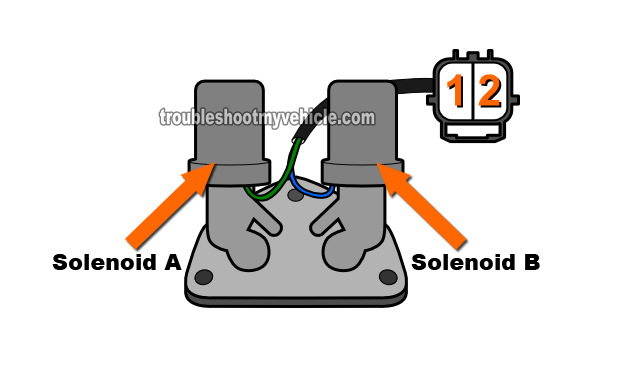
Testing the shift control solenoid A and B assembly consists of two basic tests.
The first is a multimeter resistance test of each shift solenoid that makes up the assembly.
The other test is a bench test in which you apply battery power from your Honda Civic's car battery to see if you can hear the solenoid valve move and make a clicking sound.
Both of these test are simple and easy and in this tutorial I'll show you how to do them in a step-by-step way.
Contents of this tutorial:
The following 2001-2005 Honda Civic automatic transmission diagnostic tutorials may be of help too:
- How To Test The TCC Solenoid (2001-2005 1.7L Honda Civic).
- Clutch Pressure Control Solenoid A And B (2001-2005 1.7L Honda Civic).
ES  You can find this tutorial in Spanish here: Cómo Probar Los Solenoides de Cambio A y B (1.7L Honda Civic) (at: autotecnico-online.com).
Symptoms Of A Failed Shift Control Solenoid A And B Assembly
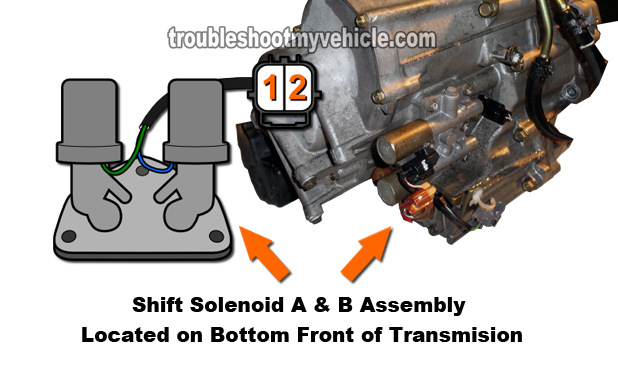
In case you're wondering, the shift control solenoid A and B assembly is located on the bottom front corner of your Honda Civic's automatic transmission.
To be a bit more specific, the shift solenoid assembly is bolted to the transmission housing under the clutch pressure control solenoid A and B assembly.
The symptoms of a bad shift control solenoid A and B assembly depend on which of the two solenoids has failed.
Here's a breakdown of the symptoms produced by each (when they fail):
Symptoms of a bad shift control solenoid A:
- P0753: Shift Solenoid A.
- P0973: Shift Solenoid A Electrical Short.
- P0974: Shift Solenoid A Electrical Open.
- D4 indicator light flashing.
- A/T transmission does not shift.
- Erratic shifting: shifts from 1st to 3rd.
- Erratic shifting: shifts from 1st to 4th.
- Erratic upshift: 1st to 2nd.
- Erratic upshift: 3rd to 4th.
- Fails to shift: stuck in 4th gear.
Symptoms of a bad shift solenoid B:
- P0758: Shift Solenoid B.
- P0976: Shift Solenoid B Electrical Short.
- P0977: Shift Solenoid B Electrical Open.
- D4 indicator light flashing.
- A/T transmission does not shift.
- Erratic shifting.
- Erratic upshift: 2nd to 3rd.
- Fails to shift: stuck in 4th gear.
TEST 1: Shift Solenoid A And B Resistance Test
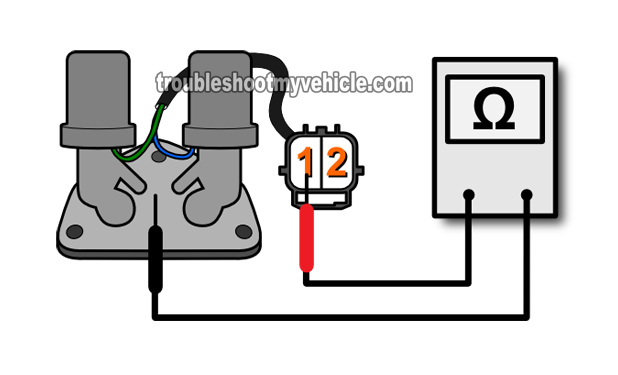
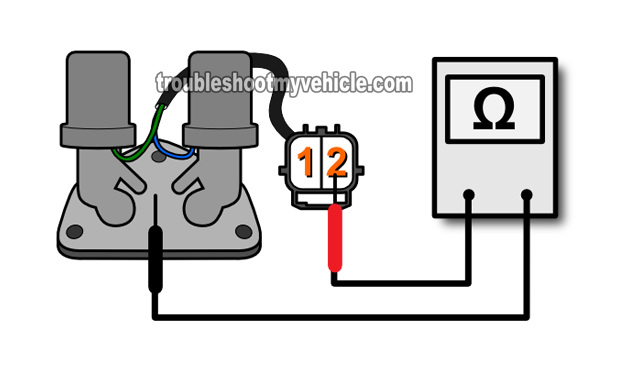
The very first test that we're going to do (on the shift solenoid A and B assembly) is to measure each solenoid's internal resistance with your multimeter in Ohms (Ω) mode.
If the resistance of each control solenoid is not within specification, then your Honda Civic's shift solenoid assembly is defective and needs to be replaced.
If you do you find that the internal resistance of each solenoid is within specification, then your next step is to apply battery voltage to each one and see if they make a solid clicking sound.
In case you're wondering, shift control solenoid A gets battery voltage on the terminal labeled with the number 1 (see image 1 of 2). Shift control solenoid B get battery voltage on the terminal labeled with the number 2 (see image 2 of 2).
NOTE: Each solenoid gets Ground through the assembly's base.
Here are the test steps:
- 1
Place your multimeter in Ohms (Ω) mode.
Don't have a multimeter or need to upgrade yours, take a look at my suggestion: Tekpower TP8268 AC/DC Auto/Manual Range Digital Multimeter (Amazon affiliate link) - 2
Unplug your Honda Civic's shift control solenoid A and B assembly from its electrical connector.
NOTE: This test is done on the shift control solenoid assembly's connector AND NOT on the engine wiring harness' pigtail connector. - 3
Measure the resistance between terminal labeled with the #1 and Ground and then between terminal #2 and Ground.
NOTE: Shift solenoid A and B are grounded by the solenoid assembly's case. If the solenoid assembly is still bolted to the transmission housing, you can Ground your multimeter's lead directly on the battery's negative (-) terminal. - 4
Your multimeter should read 12-25 Ohms for the resistance value of shift control solenoid A and shift control solenoid B.
Let's take a look at what your test results mean:
CASE 1: Resistance was between 12-25 Ohms for both shift solenoid A and B. This is the correct and expected test result and generally means that shift solenoid A is OK.
Although the shift solenoid A and B assembly passed this test, there's still one more we need to do, which is to manually apply power to each of the solenoids that make up the assembly to see if the make a clicking sound. Go to: TEST 2: Applying Battery Voltage To Solenoid A And B.
CASE 2: Resistance WAS NOT between 12-25 Ohms for shift solenoid A or B. Recheck your multimeter test connections and retest.
If you still don't get the correct resistance, then shift control solenoid A and/or B is bad and the entire shift solenoid assembly needs to be replaced.
This test result also confirms diagnostic trouble codes P0753 and P0758 correctly indicating the shift solenoid assembly is defective.
TEST 2: Applying Battery Voltage To Solenoid A And B
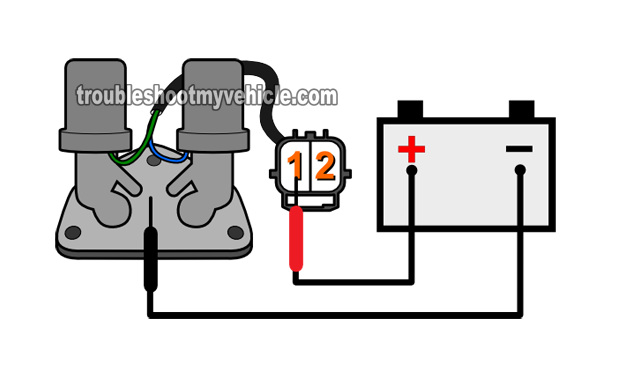
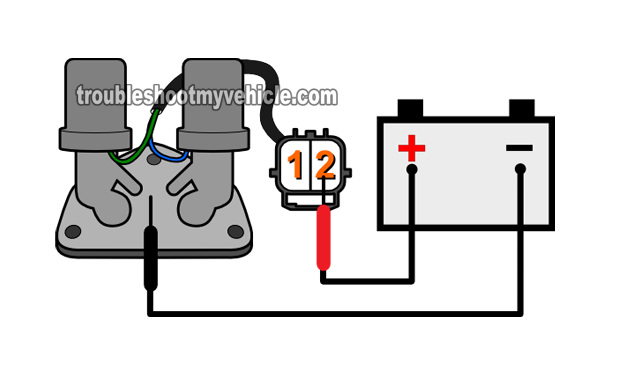
There's a good chance that even though the internal resistance of each shift control solenoid is within specification, they're still defective.
To make absolutely sure that shift solenoid A and/or B are OK, we need to manually apply battery voltage from your Honda Civic's car battery and see if they make an audible clicking sound.
This is a pretty simple test, but requires that you take all necessary safety precautions when applying battery voltage with a jumper wire. My suggestion to you is to make a jumper wire with an inline fuse.
IMPORTANT: If you've removed the shift solenoid A and B assembly to test it, you'll need to do one of two things: Bolt it back in place (on the transmission's case). Or Ground the solenoid assembly to the engine (or battery negative post) with a battery jump cable (or this test won't work).
These are the test steps:
- 1
Unplug the shift control solenoid assembly from its electrical connector.
NOTE: This test is done on the shift control solenoid assembly's connector AND NOT on the engine wiring harness' pigtail connector. - 2
Apply 12 Volts to terminal #1 and then to terminal #2, of the shift control solenoid assembly's connector, using a fused jumper wire or a power probe.
- 3
You should hear an audible click when the 12 Volts are applied.
Repeat this test as many times as you need to be certain of your test results.
CASE 1: An audible click was heard when applying 12 Volts to each shift control solenoid. This test result tells you that the solenoid is opening and closing.
Unfortunately, this test result doesn't mean the solenoid is good. There's a chance that the solenoid is bad, even though it passed TEST 1 and this one (TEST 2). I have some suggestion that may help. For more details, go to: Solenoid Assembly Is Good But Transmission Still Not Shifting.
CASE 2: An audible click WAS NOT heard when applying 12 Volts to each shift control solenoid. This test result tells you that shift solenoid A and/or B is bad.
Since either solenoid belongs to the same assembly, you'll need to replace the entire assembly to solve the problem.
This test result also confirms diagnostic trouble codes P0753 and P0758 correctly indicating the shift solenoid assembly is defective.
Solenoid Assembly Is Good But Transmission Still Not Shifting
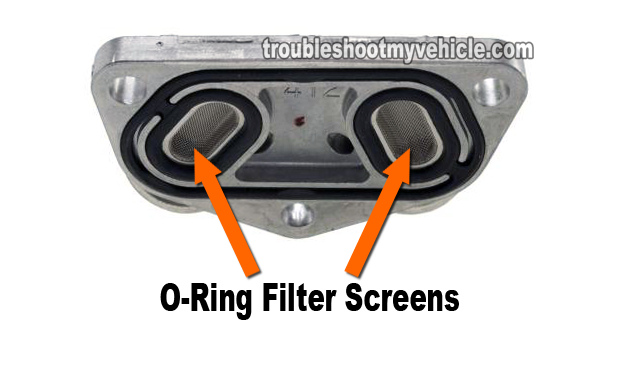
If you've tested and found both shift control solenoid A and B are good and your Honda Civic's automatic transmission IS NOT slipping yet a P0753, P0758, P0973, P0974, P0976, or a P0977 keeps popping up, I want to suggest two things:
- Remove the solenoid assembly's o-ring and clean the o-ring screens (see photo). There's a good chance they're clogged and restoring the fluid flow will solve the issue.
- Check the continuity of the wires between the solenoid assembly and the PCM and check for opens or shorts. You'll need a wiring diagram of your specific Honda Civic to accomplish this test.
Also, and especially after finding no faults in the wiring, there's a good chance that you'll have to replace the shift control solenoid A and B assembly to completely eliminate it as the source of the problem. I know this isn't something you want to hear, but in some cases this is a necessary thing.
Now, if your Honda Civic's transmission is slipping, then replacing the shift solenoid assembly isn't gonna' help bring the transmission back to normal. Slippage is a direct result of internal damage to the friction discs or hard parts. The only way to solve a slippage issue is overhauling the transmission.
More Honda Civic Test Tutorials
You can find a complete list of Honda Civic tutorials in this index: 1.7L Honda Civic Index Of Articles.
Here's a small sample of the tutorials you'll find in the index:
- How To Test The Crank Sensor (2001-2005 1.7L Honda Civic).
- Maintenance Required Light Reset (2001-05 1.7L Honda Civic).
- How To Do A Cylinder Balance Test (2001-2005 1.7L Honda).
- How To Test Trouble Code P0141 (2001-2005 Honda 1.7L).
- How To Test The TP Sensor (2001-2005 1.7L Honda Civic).
- How To Test Trouble Code P0135 (2001-2003 Honda 1.7L).

If this info saved the day, buy me a beer!