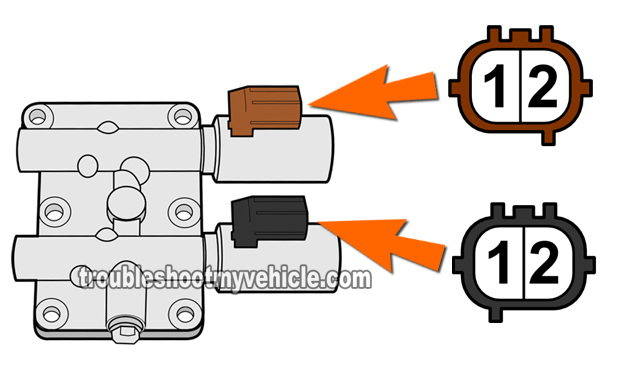
There are two basic tests to diagnose a defective A/T clutch pressure solenoid A or B on your 1.7L Honda Civic's automatic transmission.
The first test is a simple multimeter resistance test and the other is a bench test in which battery power and Ground (from your Civic's car battery) is applied to each solenoid with jumper wires.
In this tutorial, I'll show you how to do both in a step-by-step manner and help you get to the bottom of the A/T clutch pressure solenoid trouble code(s) lighting up the D4 light and/or the check engine light on your Honda Civic.
Contents of this tutorial:
- Symptoms Of A Bad A/T Clutch Pressure Solenoid A Or B.
- Basics Of A/T Clutch Pressure Solenoid A And B.
- START HERE: A/T Clutch Pressure Control Solenoid A And B Tests.
- TEST 1: Resistance Testing The A/T Clutch Pressure Solenoid A Or B.
- TEST 2: Manually Applying Power And Ground To The Solenoid.
- Solenoids Are Good But Transmission Still Not Shifting.
- More Honda Civic Test Tutorials.
The following 2001-2005 Honda Civic automatic transmission diagnostic tutorials may be of help too:
- Shift Control Solenoids A And B Tests (2001-2005 1.7L Honda Civic).
- How To Test The TCC Solenoid (2001-2005 1.7L Honda Civic).
ES  You can find this tutorial in Spanish here: Cómo Probar: Solenoides A y B de Control de Presión de Embrague (at: autotecnico-online.com).
Symptoms Of A Bad A/T Clutch Pressure Solenoid A Or B
Here's a breakdown of the symptoms produced by each A/T clutch pressure control solenoid (when it fails), you'll see one of the following:
Symptoms of a bad clutch pressure control solenoid A:
- D4 light blinking on the instrument cluster.
- P0962: a/T Clutch Pressure Control Solenoid A Electrical.
- P0963: a/T Clutch Pressure Control Solenoid A Electrical.
- P1768: a/T Clutch Pressure Control Solenoid A Electrical.
- Harsh downshift:
- 2nd to 1st gear.
- 3rd to 2nd gear.
- 4th to 3rd gear.
- Harsh upshift:
- 1st to 2nd.
- 2nd to 3rd.
- 3rd to 4th.
- Flares on upshift:
- 2nd to 3rd.
- 3rd to 4th.
- Excessive shock or upshifting:
- 2nd to 3rd.
- 3rd to 4th.
- Stuck in 4th gear.
Symptoms of a bad clutch pressure control solenoid B:
- D4 light blinking on the instrument cluster.
- P0966: a/T Clutch Pressure Control Solenoid B Electrical.
- P0968: a/T Clutch Pressure Control Solenoid B Electrical.
- P1773: a/T Clutch Pressure Control Solenoid B Electrical.
- Harsh upshift:
- 1st to 2nd.
- 2nd to 3rd.
- 3rd to 4th.
- Flares on upshift:
- 2nd to 3rd.
- 3rd to 4th.
- Excessive shock or upshifting:
- 2nd to 3rd.
- 3rd to 4th.
- Torque converter clutch does not disengage, operate smoothly or engage.
Basics Of A/T Clutch Pressure Solenoid A And B
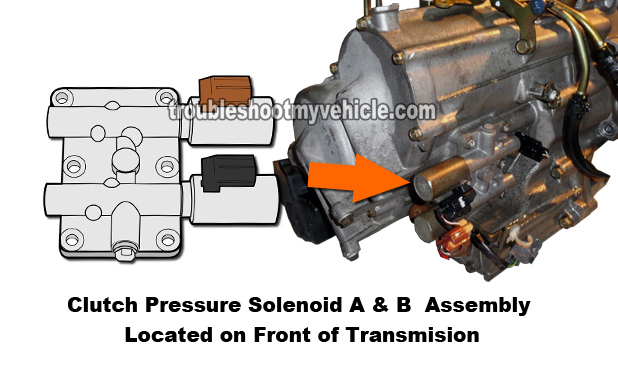
A/T clutch pressure control solenoid A and solenoid B are part of the same assembly and the tests outlined in this tutorial apply to them both.
Because of where the clutch pressure control solenoid assembly is located, the easiest way to test each solenoid (or both) is with the assembly off of your Honda Civic's automatic transmission.
In case you're wondering, the clutch pressure control solenoid assembly is located on the front of the automatic transmission (facing the radiator). Image 2 of 2, in the image above, shows you the location of the solenoid assembly.
Here are some basic things you need to know about both clutch pressure control solenoids:
Clutch Pressure Control Solenoid A:
- The connector color is brown.
- The WHT/BLK wire connects to terminal labeled #1.
- The RED/BLK wire connects to terminal labeled #2.
- Both circuits connect directly to the Powertrain Control Module (PCM).
Clutch Pressure Control Solenoid B:
- The connector color is black.
- The BRN/WHT wire connects to terminal labeled #1.
- The BLK/RED wire connects to terminal labeled #2.
- Both circuits connect directly to the Powertrain Control Module (PCM).
START HERE: A/T Clutch Pressure Control Solenoid A And B Tests
Troubleshooting clutch pressure control solenoid A or B isn't hard. As mentioned before, there are two basic tests and in this section, I'll briefly describe them.
The 2 tests in this tutorial are:
- Resistance testing clutch pressure control solenoid in question..
- This test simply involves measuring the resistance of the clutch pressure control solenoid and comparing the value with the factory spec of approximately 5 Ohms.
- TEST 1: Resistance Testing The A/T Clutch Pressure Solenoid A Or B.
- Manually applying 12 Volts and Ground to the clutch pressure control solenoid in question.
- In this test, you'll apply power and Ground (from your Honda's battery) to the clutch pressure control solenoid and listen for a clicking sound.
- TEST 2: Manually Applying Power And Ground To The Solenoid.
TEST 1: Resistance Testing The A/T Clutch Pressure Solenoid A Or B
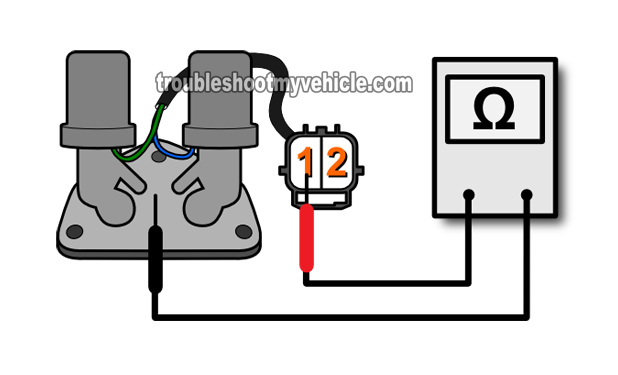
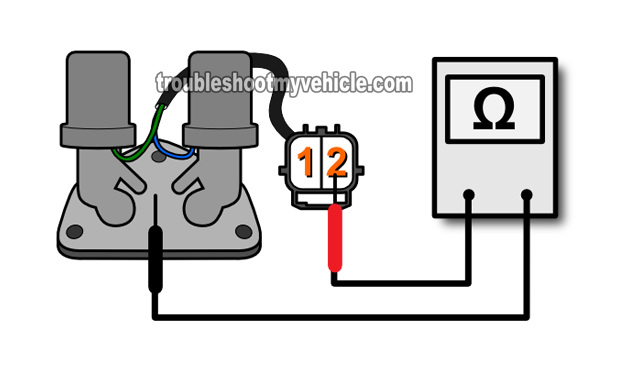
The very first thing we'll do, to get your Honda Civic's clutch pressure control solenoid diagnostic on the way, is to check the resistance of each solenoid with a multimeter in Ohms (Ω) mode.
Both clutch pressure control solenoid A and B share the exact same resistance specification (3-10 Ohms Ω).
NOTE: The easiest and fastest way to test the clutch pressure control solenoids is to test them with the solenoid assembly removed from the transmission case.
OK, this is what you need to do:
- 1
Place your multimeter in Ohms mode.
Don't have a multimeter or need to upgrade yours? Check out my recommendation: Tekpower TP8268 AC/DC Auto/Manual Range Digital Multimeter (Amazon affiliate link)). - 2
Measure the resistance between solenoid pins #1 and #2.
Remember, this test applies to either A/T clutch pressure control solenoid A or A/T clutch pressure control solenoid B.
NOTE: Clutch pressure control solenoid A's connector is brown and clutch pressure control solenoid B's connector is black. - 3
Your multimeter should register approximately between 3 to 10 Ohms if the A/T clutch pressure control solenoid is within specification.
Let's take a look at what your test results mean:
CASE 1: The resistance of each solenoid was within 3 to 10 Ohms. This test result tells you that the solenoids' internal coil is OK. There's still one more test to do, to make sure the solenoids are OK.
The next step is to bench-test both A/T clutch pressure control solenoid A and B by manually applying 12 Volts and Ground to each. For this test, go to: TEST 2: Manually Applying Power And Ground To The Solenoid.
CASE 2: The resistance of one or both solenoids WAS NOT 3 to 10 Ohms. This test result tells you that the A/T clutch pressure control solenoid(s) is bad and that the assembly needs to be replaced.
TEST 2: Manually Applying Power And Ground To The Solenoid
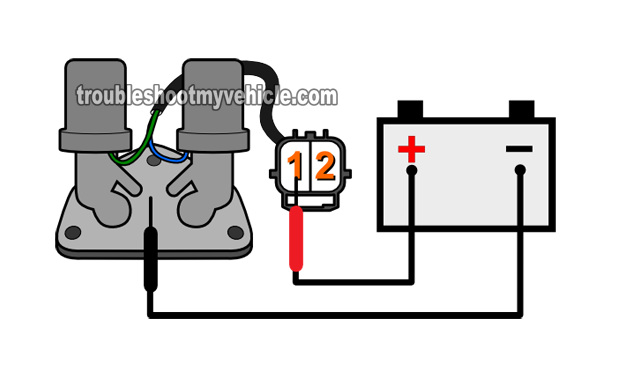
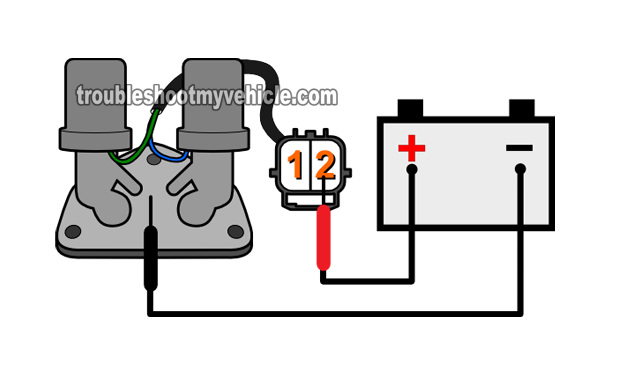
If you've reached this step, you have confirmed that each of the solenoids' resistance is within 3 to 10 Ohms. The next step is to apply battery power and Ground, from your Honda Civic's car battery, and see if you hear the valve make a clicking sound.
The easiest and safest way to do this is using a power probe since a power probe lets you apply both Ground and power with a click of a button but not everyone has one (not too mention that they're kinda' expensive).
You can make your own jumper wires and I suggest using alligator clips with rubber insulating protectors.
Using alligator clips with rubber insulating protectors will help you avoid shorting out the jumper wire that's carrying the juice (from the battery) to the solenoid.
OK, this is what you need to do:
- 1
Connect terminal #2 to battery power of the particular solenoid you're testing (A or B).
NOTE 1: Take all safety precautions when applying these 12 Volts to the terminal.
NOTE 2: Clutch pressure control solenoid A's connector is brown and clutch pressure control solenoid B's connector is black. - 2
Connect terminal #1 to Ground of the particular solenoid you're testing (A or B).
- 3
You should be able to see the valve move, of the solenoid you're testing (inside the assembly) as soon as you Ground solenoid terminal #1.
If all is good, the valve (which is visible from the under-side of the assembly) should move. When you un-Ground the solenoid, the valve should move back to its original position.
Let's interpret your test results:
CASE 1: The A/T clutch pressure control solenoid's valve moved. This is the correct and expected test result.
If you're still having an A/T clutch pressure control solenoid A or B trouble code, take a look at the test suggestions found here: Solenoids Are Good But Transmission Still Not Shifting.
CASE 2: The A/T clutch pressure control solenoid's valve DID NOT move or is binding. This test result tells you that the A/T clutch pressure control solenoid you just got done testing is fried and needs to be replaced.
Solenoids Are Good But Transmission Still Not Shifting
One of the things that can have you misdiagnosing your Honda Civic's automatic transmission is if its slipping.
By ‘slipping’ I mean you stick the lever in D and the engine rev's up but the vehicle doesn't move. Or as you're driving down the road, the automatic transmission neutralizes (and when you give the engine more gas, it only revs up but the transmission doesn't engage).
Why? Because if your Honda Civic's automatic transmission is slipping, then replacing a transmission shift solenoid will not bring the transmission back. Only an overhaul can.
This doesn't mean you shouldn't troubleshoot the transmission trouble code making the D4 light blink.
If you've tested and found either solenoid (A/T clutch pressure control solenoid B or A/T clutch pressure control solenoid B) good and your Honda's transmission isn't slipping yet a P1768: a/T Clutch Pressure Control Solenoid A Electrical and P1773: a/T Clutch Pressure Control Solenoid B Electrical keeps popping up, I would suggest that you:
- Check the continuity of circuit #2 between the A/T clutch pressure control solenoid in question and the PCM with a multimeter.
- Check the continuity of circuit #1 between the A/T clutch pressure control solenoid in question and the PCM with a multimeter.
The above two tests have to be done with the specific wiring diagram of your Honda and will help you eliminate a possible open-circuit problem between the PCM and the solenoid you're testing.
If after testing the wiring and you find no faults, then there's a good chance that you'll have to replace the A/T clutch pressure control solenoid in question to see if replacing it solves the problem. I know this isn't something you want to hear, but in some cases there's just no other way to troubleshoot the issue (I speak from personal experience and from comments other readers have sent in).
If after testing the solenoid, its related wiring, and/or replacing the A/T clutch pressure control solenoid and the problem still persists, then you either have a bad transmission (internal mechanical/hydraulic problem) or the PCM is bad. Before you run out and buy a PCM, let me tell you that it's very, very rare for a PCM to go bad and keep the transmission from shifting (it does happen but you're more likely to get hit by lightening than to have this happen to you).
Now, if your Honda's transmission is slipping, then replacing the A/T clutch pressure control solenoid in question isn't gonna' help bring the transmission back to normal. Slippage is a direct result of internal damage to the friction discs or hard parts. The only way to solve a slippage issue is overhauling the transmission.
More Honda Civic Test Tutorials
You can find a complete list of Honda Civic tutorials in this index: 1.7L Honda Civic Index Of Articles.
Here's a small sample of the tutorials you'll find in the index:
- How To Test The Crank Sensor (2001-2005 1.7L Honda Civic).
- Maintenance Required Light Reset (2001-05 1.7L Honda Civic).
- How To Do A Cylinder Balance Test (2001-2005 1.7L Honda).
- How To Test Trouble Code P0141 (2001-2005 Honda 1.7L).
- How To Test The TP Sensor (2001-2005 1.7L Honda Civic).
- How To Test Trouble Code P0135 (2001-2003 Honda 1.7L).

If this info saved the day, buy me a beer!