
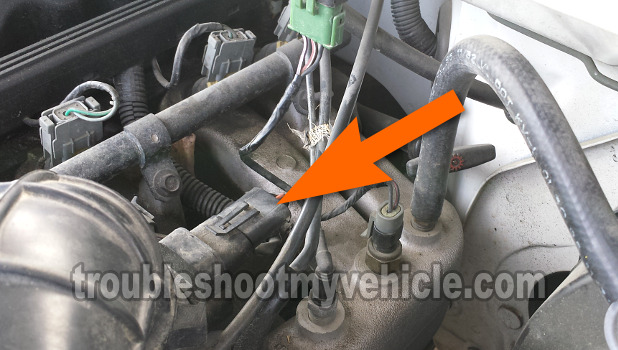
The throttle position sensor (TPS) on your 1993-1995 Jeep Grand Cherokee can be accurately tested with a simple multimeter to find out if it's bad (or not).
Also, you don't have to remove it to test it and no scan tool is required for the test. In this tutorial, I'll show you just how.
Contents of this tutorial:
ES  You can find this tutorial in Spanish here: Cómo Probar El Sensor TPS (1993-1995 4.0L Grand Cherokee) (at: autotecnico-online.com).
APPLIES TO: This tutorial applies to the following vehicles:
- 4.0L Jeep Grand Cherokee: 1993, 1994, 1995.
TPS CIRCUIT WIRING DIAGRAM: To see the TP sensor's wiring diagram go to: 1993-1995 TP Sensor Wiring Diagram (Jeep Grand Cherokee 4.0L).
1996+ TPS DIAGNOSTIC TESTS: For the TPS on 1996 and newer Grand Cherokee, go to: How To Test TPS Codes: P0121, P0122, P0123 (1997-2001 Jeep 4.0L).
Symptoms Of A Bad Throttle Position Sensor (TPS)
The throttle position sensor (TPS) is one of the key components your Jeep's powertrain control module (PCM) uses to calculate the correct amount of fuel to inject into the engine (among several things). So, when the TPS fails, your Jeep is gonna' resent it and lets you know right away something is amiss.
When the throttle position sensor (TPS) fails, you'll see one or more of the following symptoms:
- Check engine light (CEL) shining nice and bright.
- Diagnostic trouble codes (DTC) stored in the PCM's memory:
- 24: TP Sensor Voltage Low.
- 24: TP Sensor Voltage High.
- Your Jeep Grand Cherokee fails the state mandated emissions test.
- Bad gas mileage.
- Hard start and/or extended cranking time (after shut off).
- Black smoke coming out of the tailpipe.
- Hesitation when accelerating your Jeep down the road.
Where To Buy Your TP Sensor And Save
Where can you buy the TP sensor for your 4.0L Jeep? You can buy it at your local auto parts store but it's gonna' cost a whole lot more. I suggest taking a look at the price of the TP sensor in the following links and compare:


Disclosure: As an Amazon Associate, I earn from qualifying purchases. If my tutorials help you, using these links is an easy way to support the site at no extra cost to you. Thank you!
Not sure if the above TPS fits your particular Jeep Grand Cherokee? Don't worry, once you get to the site, they'll make sure it fits by asking you the particulars of your vehicle. If it doesn't fit, they'll find you the right one.
TEST 1: Testing The TPS Voltage Signal
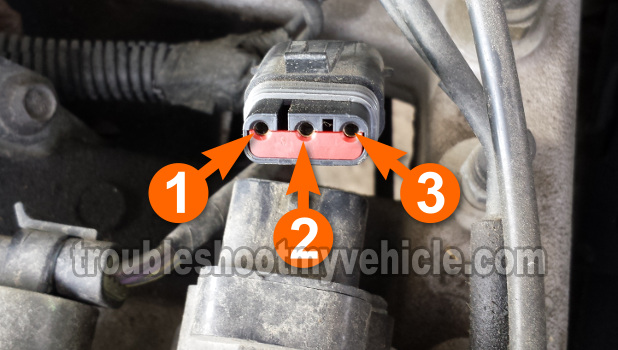
To get your TPS diagnostic on its way, you first need to identify ORG/DK BLU (orange w/ dark blue stripe) wire of the sensor's 3-wire connector.
The ORG/DK BLU wire is the middle wire of the connector and is the one that carries the throttle angle voltage signal, the TPS creates (and it's the one we're gonna' tap into with a multimeter).
When the throttle position sensor (TPS) fails, it'll fail in one of two ways. It'll either stop producing a throttle angle signal, which usually means it'll stay stuck at a certain voltage value. Or the TPS will fail intermittently.
The test below will help you check for both types of failures.
NOTE: To ensure the accuracy of your test, my suggestion is to test the throttle position sensor (TPS) with a warmed up engine (but not running).
OK, let's start:
Part 1
- 1
Place your multimeter in Volts DC mode.
- 2
With the red multimeter test lead probe the wire labeled with the number 2 in the illustration above. This is the circuit that supplies the TP Signal to the PCM.
If you don't have a multimeter or need to upgrade yours, check out my recommendation: Tekpower TP8268 AC/DC Auto/Manual Range Digital Multimeter (Amazon affiliate link).
NOTE: The throttle position sensor has to remain connected to its connector for this test to work (this is where a wire piercing probe comes in handy to get to the signal inside the wire. To see what one looks like, click here: Goupchn 4mm Banana to Banana Plug Test Leads Kit (Amazon affiliate link)). - 3
Ground the black multimeter test lead on the battery negative (-) terminal.
- 4
Have your helper turn the key to the ON position, but don't start the engine (this will power up the TP sensor).
- 5
Your multimeter should report 0.4 to 0.9 Volts DC. If your multimeter doesn't, don't worry about it just yet, continue with the other steps.
Part 2
- 6
Now, slowly open the throttle plate (by hand and from the engine compartment) while you observe the change in voltage numbers on your multimeter.
For this test result to be accurate, you need to open the throttle plate by hand and not from inside the vehicle. - 7
As the throttle plate opens, the voltage numbers will increase.
This increase in voltage should be smooth and without any gaps or skips.
Once the throttle is wide open, your multimeter should read somewhere between 3.5 to 4.5 Volts DC. - 8
Now, slowly close the throttle plate.
As the throttle is closing, you should see the voltage decrease smoothly and without any gaps or skips, to the exact same voltage you noticed in step 4.
Part 3
- 9
Lightly tap on the throttle position sensor with the handle of a screw-driver (or something similar, and I want to emphasize the words ‘lightly tap’) as you slowly open and close the throttle and observe the multimeter.
If the TPS is bad, the tapping will cause the voltage numbers to skip or go blank. If the TPS is OK, the tapping will have no effect on the voltage numbers. - 10
Repeat step 9 several times to make sure of your multimeter test results.
Let's take a look at your test results:
CASE 1: The multimeter registered a smooth increase or decrease in voltage with no gaps. This tells you several important things. First, that the TP sensor is working like it should. Lastly, that the TP sensor is getting power (5 Volts DC) on the VIO/WHT wire and Ground on the BLK/LT BLU wire of the TP sensor connector.
No further testing is required.
CASE 2: Multimeter DID NOT register a smooth increase or decrease in voltage, in other words, it stayed stuck in one voltage value as you opened and closed the throttle plate, then this tells you that the sensor is bad and needs to be replaced.
If I where in your shoes, I would still make sure that the TP sensor is getting both power and Ground. To check for power on the VIO/WHT wire, go to: TEST 2: Verifying TPS Has Power.
CASE 3: The multimeter DID NOT register any voltage. This test result doesn't condemn the TPS as bad just yet.
Why? Because the TPS may be missing either power or Ground. So the next step is to check that the TPS is getting power, go to: TEST 2: Verifying TPS Has Power.
TEST 2: Verifying TPS Has Power
The VIO/WHT (violet w/ white stripe) wire is the one that feeds power (5 Volts DC) to the throttle position sensor (TPS).
This power comes from the PCM. In other words, the other end of the VIO/WHT wire connects directly to your Jeep Grand Cherokee's powertrain control module (PCM).
The VIO/WHT wire is the one that connects to terminal #3 in the photo above.
NOTE: You can test for these 5 Volts DC with the TP sensor connected or disconnected to the TPS. I personally prefer to do this test with the TP sensor's connector unplugged.
This is what you'll need to do:
- 1
Place your multimeter's dial in Volts DC mode.
- 2
Disconnect the throttle position sensor from its connector.
- 3
Turn the key to the ON position but don't crank or start the engine.
- 4
Connect the black multimeter test lead to the negative (-) battery terminal.
- 5
Gently probe the terminal labeled with the number 3 with the red multimeter test lead and an appropriate tool.
IMPORTANT Be careful and don't damage the terminal. Damaging the terminal will require that you replace the connector. - 6
Your multimeter should display 4.5 to 5 Volts on its screen.
CASE 1: The multimeter registered 4.5 to 5 Volts. So far so good since this tells you that the throttle position sensor (TPS) is getting power from the powertrain control module (PCM).
The next step (and the last test) is to check that the BLK/LT BLU wire (which connects to terminal number 1 of the TP sensor's harness connector) is providing Ground. For this test, go to: TEST 3: Verifying TPS Has Ground.
CASE 2: Multimeter DID NOT register 4.5 to 5 Volts. Double check all of your connections and repeat the test.
If your multimeter still doesn't register the 4.5 to 5 Volts DC, then you've just eliminated the TP sensor itself, on your Jeep, as bad. The two most likely reasons for this are: 1) an open in the wire between the TP sensor's harness connector and the PCM's harness connector or 2) the PCM may be fried (although a bad PCM is very rare).
Although it's beyond the scope of this article to test these two conditions, you have now eliminated the throttle position sensor (TPS) on your Jeep as being the cause of the problem and/or the TPS diagnostic trouble code (DTC) lighting up the check engine light (CEL).
TEST 3: Verifying TPS Has Ground
So far, if you've reached this point you have confirmed that the sensor:
One: Is not creating an appropriate throttle position signal (TEST 1).
Two: That the sensor is getting power in the form of 5 Volts from the VIO/WHT wire (TEST 2).
As mentioned earlier, the throttle position sensor (TPS) needs power and Ground to create a throttle angle voltage signal the PCM can use to find out how much you're stepping on or off the accelerator pedal. In this last test step, we're gonna' check that the BLK/LT BLU wire is providing Ground to the TP sensor.
OK, here are the test steps:
- 1
Place your multimeter's dial in Volts DC mode.
- 2
Disconnect the throttle position sensor from its connector.
- 3
Turn the key to the ON position but don't crank or start the engine.
- 4
Connect the red multimeter test lead to the positive (+) battery terminal.
- 5
Gently probe the terminal labeled with the number 1 with the black multimeter test lead and an appropriate tool.
IMPORTANT Be careful and don't damage the terminal. Damaging the terminal will require that you replace the connector. - 6
Your multimeter should display 10 to 12 Volts on its screen.
CASE 1: The multimeter showed 10 to 12 Volts. This confirms that the PCM and the wire/circuit (that supply this Ground) are OK.
All three test have confirmed that:
- The TPS is not providing a varying voltage signal when manually opening the throttle plate.
- The TPS is being fed 5 Volts DC.
- The TPS is being fed Ground.
Therefore, you can conclude that the TP Sensor is bad and needs to be replaced (and that this will solve the TP sensor code lighting up the check engine light).
CASE 2: Multimeter DID NOT show 10 to 12 Volts. Double check that you're testing the correct TP sensor harness terminal wire and repeat the test.
If your multimeter still doesn't show the indicated voltage, then this indicates a problem with either your Jeep's PCM (internal fault/problem) or an open in the wire between the TPS harness connector and the PCM's harness connector.
Although testing these two conditions are beyond the scope of this article, you have now eliminated the throttle position sensor (TPS) on your Jeep as being the cause of the problem and/or the TPS diagnostic trouble code (DTC) lighting up the check engine light (CEL). You can use the wiring diagram found in the following article to check continuity of the TP sensor circuits:
More Jeep 4.0L Test Tutorials
If this tutorial was helpful/informative, you can find a complete list of tutorials here: Jeep 4.0L Index Of Articles.
Here's a sample of the tutorials you'll find there:
- How To Test Trouble Code P0135 (1996-2000 Jeep 4.0L).
- How To Test The MAP Sensor (1997-2003 Jeep 4.0L).
- How To Do A Cylinder Balance Test (Jeep 4.0L).
- Jeep PWM Fan Relay Test Troubleshooting An Overheating Condition.
- How To Test The Crankshaft Position Sensor (1994-1996 4.0L Jeep).

If this info saved the day, buy me a beer!
