
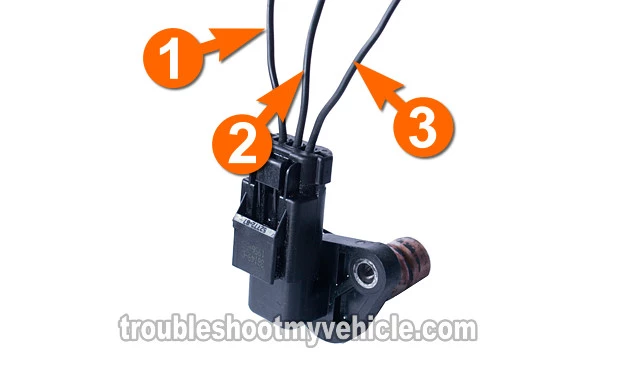
This tutorial will help you test the crankshaft position (CKP) sensor on Chrysler, Dodge, Eagle, Mitsubishi, and Plymouth cars and minivans equipped with the 2.0L (SOHC and DOHC) or 2.4L (DOHC) 4-cylinder engine.
To see if this article applies to your specific vehicle, look for the box titled ‘Applies To:’ (on the right column if you're on a PC, or at the bottom of the page if you're on a mobile device).
Since the CKP sensor cannot be tested off the vehicle with a simple resistance test (multimeter in Ohms mode), I'm going to show you how to test it on the car and while it's in action. This is a simple multimeter test done in Volts DC mode, and I'll walk you through it step by step.
Contents of this tutorial:
- Symptoms Of A Bad Crank Sensor.
- Tools You'll Need To Test The 2.0L, 2.4L Crank Sensor.
- How The Crank Sensor Works.
- Where To Buy The CKP Sensor And Save.
- TEST 1: Testing The CKP Signal With A Multimeter.
- TEST 2: Making Sure The CKP Sensor Is Getting Power.
- TEST 3: Making Sure The CKP Sensor Is Getting Ground.
- Related Test Articles.
ES  You can find this tutorial in Spanish here: Cómo Probar El Sensor De La Posición Del Cigüeñal (Chrysler 2.0L, 2.4L) (at: autotecnico-online.com).
ENGINE NO-START DIAGNOSTICS: Testing an engine no-start issue? The following tutorial is a must read:
CMP SENSOR DIAGNOSTICS: You can find the camshaft position (CMP) sensor test here:
Symptoms Of A Bad Crank Sensor
When the crankshaft position (CKP) sensor goes bad on your Chrysler 2.0L, 2.4L -the most obvious symptoms will be that your car is not gonna' start. It will crank but not start.
Here are some more specific symptoms of a bad crankshaft position sensor:
- The Auto Shutdown Relay does not activate and thus does not provide power to:
- The fuel injectors.
- The ignition coil pack.
- The fuel pump relay and thus the fuel pump.
- No spark firing from all of the spark plugs.
- Fuel pump does not activate during cranking.
- The PCM (Powertrain Control Module = Fuel Injection Computer) does not activate the fuel injectors.
The two most important symptoms to look for are no spark from all of the spark plug wires and no fuel injector pulses from all of the fuel injector connectors (as tested by a Noid light).
If you have spark, even if it's just from one spark plug wire or fuel injector pulses, the crankshaft position sensor is not bad.
Tools You'll Need To Test The 2.0L, 2.4L Crank Sensor
You don't need any expensive tools to test the crankshaft position sensor on your 2.0L, 2.4L engine. As a matter of fact, you don't even need a scan tool to test it.
Tools you'll need to test the crankshaft position sensor on your car (or minivan):
- Multimeter: You can use a digital multimeter or an analog multimeter although the digital one is the preferred one. If you don't have a multimeter or need to upgrade yours, check out my recommendation here: Tekpower TP8268 AC/DC Auto/Manual Range Digital Multimeter (Amazon affiliate link).
- Wire piercing probe: This tool comes in handy when connecting your multimeter test lead to the CKP signal wire of the sensor. This is the one I use and recommend, and you can see it and buy it here: Goupchn 4mm Banana to Banana Plug Test Leads Kit (Amazon affiliate link).
- Jack.
- Jack stands.
- 1/2 inch ratchet wrench and the necessary sockets to turn the crank pulley.
As you see, the tools you'll need won't break the bank and more than likely you already own most of them.
How The Crank Sensor Works
The crankshaft position sensor, on your Chrysler 2.0L/2.4L equipped car or minivan, is a Hall-Effect three wire crankshaft position sensor.
Since the crankshaft position sensor is a Hall Effect type sensor, it produces an ON/OFF DC voltage signal that can be easily measured with:
- A multimeter.
- An oscilloscope.
- Or an LED Light.
This also means that there is no crankshaft position sensor resistance test to see if the crankshaft position sensor is bad or not. Only the 2-wire reluctor type crankshaft position sensor can be resistance tested.
As you turn the key and crank the engine, each one of the three wires that connect to the crankshaft position sensor have a specific job to do:
- One delivers power in the form of 5 or 8 Volts from the PCM.
- This thru' the wire labeled with the number 3.
- Another delivers Ground. This Ground is provided inside the PCM, too.
- This thru' the wire labeled with the number 2.
- The last remaining, delivers the signal, that the CKP sensor creates, to the PCM.
- This thru' the wire labeled with the number 1.
- The PCM uses the crank signal to activate the Auto Shut Down (ASD) Relay.
- The Auto Shut Down (ASD) Relay activates:
- The fuel pump relay and thus the fuel pump.
- The fuel injectors.
- The ignition coil pack and thus spark to each engine cylinder.
- Therefore, the crankshaft position sensor (and its signal) is critical for the engine to start.
The most important thing to know, is that if the crankshaft position sensor goes bad, your Chrysler (or Dodge or Plymouth or Eagle) vehicle will crank but not start due to a lack of spark and fuel injection.
Where To Buy The CKP Sensor And Save
There's a good chance that you can buy the crankshaft position sensor online for a whole lot cheaper than somewhere local.
The following links will help you comparison shop for the crankshaft position sensor:


Disclosure: As an Amazon Associate, I earn from qualifying purchases. If my tutorials help you, using these links is an easy way to support the site at no extra cost to you. Thank you!
Not sure if the above crank position sensor fit your particular Dodge (Chrysler/Plymouth)? Don't worry, once you get to the site, they'll make sure it fits by asking you the specifics of your vehicle. If the above don't fit, they'll find the right ones for you.
TEST 1: Testing The CKP Signal With A Multimeter
The crankshaft position sensor is located behind the engine (the side facing the vehicle's firewall) above the oil filter adapter. This type of crankshaft position sensor goes thru' the block itself and is held securely in place by a bolt.
You'll need to jack up the vehicle to gain access to the crankshaft position sensor. Be careful, think safety all of the time, take all precautions. Use a jack stand to hold the car up in the air, do not trust the jack! Wear safety glasses to protect your eyes from falling debris.
The very first thing you do, to start troubleshooting the crankshaft position sensor, is to verify that it's either generating a crankshaft position sensor signal or not. You'll use a multimeter for this and all parts of the crankshaft position sensor test.
NOTE: The crankshaft position sensor must remain connected to its electrical connector to read the CKP signal. To access the CKP signal, inside the wire, you'll need to use a back probe on the connector or a wire piercing probe on the wire. You can see an example of this tool here (this is the one I use): Goupchn 4mm Banana to Banana Plug Test Leads Kit (Amazon affiliate link).
Alright, this are the test steps:
- 1
Jack up the car or minivan and place it on jack stands.
CAUTION: Set the parking brake and/or place wheel chocks behind the rear wheels to keep the vehicle from rolling back. - 2
Disconnect the ignition coil pack from its electrical connector. This is important! Do not proceed with the test without first unplugging the ignition coil pack.
- 3
Locate the CKP sensor's connector.
Remove some of the plastic wire loom protector and/or the black electrical tape that shields the three wires of the CKP sensor. Remove enough of this electrical tape insulation to gain comfortable access to the three wires it protects. - 4
Reconnect the crankshaft position sensor to its electrical connector now if it was necessary to unplug the connector from the crank (CKP) sensor to remove some of the black electrical tape insulation.
NOTE: The crankshaft position sensor must be connected to its electrical connector for this test to work. - 5
Place the multimeter in Volts DC mode.
- 6
Connect the red multimeter test lead to the wire identified with the number 1 in the photo above, of the three wire connector. This wire is the middle wire of the connector.
The number 1 is the signal wire that transmits the crankshaft position (CKP) sensor signal to the PCM. - 7
Connect the black multimeter test lead to a good Ground point on the engine or directly on the battery negative (-) terminal.
- 8
When everything is set up, turn the crankshaft pulley by hand in a clock-wise direction while you keep your eyes on the multimeter.
IMPORTANT: Do not use the starter motor to crank the engine, since this will defeat the accuracy of this test. - 9
The multimeter should register an ON/OFF voltage of 5 Volts DC as you manually turn the engine by hand.
ON is when the multimeter displays 5 Volts DC and OFF is 0.5 Volts DC.
The key to seeing this voltage change is to turn the crankshaft pulley slowly and steadily.
Alright, let's find out if you have a bad CKP sensor on your hands or not. Choose from the CASES below that best match your specific results:
CASE 1: The multimeter registered the ON/OFF 5 Volts DC as the crankshaft pulley was hand-turned. This result indicates that the CKP sensor is creating a good CKP signal and is working fine.
Now, if the crankshaft position sensor signal is present and yet your car does not start you'll need to make sure that there's no spark and no fuel injection since if either of these are present, the crankshaft position sensor is not the cause of your vehicle's no-start condition.
CASE 2: The multimeter DID NOT register the ON/OFF 5 Volts DC as the crankshaft pulley was hand-turned. This is not good. The sensor should have produced the indicated ON/OFF 5 Volt signal. But before we condemn the CKP sensor as bad, you need to verify that it's getting power and Ground. Go to: TEST 2: Making Sure The CKP Sensor Is Getting Power.
The next step is to check that the crankshaft position sensor is getting power. This comes in the form of either 5 Volts or 8 Volts, depending on how old your specific Chrysler (or Dodge or Plymouth or etc.) is. The PCM (Powertrain Control Module=Fuel Injection Computer) is the one that provides these 8 Volts to power the crankshaft position sensor.
TEST 2: Making Sure The CKP Sensor Is Getting Power
In this test step, you're going to verify that the crankshaft position sensor is getting power.
As mentioned earlier, this power comes in the form of 5 or 8 Volts from the PCM. Don't worry about what specific voltage your specific vehicle should output since it will be either one or the other.
IMPORTANT: Don't use a test light to verify this voltage, use a multimeter.
CAUTION: When probing the front of the female terminal on the 3-wire connector, be careful not to damage it with your multimeter test lead. If the metal probe is too large to fit safely, use an appropriate tool to make the connection.
Let's get started:
- 1
Place your multimeter in Volts DC mode.
- 2
Disconnect the crankshaft positions sensor from its electrical connector.
- 3
Ground the black multimeter test lead to a good Ground point on the engine or directly on the battery negative (-) terminal.
NOTE: If you connect to a metal spot on the engine, it has to be clean, paint and rust free. - 4
Have your helper turn the key to the ON position but don't crank the engine.
- 5
Gently probe the terminal that connects to the wire identified with the number 3 with the red multimeter test lead and an appropriate tool.
- 6
Your multimeter should register 5 or 8 Volts DC.
OK, let's interpret your multimeter test results:
CASE 1: The multimeter registered 5 or 8 Volts DC when the key was turned On. This let's you know that the CKP sensor is being fed with power from the PCM.
There's still one more test to do, before we can condemn the crankshaft position sensor as bad, and that is to make sure that it's getting Ground. For this test go to: TEST 3: Making Sure The CKP Sensor Is Getting Ground.
CASE 2: The multimeter DID NOT register 5 or 8 Volts DC when the key was turned On. Recheck your connections and try the test again.
If the multimeter still does not register the indicated voltage, then this result lets you know that the reason there was no ON/OFF 5 Volt signal, registered in TEST 1, is because the crankshaft position (CKP) sensor is not getting power. You have now eliminated the crankshaft position sensor as the cause of the no-start condition.
Solving the issue that is causing these missing 5 or 8 Volts will solve the no-start condition of your Chrysler 2.0L/2.4L equipped car or minivan.
TEST 3: Making Sure The CKP Sensor Is Getting Ground
In this test step, you're going to verify that the crankshaft position sensor is getting Ground. As mentioned earlier, the Ground path is completed inside the PCM.
IMPORTANT: Be very careful not to short this wire to battery voltage, or you risk damaging the PCM. The multimeter voltage test I'm outlining below is a safe way to check for the presence of this PCM-supplied ground.
OK, to get this show on the road, this is what you need to do:
- 1
Place your multimeter in Volts DC mode.
- 2
Disconnect the crankshaft positions sensor from its electrical connector.
- 3
Connect the red multimeter test lead to the battery positive (+) terminal.
- 4
Have your helper turn the key to the ON position but don't crank the engine.
- 5
Gently probe the terminal that connects to the wire identified with the number 2 with the black multimeter test lead and an appropriate tool.
- 6
Your multimeter should register 10 to 12 Volts DC.
Lets see what your test result means:
CASE 1: The multimeter registered 10 to 12 Volts DC when the key was turned On. Then the CKP sensor is getting a good Ground.
You can conclude that the crankshaft position (CKP) sensor is bad. Replace the CKP sensor. Here's why: A good working CKP sensor, when it receives power and Ground and the engine is cranking, will generate an ON/OFF 5 Volt signal. Now, in your particular case, in TEST 1 you verified the CKP sensor is not creating its ON/OFF 5 Volt signal. In TEST 2 you confirmed that it's being fed with power (5 or 8 Volts) and in this test step, you have verified that it's getting a good Ground, therefore the CKP sensor is bad. Replace the CKP sensor.
CASE 2: The multimeter DID NOT register 10 to 12 Volts DC when the key was turned On. Recheck your connections and try the test again.
If the multimeter still does not register 12 Volts, then this result lets you know that the CKP is not getting Ground from the PCM. You have now eliminated the crankshaft position sensor as the cause of the no-start condition, since without this Ground, the CKP sensor will not work.
Related Test Articles
I have written quite a bit about the 2.0L and 2.4L (SOHC and DOHC) ignition systems. You can find all of them here: Chrysler 2.0L, 2.4L Index Of Articles.
Here's a sample of the articles you'll find there:
- How To Test The Camshaft Position Sensor (Chrysler 2.0L, 2.4L).
- How To Test The Engine Compression (Chrysler 2.0L, 2.4L).
- How To Test The Oxygen Sensors (Chrysler 2.0L, 2.4L).
- How To Test The Coil Pack (Chrysler 2.0L, 2.4L) (at: easyautodiagnostics.com).
- How To Bench Test The Starter Motor (at: easyautodiagnostics.com).

If this info saved the day, buy me a beer!


