

If you've got a P0341 diagnostic trouble code lighting up the check engine light on your 3.8L V6 Buick LeSabre, there's a good chance the CMP sensor itself may be bad or that the magnet attached to the camshaft gear has fallen off.
Either way, checking these two conditions isn't difficult. In this tutorial, I'll show you how to test the CMP sensor signal with a multimeter. We'll also remove the sensor so that we can check whether the magnet is still in place on the cam gear.
All of the test steps are explained in a simple, step-by-step manner so that you can quickly and easily figure out what's going on.
Contents of this tutorial:
- Symptoms Of A Bad CMP Sensor.
- Where To Buy The CMP Sensor And Save.
- How The CMP Sensor Works.
- TEST 1: Checking The CMP Signal.
- TEST 2: Making Sure The CMP Sensor Is Getting Power.
- TEST 3: Making Sure The CMP Is Getting Ground.
- TEST 4: Making Sure The CMP Sensor Interrupter Hasn't Fallen Off.
- More 3.8L V6 Buick LeSabre Diagnostic Tutorials.
APPLIES TO: This tutorial applies to the following vehicles:
- 3.8L V6 Buick LeSabre: 1994, 1995, 1996, 1997, 1998, 1999, 2000, 2001, 2002, 2003, 2004, 2005.
CMP SENSOR CIRCUIT WIRING DIAGRAMS:
- ICM And CKP/CMP Sensor Circuit Wiring Diagram (1994-1995 3.8L V6 Buick LeSabre).
- ICM And CKP/CMP Sensor Circuit Wiring Diagram (1996-1997 3.8L V6 Buick LeSabre).
- ICM And CKP/CMP Sensor Circuit Wiring Diagram (1998-2000 3.8L V6 Buick LeSabre).
- ICM And CKP/CMP Sensor Circuit Wiring Diagram (2001-2002 3.8L V6 Buick LeSabre).
- ICM And CKP/CMP Sensor Circuit Wiring Diagram (2003-2005 3.8L V6 Buick LeSabre).
CKP SENSOR TESTS: How To Test The CKP Sensor With A Multimeter (1994-2005 3.8L V6 Buick LeSabre).
Symptoms Of A Bad CMP Sensor
When the CMP sensor develops a problem, the first thing you'll usually notice is the check engine light (CEL) turning on.
Depending on the nature of the problem, you may also notice one or more of the following symptoms:
- Diagnostic trouble code P0341: CMP Sensor Circuit Performance.
- Reduced fuel economy: Your Buick uses more fuel than normal.
- Rough idle: The engine may idle rough after starting, stumble, or even stall.
The good news is that a bad CMP sensor usually won't keep the engine from starting. In most cases, it'll still start and run, although it may not run as smoothly as it should.
Where To Buy The CMP Sensor And Save
There's a good chance you can buy an original AC Delco or Delphi CMP sensor online for quite a bit less than what you'd pay at your local auto parts store.
The following links will help you comparison shop for both the CMP sensor and the camshaft sensor interrupter (magnet):


Disclosure: As an Amazon Associate, I earn from qualifying purchases. If my tutorials help you, using these links is an easy way to support the site at no extra cost to you. Thank you!
How The CMP Sensor Works
The CMP sensor on your 3.8L V6 Buick LeSabre is a 3-wire Hall-effect sensor. For it to do its job, it needs an external power supply, a good Ground, and a signal circuit.
- When you turn the key ON and crank the engine:
- The ignition control module (ICM) supplies power and Ground to the CMP sensor.
- The power supply is about 10 Volts. This same power circuit also supplies the crankshaft position (CKP) sensor.
- The ICM also supplies about 5 to 7 Volts on the CMP sensor signal circuit.
- As the engine cranks:
- A small magnet attached to the camshaft gear (called the camshaft sensor interrupter) passes in front of the CMP sensor.
- As the magnet passes the sensor, it activates the CMP sensor.
- When activated, the CMP sensor pulls the signal voltage from about 5 to 7 Volts down to 0 Volts.
- This creates a digital ON/OFF signal that the ignition control module interprets and then passes along to the PCM.
NOTE: The CMP sensor doesn't connect directly to the PCM. Instead, all three of its circuits connect to the ignition control module. The ICM then filters and buffers the CMP signal before sending it to the PCM.
TEST 1: Checking The CMP Signal
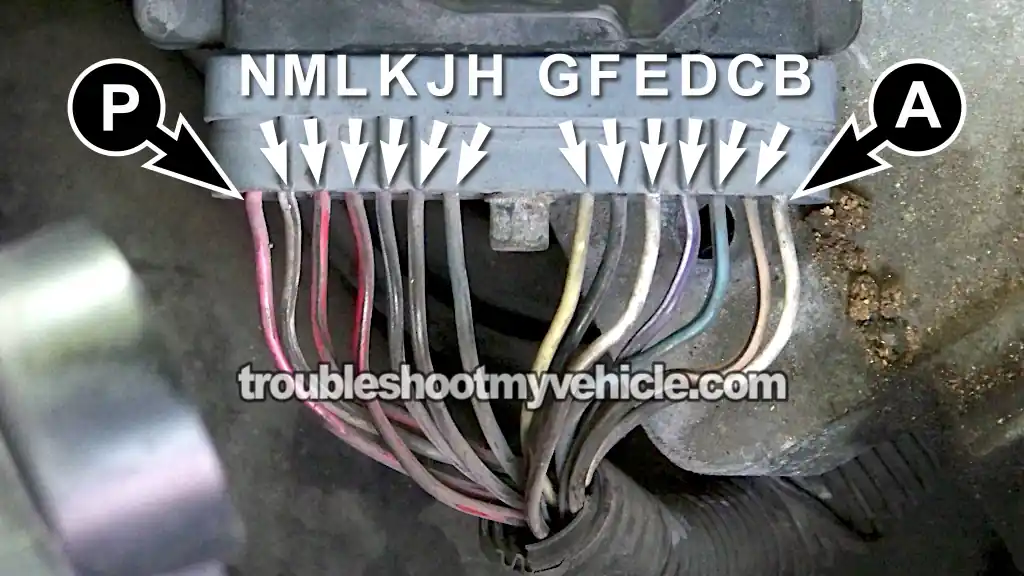
The CMP sensor is located on the front timing cover, just above the crankshaft pulley and next to the water pump pulley.
We're not gonna test for the CMP sensor signal at the sensor's connector. Instead, we'll check for it at the ignition control module (ICM) connector.
One more important thing: this test also requires that you manually rotate the engine using a 1/2-inch ratchet, the appropriate socket, and an extension.
NOTE: Since you'll be checking the CMP sensor signal while turning the engine by hand, you'll need to raise the front of the vehicle. So it goes without saying (but I'm gonna say it anyway): Think safety at all times. Use a jack stand to support the vehicle and never trust the jack by itself.
IMPORTANT: Both the CMP sensor and the ignition control module (ICM) must remain connected to their electrical connectors for this test to work. To check the CMP signal, you'll need to either backprobe the ICM connector or use a wire-piercing probe on the signal wire itself. A wire-piercing probe is the tool I use for this type of test. You can see what one looks like and buy one here. Goupchn 4mm Banana to Banana Plug Test Leads Kit (Amazon affiliate link).
OK, let's get started:
- 1
Raise the front of the vehicle and support it securely on jack stands.
- 2
Remove the passenger-side front wheel and then remove the splash shield behind it. This will give you access to the crankshaft pulley.
- 3
Disconnect all six fuel injectors from their electrical connectors. This disables the fuel system and prevents the engine from accidentally starting while you're performing the test.
- 4
Disconnect the ignition control module (ICM) connector to remove enough of the plastic wire loom and electrical tape so you can access the individual wires.
- 5
Reconnect the ICM connector.
IMPORTANT: All of the electrical tests in this tutorial are performed with the connector plugged into the ignition control module. - 6
Set your multimeter to Volts DC mode.
- 7
Connect the black multimeter lead to the battery negative (-) terminal.
- 8
Using a wire-piercing probe (or a back probe), connect the red multimeter test lead to the wire labeled J —see the photo above.
This wire carries the CMP sensor signal from the sensor to the ignition control module. It does not go directly to the PCM. - 9
Turn the key to the ON position but don't crank the engine.
- 10
Using a 1/2-inch ratchet, the correct socket, and an extension, slowly rotate the crankshaft clockwise while watching the multimeter.
IMPORTANT: Do not use the starter motor to crank the engine. This test only works when you rotate the engine by hand. - 11
As you turn the crankshaft, your multimeter should stay between 5 and 7 Volts DC most of the time. Once every two complete turns of the crankshaft, the voltage should momentarily drop to 0 Volts before immediately returning to 5 to 7 Volts.
This momentary drop to 0 Volts is the CMP sensor signal, you're checking for.
If you're wondering why it only happens once every two crankshaft revolutions, it's because the camshaft turns at half the speed of the crankshaft. In other words, the camshaft completes one revolution for every two revolutions of the crankshaft.
OK, let's see what your result is saying:
CASE 1: The multimeter registered one momentary 0-Volt reading as you manually turned the crankshaft two complete revolutions. This is the correct and expected test result. It confirms that the CMP sensor is generating its signal and is working properly.
No further testing is required, since this result eliminates the CMP sensor as the cause of the P0341 trouble code.
CASE 2: The multimeter DID NOT register a momentary 0-Volt reading as you manually turned the crankshaft two complete revolutions. This usually indicates a problem with the CMP sensor circuit, but don't replace the sensor just yet. We've got to perform a few more tests to pinpoint the exact cause.
Our next step is to make sure the CMP sensor is getting both power and Ground. Without either one, it won't produce a CMP signal. We'll check both of these circuits in TEST 2 and TEST 3.
If both power and Ground are present, we'll then remove the CMP sensor and verify that the camshaft sensor interrupter (the small magnet attached to the camshaft gear) is still in place. If the magnet has fallen off, the CMP sensor won't generate a signal even though the sensor itself is perfectly good. Go to: TEST 2: Making Sure The CMP Sensor Is Getting Power.
TEST 2: Making Sure The CMP Sensor Is Getting Power
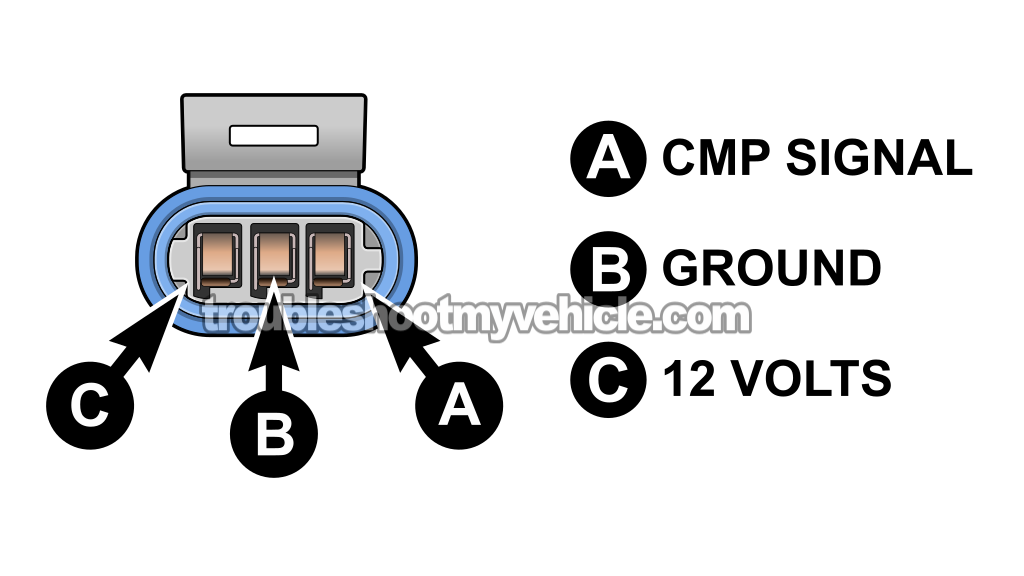
As I mentioned earlier, the CMP sensor is a Hall-effect sensor. That means it can't generate a CMP signal unless it's getting both power and Ground.
In this test, we're gonna make sure the ignition control module (ICM) is supplying the CMP sensor with the 10 to 12 Volts it needs to operate.
You'll be checking this voltage at the CMP sensor connector. On the connector, the power circuit is the terminal labeled C in the photo above.
Although you can use a 12-Volt test light for this check, I recommend using a multimeter. It'll give you a more accurate test result.
OK, here's what you'll need to do:
- 1
Disconnect the CMP sensor from its 3-wire electrical connector.
- 2
Turn the ignition key to the ON position, but don't crank or start the engine.
- 3
Set your multimeter to Volts DC.
- 4
Connect the black multimeter lead to the battery negative (-) terminal.
- 5
Probe terminal C on the CMP sensor connector with the red multimeter lead.
- 6
Your multimeter should register between 10 and 12 Volts DC.
Let's interpret your test results:
CASE 1: The multimeter registered 10 to 12 Volts with the ignition key in the ON position. This is the correct and expected test result. It confirms that the CMP sensor is getting the power it needs from the ignition control module (ICM).
Our next step is to make sure the CMP sensor is also getting a good Ground. Go to: TEST 3: Making Sure The CMP Sensor Is Getting Ground.
CASE 2: The multimeter DID NOT register 10 to 12 Volts with the ignition key in the ON position. This tells you that the ignition control module (ICM) is not supplying power to the CMP sensor.
This also tells you that the CMP sensor itself isn't the cause of the problem. Without this power supply, it can't generate a CMP signal.
Your next step is to find out why the 10 to 12 Volts are missing. Once power is restored to the CMP sensor, it'll be able to generate its signal again.
TEST 3: Making Sure The CMP Is Getting Ground
So far, your test results have confirmed the following:
- The CMP sensor isn't generating its ON/OFF signal (TEST 1).
- The CMP sensor is getting 10 to 12 Volts from the ignition control module (TEST 2).
The next step is to make sure the CMP sensor has a good Ground. Just like the power circuit, this Ground is supplied by the ignition control module (ICM).
We'll use a multimeter to verify that this Ground is present at the CMP sensor's 3-wire connector. Specifically, we'll be checking the female terminal labeled B in the connector illustration above.
OK, here's the test:
- 1
Disconnect the CMP sensor from its 3-wire electrical connector.
- 2
Turn the ignition key to the ON position, but don't crank or start the engine.
- 3
Set your multimeter to Volts DC.
- 4
Connect the red multimeter lead to the battery positive (+) terminal.
- 5
Probe terminal B on the CMP sensor connector with the black multimeter lead.
- 6
Your multimeter should register between 10 and 12 Volts DC.
Now, let's take a look at what those voltage readings (or lack of) mean:
CASE 1: The multimeter registered 10 to 12 Volts with the ignition key in the ON position. This is the correct and expected test result. It confirms that the CMP sensor has a good Ground.
If TEST 1 showed that the CMP sensor wasn't generating its ON/OFF signal, and TESTS 2 and 3 confirmed that it's getting both power and Ground, then the CMP sensor may indeed be bad. I say may because there's one last thing we've got to check before condemning it.
Our final test is to remove the CMP sensor from the timing cover and verify that the camshaft sensor interrupter (the magnet attached to the camshaft gear) is still in place. Go to: TEST 4: Making Sure The CMP Sensor Interrupter Hasn't Fallen Off.
CASE 2: The multimeter DID NOT register 10 to 12 Volts with the ignition key in the ON position. This tells you that the ignition control module (ICM) is not providing the Ground path the CMP sensor needs to operate.
This is a pretty rare failure. In most cases, the problem is a poor connection at the ICM connector. One of the female terminals may have backed out of the connector or may not be making good contact with the matching male terminal on the ignition control module.
TEST 4: Making Sure The CMP Sensor Interrupter Hasn't Fallen Off
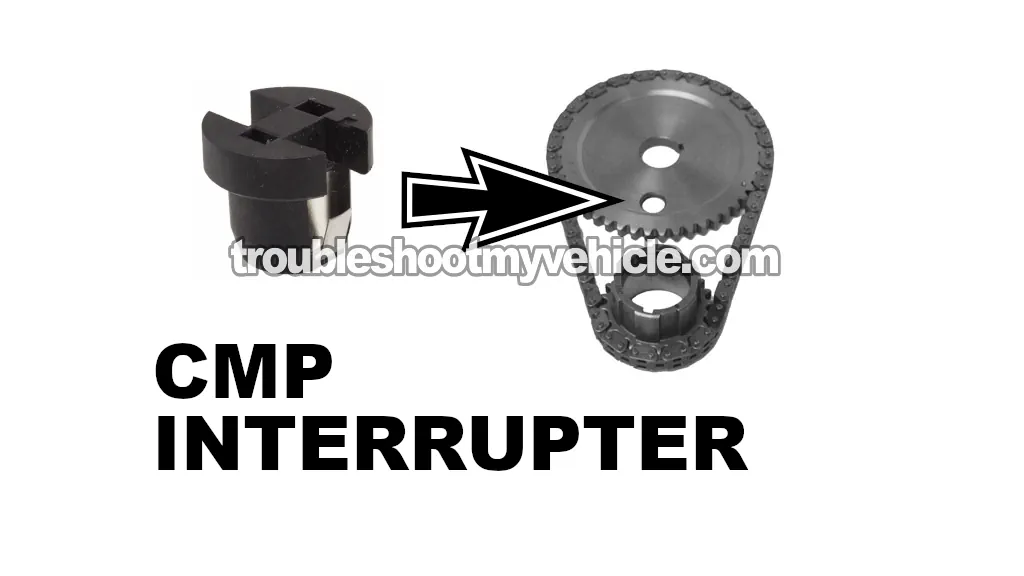
One of the most common reasons for a no-signal CMP sensor on the GM 3.8L V6 isn't the sensor itself. It's the camshaft sensor interrupter (the small magnet attached to the camshaft gear) falling off.
As I mentioned earlier, the interrupter magnet is held in place by a plastic carrier. Over time, this plastic becomes brittle, breaks apart, and allows the magnet to fall off. When that happens, the CMP sensor has nothing to detect and won't generate a signal.
Unfortunately, you can't look straight through the CMP sensor opening in the timing cover to see whether the interrupter magnet is still there. You'll need to remove the CMP sensor and use a small inspection mirror to look inside.
OK, here's how to check it:
- 1
Remove the CMP sensor from the timing chain cover.
- 2
Have a helper slowly rotate the crankshaft by hand using a ratchet and the appropriate socket.
- 3
Using a small inspection mirror, look through the CMP sensor opening as the camshaft gear rotates.
NOTE: It may take two complete revolutions of the crankshaft before the interrupter magnet comes into view. Remember, the camshaft turns at half the speed of the crankshaft. - 4
You should see the interrupter magnet pass in front of the CMP sensor opening.
Let's interpret your test results:
CASE 1: The interrupter magnet was present on the camshaft gear. This is the correct and expected result.
Since you've already confirmed that the CMP sensor isn't producing a signal and that it's getting both power and Ground, you can now confidently conclude that the CMP sensor has failed and needs to be replaced.
If you'd like to save a few bucks on an original AC Delco/Delphi sensor or a quality aftermarket replacement, take a look here: Where To Buy The CMP Sensor And Save.
CASE 2: The interrupter magnet was missing from the camshaft gear. This confirms why the CMP sensor isn't generating a signal.
Without the interrupter magnet, the sensor has nothing to detect, so it can't produce the ON/OFF signal the ignition control module needs.
To repair the problem, you'll need to remove the timing chain cover and install a new camshaft sensor interrupter (magnet).
More 3.8L V6 Buick LeSabre Diagnostic Tutorials
I have written several other 3.8L V6 Buick LeSabre specific tutorials that may be of interest to you. You can find them in this index:
Here's a sample of the tutorials you'll find in the index:

If this info saved the day, buy me a beer!
