
A fuel injector can pass a resistance test but may still not be delivering fuel properly or at all.
Clogged or restricted injectors are a common cause of misfires, especially on high-mileage engines.
In this tutorial, I'll show you how to test the injector spray pattern using an inexpensive tool —and how to tell if an injector is clogged or needs replacement.
This simple test can save you time, money, and frustration when troubleshooting a cylinder fuel delivery problem.
Contents of this tutorial:
APPLIES TO: This tutorial applies to the following vehicles:
- 3.0L V6 (OHV) Ford Taurus: 1990, 1991, 1992, 1993, 1994, 1995, 1996, 1997, 1998, 1999, 2000, 2001, 2002, 2003, 2004, 2005, 2006, 2007.
- 3.0L V6 (OHV) Mercury Sable: 1990, 1991, 1992, 1993, 1994, 1995, 1996, 1997, 1998, 1999, 2000, 2001, 2002, 2003, 2004, 2005.
FUEL INJECTOR RESISTANCE TESTS:
- How To Test The Fuel Injectors (1991-1995 3.0L V6 Ford Taurus, Mercury Sable).
- How To Test The Fuel Injectors (1996-1999 3.0L V6 Ford Taurus, Mercury Sable).
- How To Test The Fuel Injectors (2000-2007 3.0L V6 Ford Taurus, Mercury Sable).
CYLINDER MISFIRE DIAGNOSTICS:
Why Testing Injector Spray Matters
It's happened to me quite a few times over the years that I've pinpointed a cylinder misfire to a clogged fuel injector. And during my diagnostic test, the injector for the dead cylinder passed the resistance test with flying colors —meaning its internal resistance was within factory spec. But once I removed the injector and checked its spray pattern, it either wasn't spraying at all or it was just squirting fuel out.
So if you find yourself in a situation where you've narrowed the misfire down to a specific cylinder —and that cylinder is getting spark, compression is good, and its fuel injector's internal resistance is within spec— then the next important step is to remove the injector and visually check its spray pattern.
In the past, before DIY fuel-injector cleaning tools were available, I used to swap the suspect injector with its neighbor to see if the misfire followed the swap. But now, with a fuel-injector cleaning toolkit, all I've got to do is remove the injector, connect it to a spray can of brake cleaner via the tool's adapter, and see exactly how it's atomizing the fuel.
The tool typically has two parts:
- Pulse module: Connects to your Ford Taurus or Mercury Sable's battery and pulses the injector to mimic normal operation.
- Adapter fitting: Lets you connect the injector to a spray can of brake cleaner so the can's pressure can force cleaner through the injector and let you see its spray pattern.
Once you've got everything connected and set up, you'll press the pulse button on the power module. This activates the fuel injector, and the pressure from the spray can will push cleaner through it. You're going to see one of three things:
- Good injector: The fuel injector sprays in a fine, conical pattern.
- Clogged injector: The fuel injector sprays in a weak stream —more of a squirt.
- Bad injector: The fuel injector doesn't spray anything at all.
I can tell you from experience —this is one of the handiest diagnostic tools for tracking down misfires or lean conditions on these 3.0L engines. It takes the guesswork out of hard-to-diagnose injector problems and speeds up the whole troubleshooting process.
Where to buy it:


Disclosure: As an Amazon Associate, I earn from qualifying purchases. If my tutorials help you, using these links is an easy way to support the site at no extra cost to you. Thank you!
Checking If The Fuel Injector Sprays Fuel
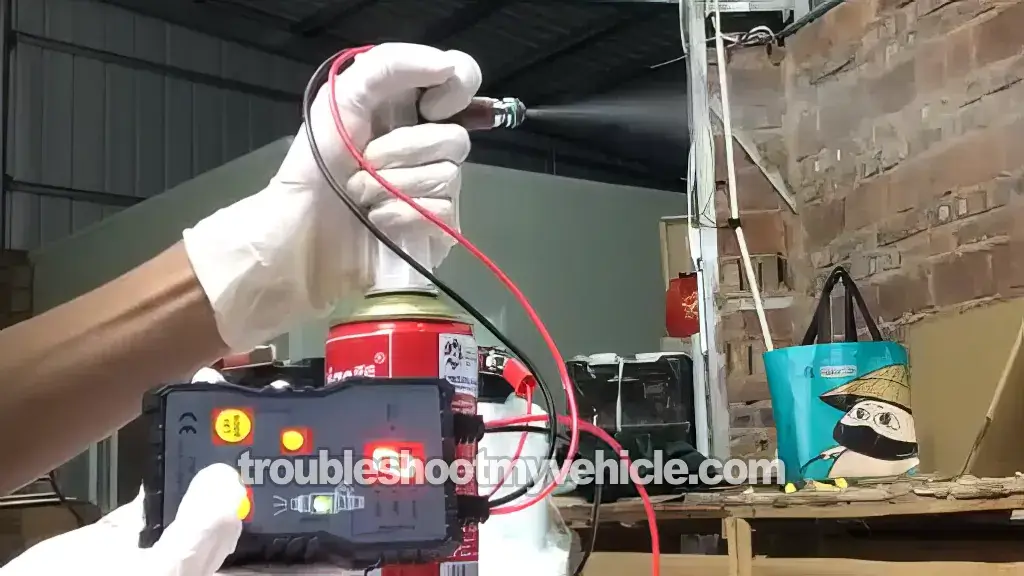
Before we get started, I do want to make you aware that brake cleaner spray is very flammable. You've got to think safety all the time. It's important that you take the following precautions before you begin your spray test:
- Read the injector cleaner tool instructions so you know exactly how to connect all of the parts.
- Work in a well-ventilated area —you don't want to be near any heat sources, sparks, or open flames.
- Wear eye protection —trust me on this one. I learned the hard way by spraying myself with cleaner a while back. Safety glasses are a must.
- Wear gloves —brake cleaner can be harsh on the skin.
IMPORTANT: Once you're done with the spray test, you're either going to reinstall the same fuel injector or install a new one (back onto the fuel injector rail). There are some very important precautions you need to take before you do. For more info on this, see this section: TECH TIP: Always Replace Injector O-Rings.
OK, this is what you'll need to do:
- 1
Remove the injector from the engine.
- 2
Remove the spray straw/nozzle from your can of brake cleaner —you won't be using it for this test.
- 3
Connect the power module's two leads to the fuel injector.
The red lead supplies power and the black lead supplies the pulse signal. - 4
Connect the injector to the test tool's adapter.
The adapter allows you to securely link the injector to the brake cleaner can. - 5
Attach the adapter to the brake cleaner can.
- 6
Pulse the injector using the power module.
This simulates the injector's normal operation and forces cleaner through so you can observe the spray pattern.
Here's how to interpret what you see:
CASE 1: The fuel injector sprayed a fine conical mist. This is the correct and expected test result, and it confirms that the injector is working correctly and atomizing the fuel the way it should.
If you're troubleshooting a cylinder misfire, then this test result rules out the injector itself as the cause. You'll need to continue your diagnostic efforts by checking the ignition system, making sure that that specific cylinder has good compression. The following step-by-step tutorial will help you troubleshoot a cylinder misfire:
CASE 2: The injector did not spray at all. This lets you know the injector is completely clogged.
In most cases, you'll need to replace the fuel injector with a new one. You can still try cleaning it with the injector cleaner tool you're using to check its spray pattern, but in my experience, once a fuel injector stops spraying completely, it usually can't be revived —it's got to be replaced.
CASE 3: The injector sprays in a stream (more like a squirt) instead of a conical mist. This tells you the injector is clogged. It's not completely clogged, but it's clogged enough that it's not producing a fine, conical spray.
Try running more cleaner through it to see if it clears up. Once you've got the injector spraying a proper conical mist, it's clean and ready to be reinstalled. If not, then it's time to replace it with a new one.
TECH TIP: Always Replace Injector O-Rings
One of the most important —I'd say one of the most critical— things you've got to keep in mind when removing and installing a fuel injector on your 3.0L V6 Ford Taurus or Mercury Sable is that you cannot reuse the old fuel-injector O-rings. Once the injector has been removed, its O-rings have to be replaced.
Once you've removed a fuel injector, even if its O-rings don't look damaged, they're going to be stretched or slightly nicked. To the naked eye they may look like they're still in tip-top shape, but that can be deceiving.
If you reuse them, you run the risk of a fuel leak and a potential engine fire. And believe you me, that's a nightmare you definitely want to avoid —and can avoid— simply by installing new O-rings.
Here are some guidelines to follow:
- Use brand-new O-rings that match your engine exactly —don't guess or mix and match.
- Before installing the fuel injector (onto the fuel rail), lightly coat the new O-rings with clean engine oil —this helps them slide into place without twisting or tearing.
- Press the injector in gently and make sure the O-rings are seated properly.
O-rings are cheap —but skipping them could cost you an engine... Or much worse. It's one of those small details that really matters.
More 3.0L V6 Ford Taurus And Mercury Sable Tutorials
You can find a complete list of tutorials for the 3.0L V6 Ford Taurus (Mercury Sable) in this index:
Here's a sample of the tutorials you'll find in the index:
- How To Test The TPS With A Multimeter (1996-2007 3.0L V6 Ford Taurus, Mercury Sable).
- How To Test The MAF Sensor (1996-1999 3.0L V6 Ford Taurus, Mercury Sable).
- How To Test The Fuel Pump (2004-2007 3.0L V6 Ford Taurus, Mercury Sable).
- How To Test For A Blown Head Gasket (1990-2007 3.0L V6 Ford Taurus, Mercury Sable).

If this info saved the day, buy me a beer!
