
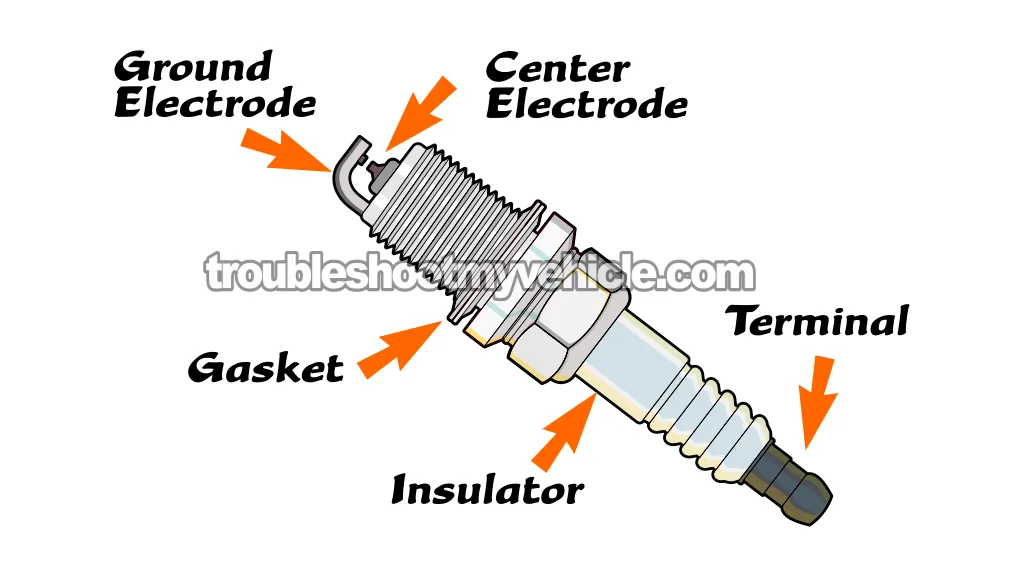
The spark plugs in your Nissan Quest —and there are six of them— are small ignition components, but they do some serious heavy lifting when it comes to getting the engine started and keeping it running optimally.
In this tutorial, I'm going to go over some of the most common causes of spark plug failure and what type of spark plug replacement interval you should follow.
This info will definitely come in handy, especially if your Nissan Quest's 3.0L V6 engine is burning oil, and it'll also help you if you're troubleshooting a rough idle or a cylinder misfire issue.
Contents of this tutorial:
APPLIES TO: This tutorial applies to the following vehicles:
- 3.0L V6 Nissan Quest: 1993, 1994, 1995, 1996, 1997, 1998.
- 3.0L V6 Mercury Villager: 1993, 1994, 1995, 1996, 1997, 1998.
CYLINDER MISFIRE DIAGNOSTICS:
Why Spark Plugs Fail On High-Mileage Engines
The spark plug is probably the only ignition system component that starts wearing out the moment you fire up the engine. Yep —every time a spark jumps from the center electrode to the side electrode, that spark takes a microscopic amount of metal with it. It's not much, but when you multiply that process by thousands of sparks per minute over tens of thousands of miles, that wear starts to add up.
Now, how long a spark plug will last depends on the type of plug you're running.
- The original-style copper plugs on these vans usually give you about 50,000 to 60,000 miles of reliable life.
- If someone installed platinum or iridium plugs, you can usually stretch that to around 100,000 miles.
Like everything in life, there's always a catch —and when it comes to spark plugs, the catch is that the advertised mileage service life only applies when the engine is healthy. In other words, the engine isn't burning oil.
Now, since we're talking about a minivan that's about 25 to 30+ years old at this point, even if the engine was rebuilt somewhere along the line, a lot of them still have a serious amount of mileage. And with that mileage usually comes worn valve seals or worn piston rings that let a little oil sneak into the combustion chamber.
Now, when your Nissan Quest's 3.0L V6 engine starts burning oil, that process is going to leave a layer of carbon on the spark plugs —especially around the electrode gap. I do want to point out that those carbon deposits don't actually wear out the spark plug, but they do block the air gap that the spark needs to jump across.
So yeah, once that air gap starts closing up because of carbon buildup, the spark gets weak or disappears completely, and that cylinder is going to start misfiring. You'll definitely feel a rough idle, a stumble on acceleration, and if enough cylinders are dealing with the same issue, you're going to feel a general lack of power from the engine.
How your Nissan Quest (Mercury Villager) reports that misfire depends on its year:
- 1993-1995 models: OBD1 —no cylinder-specific misfire codes. You have to diagnose it the old-fashioned way.
- 1996-1998 models: OBD2 —the PCM will set a P0301-P0306 code pointing straight at the "dead" cylinder.
Alright, now that you know spark plugs will either wear out on their own or fail because of carbon buildup, let's move on to the next section and talk about when you should be replacing the spark plugs on your Nissan Quest or Mercury Villager.
When Should I Replace The Spark Plugs?
There are really only two ways to know when it's time to install a new set of spark plugs:
- You can either follow the factory replacement schedule, or...
- You can pay attention to how the engine in your Nissan Quest or Mercury Villager is actually running.
If your Nissan Quest or Mercury Villager's engine is in good mechanical shape and isn't burning oil, then the replacement interval in the owner's manual is spot on. On these minivans, that usually means replacing the original-style copper spark plugs every 50,000 miles. Or, if platinum or iridium plugs have been installed, replacing them every 100,000 miles.
But if your minivan is burning oil, then following the factory replacement schedule doesn't make much sense, since that oil burning is going to leave carbon deposits on the spark plug's electrode gap —fouling them up long before the scheduled interval arrives and causing engine performance issues.
Depending on how much oil the engine is burning, you might find yourself replacing those spark plugs every few months just to keep the idle smooth and the power consistent.
So how will you know it's time to change them if it's burning oil? Simple —your minivan will start talking to you:
- The idle gets rough when you come to a stop.
- The engine starts to stumble or hesitate.
- On 1996–1998 OBD2 models, the Check Engine Light may pop on with a P0301–P0306 misfire code.
- On 1993–1995 OBD1 models, you won't get misfire codes —you'll just feel the engine running rough.
If you're not sure whether your Quest or Villager is burning oil, here are the classic signs:
- You're topping off the oil regularly just to keep it full.
- You see blue smoke from the exhaust when you accelerate.
- There's a puff of blue smoke on startup after the van has been sitting overnight.
If your engine isn't burning oil, follow the factory intervals and you'll get the full service life out of the spark plugs. If it is burning oil, then forget the mileage chart —replace the plugs whenever they start to foul, misfire, or make the engine run rough.
Which Spark Plugs Should I Buy: NGK Or Brand X?
When these vans rolled off the assembly line, they came equipped with NGK copper spark plugs. NGK is the original equipment brand for the Nissan Quest, and the Mercury Villager —even though it wears a Mercury badge— is really just a rebadged Quest underneath.
Now, does that mean you're locked into buying NGK? Not at all. Any quality plug from a reputable brand —Autolite, Bosch, Denso, Champion, take your pick— will run just fine in your minivan's 3.0L V6 engine. That said, NGK is still the "safe bet", mainly because its heat range and construction match this VG30E engine perfectly.
Which plug you should buy really comes down to one simple question: Is your Nissan Quest or Mercury Villager burning oil?
If the engine is burning oil:
Don't spend extra money on platinum or iridium plugs. The oil burning in the cylinders is going to carbon-foul the plugs long before they reach their full service life. In this situation, it makes more sense to buy inexpensive copper plugs —whether they're NGK copper plugs or a reasonably priced Brand X.
As soon as they start to foul, swap in a fresh set and keep the engine running smoothly.
If the engine is not burning oil:
Now you've got options —since you'll actually benefit from the longer-life platinum or iridium plugs, not to mention that even the regular copper NGK plugs will shine. Going with NGK platinum or iridium plugs means fewer plug changes, smoother idle, and solid long-term performance. But if a reputable aftermarket brand is available at a better price, there's nothing wrong with using it.
To sum it all up:
- Oil-burning engine: Stick with inexpensive copper plugs (NGK or equivalent).
- Healthy engine: Invest in NGK platinum or iridium plugs for longer service life.
Either way, NGK remains the most dependable choice for the Nissan Quest and Mercury Villager's 3.0L V6 engine.
Other Things That Can Kill A Spark Plug
So far, we've talked about the two big reasons spark plugs fail: normal wear and carbon fouling. But on these older Nissan Quest and Mercury Villager vans, those aren't the only culprits. A spark plug can stop firing for all kinds of reasons —and some of them have nothing to do with the spark plug itself.
Here are the most common "spark plug killers" I've run into:
1. Engine Problems That Can Kill a Spark Plug:
- A leaking or stuck fuel injector: If an injector stays open or sticks for even a moment, it can flood the cylinder with raw fuel. That extra fuel soaks the spark plug and kills the cylinder.
- Bad spark plug wires: The most most common issues you'll see are:
- Damaged spark plug wires allowing the spark to arc to metal instead of being channeled to the spark plug.
- Spark plug wire has build up too much internal resistance. When that happens, the spark gets weak or never reaches the plug in the first place.
- Distributor-related problems: Since every 1993-1998 Quest and Villager uses a distributor, anything wrong inside that distributor can kill a spark plug:
- Worn or cracked distributor cap.
- Carbon tracks inside the cap
- Low compression: Low compression means weak combustion —and weak combustion will cause the cylinder to misfire.
- Oil burning: We already covered this one, but it deserves another mention. Once the engine starts burning oil, that oil coats the spark plug with carbon and ash, shutting the spark down in no time.
2. Installation Mistakes That Can Kill a Plug:
Even a brand-new plug can fail if something goes wrong during installation:
- Over-tightening the plug: This can crack the ceramic insulator. Sometimes the crack is obvious, sometimes it's microscopic —but either way, that cylinder will misfire.
- Dropping the plug before installation: This happens, and when it does, you've got to check the spark plug's ceramic insulator for cracks. If its ceramic insulator fractured, you've got to use another spark plug.
- Closing the spark gap by accident: It's easier to do than most people think. One hard bump against metal and the electrode closes up.
- Wrong spark plug air gap: If the gap between the electrodes is too wide or too narrow, the spark either becomes weak or inconsistent.
- Washing a hot engine: Cold water hitting a hot spark plug can crack its porcelain insulator instantly.
Real-World Case Studies:
After decades diagnosing all kinds of engine performance issues -in this case: misfires, I can't tell you how many times the problem wasn't the spark plug at all —it was a bad spark plug wire, a worn-out distributor cap, a low-compression cylinder, or a spark plug that someone had dropped without realizing it. I've written about some of those experiences and you can find them here:
- Diagnosing A Toyota Corolla Misfire Case Study —a misfire caused by a simple installation error.
- Troubleshooting A Hard To Diagnose Misfire Case Study (GM 3.1L, 3.4L) —this one involved low compression causing a stubborn cylinder misfire (it was my brother-in-law's car, too).
- Carbon Tracks Are A Common Cause Of Ignition Misfires —spark plug and spark plug wire boot with carbon tracks causing a cylinder misfire (at: easyautodiagnostics.com).
More 3.0L V6 Nissan Quest Tutorials
You can find a complete list of tutorials for the 3.0L V6 Nissan Quest in this index:
Here's a sample of the tutorials you'll find in the index:
- How To Test The Ignition Coil And Power Transistor (1993-1998 3.0L V6 Nissan Quest).
- How To Test The Camshaft Position Sensor (1993-1998 3.0L V6 Nissan Quest).
- How To Test For A Blown Head Gasket (1993-1998 3.0L V6 Nissan Quest).
- How To Do And Interpret An Engine Compression Test (1993-1998 3.0L V6 Nissan Quest).

If this info saved the day, buy me a beer!
