
In this tutorial, I'll walk you through the steps to test the throttle position sensor (TPS) on a 1997-2001 2.2L Toyota Camry.
The great thing about this test is that you can do it quickly and accurately using just a multimeter. That's right —there's no need for any pricey diagnostic tools to check if the TPS is working properly.
I'll break down the process into three simple tests. By the end, you'll have all the information you need to determine if the TPS is faulty.
Contents of this tutorial:
NOTE: This tutorial applies to the following vehicles:
- 2.2L Toyota Camry: 1997, 1998, 1999, 2000, 2001.
Symptoms Of A Bad Throttle Position Sensor
The throttle position sensor (TPS) measures the angle of the throttle plate inside the throttle body.
As you may already know, the throttle plate is connected to the accelerator pedal via an accelerator cable.
When you press the accelerator pedal, the throttle plate opens, allowing more air to flow into the engine. When you release the pedal, the throttle plate closes, reducing the air entering the engine.
The fuel injection computer relies on the TPS to monitor how much the throttle plate opens or closes, making it a crucial part of the fuel injection system.
When the TPS fails, it can significantly affect the performance of your 2.2L Toyota Camry's engine. You're likely to notice one or more of these symptoms:
- The check engine light (CEL) is illuminated on the instrument panel.
- A TPS diagnostic trouble code (DTC) is stored in the PCM's memory:
- P0120: Throttle Position Sensor Circuit Malfunction.
- P0121: Throttle Position Sensor Circuit Range/Performance Problem.
- Poor gas mileage.
- Hard starts or extended cranking time after shutting the engine off.
- Black smoke coming from the tailpipe.
- Hesitation when accelerating.
Circuit Descriptions Of The TPS
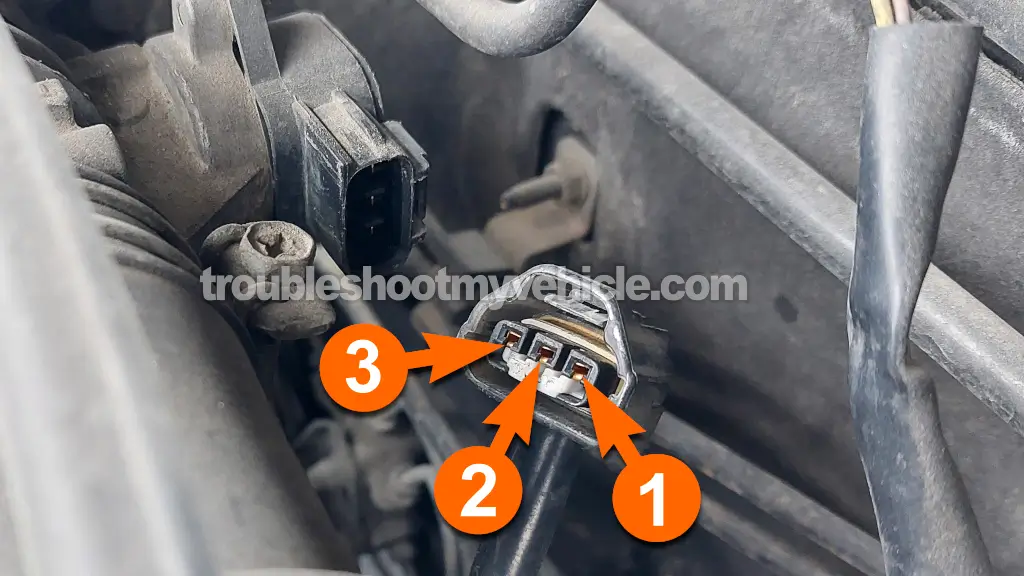
| Camry TPS Pinout | ||
|---|---|---|
| Pin | Wire Color | Description |
| 1 | Light Green (LT GRN) | TPS Signal |
| 2 | Brown (BRN) | Sensor Ground |
| 3 | Yellow (YEL) | 5 Volts |
To accurately diagnose the throttle position sensor (TPS), it's essential to understand how it works. The TPS generates a voltage signal that changes as the throttle plate moves. This signal allows the fuel injection computer to monitor the throttle plate's position.
- When the throttle plate is fully closed, the TPS typically produces a voltage signal between 0.5 and 0.9 Volts DC.
- As the throttle plate opens —like when you step on the accelerator pedal— the voltage signal steadily increases. At full throttle, this signal can reach around 4.5 to 5 Volts DC, depending on the vehicle.
If the throttle position sensor fails, one of the most common issues is that the voltage signal gets "stuck" at a single value, regardless of the throttle plate's position.
This means the TPS isn't accurately reporting the movement of the throttle plate to the computer, leading to performance problems.
Where To Buy Your TP Sensor And Save
Where can you buy the TP sensor for your 2.2L Toyota Camry? You can buy it at your local auto parts store but it's gonna' cost a whole lot more. I suggest taking a look at the price of the TP sensor in the following links and compare:


Disclosure: As an Amazon Associate, I earn from qualifying purchases. If my tutorials help you, using these links is an easy way to support the site at no extra cost to you. Thank you!
Not sure if the above TP sensor fits your particular 2.2L Toyota Camry? Don't worry, once you get to the site, they'll make sure it fits by asking you the particulars of your vehicle. If it doesn't fit, they'll find you the right one.
TEST 1: Testing The Throttle Position Sensor Voltage Signal
To determine if the throttle position sensor (TPS) is faulty, we'll connect a multimeter to the light green (LT GRN) wire on the TPS's 3-wire connector.
Next, we'll manually open and close the throttle plate while monitoring the voltage signal on the multimeter.
- If the TPS is working correctly, the voltage signal will increase smoothly as you open the throttle plate and decrease as you close it.
- If the TPS is defective, the voltage signal will stay stuck at one value, regardless of the throttle plate's position.
IMPORTANT: For this test to work, the throttle position sensor must stay connected to its 3-wire connector. You'll need to use a back probe or a wire-piercing probe to access the TPS signal. You can see an example of this tool here (and where to buy it): Goupchn 4mm Banana to Banana Plug Test Leads Kit (Amazon affiliate link).
Let's get started:
- 1
Place your multimeter in Volts DC mode.
- 2
Ground the black multimeter lead directly on the battery negative (-) post.
- 3
Turn the key to the ON position.
- 4
Connect the red test lead to the LT GRN wire of the TP sensor's connector.
- 5
You should see around 0.5 and 0.9 Volts DC at this point (Key ON Engine OFF).
- 6
Manually open the throttle plate.
You'll get the best results by opening and closing the throttle plate directly on the throttle body instead of stepping on the accelerator pedal. - 7
Slowly open the throttle plate to its wide open throttle position →your multimeter should show an increasing voltage.
At wide open throttle, you'll see about 4.5 to 5 Volts DC. - 8
Begin to slowly close the throttle plate →your multimeter should show a decreasing voltage.
At it's closed throttle position, your multimeter should register the same voltage you saw in step 5. - 9
Using a screwdriver's handle, gently tap the TP sensor as you open and close the throttle plate and observe the multimeter.
The purpose (of tapping the TP sensor with the screwdriver's handle) is to see if the TP sensor shows gaps in the voltage signal. Why? Because a good TP sensor will show a continuous increasing or decreasing voltage signal even while getting tapped by the screw-driver's handle.
Let's examine your test results:
CASE 1: The voltage increased/decreased as you manually opened/closed the throttle plate. This test result confirms that the TP sensor is OK and not defective.
CASE 2: The voltage DID NOT increase/decrease as you manually opened/closed the throttle plate. This tells you that the throttle position sensor (TPS), on your Camry, has a problem.
Before condemning the TPS as bad, you need to make sure that it's getting both 5 Volts and Ground. For the next test, go to: TEST 2: Making Sure The TPS Has 5 Volts.
CASE 3: The multimeter DID NOT register any voltage. This test result doesn't condemn the TP sensor as bad just yet.
Why? Because the TP sensor may be missing either 5 Volts or Ground. So the next step is to check that the TP sensor is getting 5 Volts, go to: TEST 2: Making Sure The TPS Has 5 Volts.
TEST 2: Making Sure The TPS Has 5 Volts
If, during TEST 1, the throttle position sensor (TPS) signal didn't increase or decrease as you opened and closed the throttle plate, it's possible that the sensor isn't receiving the required 5 Volts on the yellow (YEL) wire of its 3-wire connector.
In this section, we'll verify that the YEL wire is supplying the TPS with 5 Volts DC.
If the throttle position sensor is receiving 5 Volts DC, the next step is to confirm it's getting a proper Ground through the brown (BRN) wire of the 3-wire connector (covered in TEST 3).
These are the test steps:
- 1
Disconnect the TPS from its electrical connector.
- 2
Place your multimeter in Volts DC mode.
- 3
Connect the black multimeter test lead to the negative (-) battery terminal.
- 4
Turn the key ON but don't start the engine.
- 5
Connect the red multimeter test lead (using the appropriate tool) to the YEL wire.
- 6
Your multimeter should read 4.5 to 5 Volts DC.
Let's examine your test results:
CASE 1: The multimeter registered 4.5 to 5 Volts. This is the correct test result and confirms that the throttle position sensor (TPS) is getting power from your Toyota Camry's fuel injection computer.
The next and last test, is to make sure that the throttle position sensor is getting Ground (from the fuel injection computer too). For this test, go to: TEST 3: Making Sure The TPS Has Ground.
CASE 2: Your multimeter DID NOT register 4.5 to 5 Volts. Double check all of your connections and repeat the test.
If the multimeter still doesn't register 4.5 to 5 Volts, this indicates that the TPS is not receiving power, meaning it's not the source of the problem. Without power, the TPS cannot produce a throttle angle voltage signal.
Although troubleshooting the missing 5 Volts goes beyond the scope of this tutorial, your next step would be to identify and resolve the issue causing the lack of power.
TEST 3: Making Sure The TPS Has Ground
So far, your test results have confirmed the following:
- The throttle position sensor is not producing a voltage signal that increases or decreases as you open and close the throttle plate (TEST 1).
- The throttle position sensor is receiving 5 Volts DC on the yellow (YEL) wire (TEST 2).
Now, for the final test, we'll check if the brown (BRN) wire is providing a proper Ground connection from the fuel injection computer.
To verify Ground on the BRN wire, we'll perform a simple multimeter voltage test.
IMPORTANT: Be extremely careful not to accidentally or intentionally connect the Ground wire to battery voltage —doing so could damage the fuel injection computer on your 2.2L Toyota Camry. The multimeter voltage test outlined in the instructions is a safe and reliable method to check for Ground without risking any damage.
Let's get started:
- 1
Disconnect the TPS from its electrical connector.
- 2
Place your multimeter in Volts DC mode.
- 3
Connect the red multimeter test lead to the positive (+) battery terminal.
- 4
Turn the key on but don't start the engine.
- 5
Connect the black multimeter test lead (using the appropriate tool) to the BRN wire.
- 6
Your multimeter should read 10 to 12 Volts DC.
Let's interpret your test results:
CASE 1: The multimeter showed 10 to 12 Volts. This is the expected result and confirms that the throttle position sensor (TPS) on your 2.2L Toyota Camry is receiving Ground.
You can confidently determine that the TPS is faulty and needs replacement if the following have been verified:
- The TPS does not produce a voltage signal that changes as you open and close the throttle plate (TEST 1).
- The TPS is receiving 5 Volts DC on the yellow wire (TEST 2).
- The TPS is being supplied with Ground via the brown wire (this test).
CASE 2: Multimeter DID NOT show 10 to 12 Volts. First confirm that you're testing the correct wire and repeat the test. If the voltage is still missing, it means the TPS is not getting Ground.
Without Ground, the TPS cannot function, and the fuel injection computer will generate a TPS diagnostic trouble code (DTC), causing the check engine light (CEL) to turn on.
Diagnosing why Ground is missing goes beyond the scope of this tutorial, but at this point, you can rule out the TPS itself as the cause of the issue or the reason behind the DTC and check engine light.
More 2.2L Toyota Camry Tutorials
You can find a complete list of 2.2L Toyota Camry tutorials and wiring diagrams in this index:
Here's a sample of the tutorials you'll find there:
- How To Test Engine Compression (1990-2001 2.2L Toyota Camry, Celica).
- How To Test The TPS With A Multimeter (1997-2001 2.2L Toyota Camry).
- How To Test For A Blown Head Gasket (1990-2001 2.2L Toyota Camry, Celica).
- How To Test The MAP Sensor (1997-2001 2.2L Toyota Camry).

If this info saved the day, buy me a beer!
