

To test your throttle position sensor (TPS), all you need is a multimeter (no scan tool is required). In this tutorial, I'll show you how to test it in a step-by-step manner.
You'll be able to easily and quickly determine whether the TP sensor is functioning correctly with three simple tests.
Contents of this tutorial:
ES  You can find this tutorial in Spanish here: Cómo Probar El Sensor De Posición Del Acelerador —Sensor TPS (1991 3.9L V6 Dodge Ram Van) (at: autotecnico-online.com).
APPLIES TO: This tutorial applies to the following vehicles:
- 3.9L V6 Dodge Ram B150 Van: 1991.
- 3.9L V6 Dodge Ram B250 Van: 1991.
OTHER TPS SENSOR TESTS:
- How To Test The TPS (1989-1990 3.9L V6 Dodge Ram Van).
- How To Test The TPS (1992-1997 3.9L V6 Dodge Ram Van).
- How To Test The TPS (1997-2003 3.9L V6 Dodge Ram Van).
Symptoms Of A Bad Throttle Position Sensor
As you're aware, the accelerator pedal connects to the throttle plate via a mechanical cable. When the engine is running, this is what happens:
- When you press the accelerator pedal, the throttle plate opens, allowing more air to enter the engine.
- When you release the pedal, the throttle plate closes, reducing airflow into the engine.
Your Dodge Ram van's fuel injection computer keeps track of the throttle plate angle (as you press or release the accelerator pedal) with the throttle position sensor.
When the TP sensor malfunctions, engine performance goes out the window. Below are some symptoms you may encounter:
- Trouble codes: The following trouble codes will illuminate the check engine light (CEL):
- Code 24: TPS Voltage Is Too Low.
- Code 24: TPS Voltage Is Too High.
- Engine no-start: The engine won't start no matter how long you crank it.
- Hard start: You may need to crank the engine several times before it starts.
- Engine hesitation: Hesitation during acceleration from a stop or while driving.
- Lack of power: You'll notice a lack of power, whenever you step on the gas pedal.
- Bad gas mileage: The fuel injection system will switch to 'limp-in' mode, which reduces engine output to prevent damage but wreaks havoc on gas mileage.
Where To Buy The TPS And Save
The following links will help you to comparison shop for the TPS for your 3.9L V6 Dodge Ram van. I think they'll save you a few bucks:


If you're unsure if this TPS is compatible with your specific 3.9L V6 Dodge Ram van, no worries. Once you visit the site, they'll check and ensure it's the right one by asking for more details about your vehicle. If it doesn't fit, they'll help find the correct one.
TEST 1: Testing The TPS Voltage Signal
As I previously mentioned, the throttle position sensor generates a voltage signal based on the position of the throttle plate.
Here's how a properly working TPS behaves:
- Closed throttle: The TPS outputs a low voltage when the throttle plate is fully closed.
- Throttle opening: As the throttle plate begins to open, the TPS sends a gradually increasing voltage signal.
- Wide Open Throttle (WOT): At full throttle, the TPS typically produces around 4.5 Volts DC.
- Throttle closing: As the throttle plate returns to the closed position, the voltage decreases accordingly and settles back to its original low value.
Generally, if the TPS fails, its voltage signal will not increase or decrease as the throttle plate opens or closes.
NOTE: You'll need a multimeter to be able to test the throttle position sensor. If you don't have one, this is the one I use and recommend: Tekpower TP8268 AC/DC Auto/Manual Range Digital Multimeter (Amazon affiliate link).
IMPORTANT: The TP sensor must remain connected to its electrical connector. You'll need to use a back probe on the connector or wiring piercing probe to access the signal in the wire. You can see an example of this tool here and where to buy it: Goupchn 4mm Banana to Banana Plug Test Leads Kit, 15PCS Five Colors (Amazon affiliate link).
Let's get started:
- 1
Set your multimeter to Volts DC mode.
- 2
Connect the black multimeter test lead to the negative (-) battery terminal.
- 3
Turn the key to the ON position but don't start the engine.
- 4
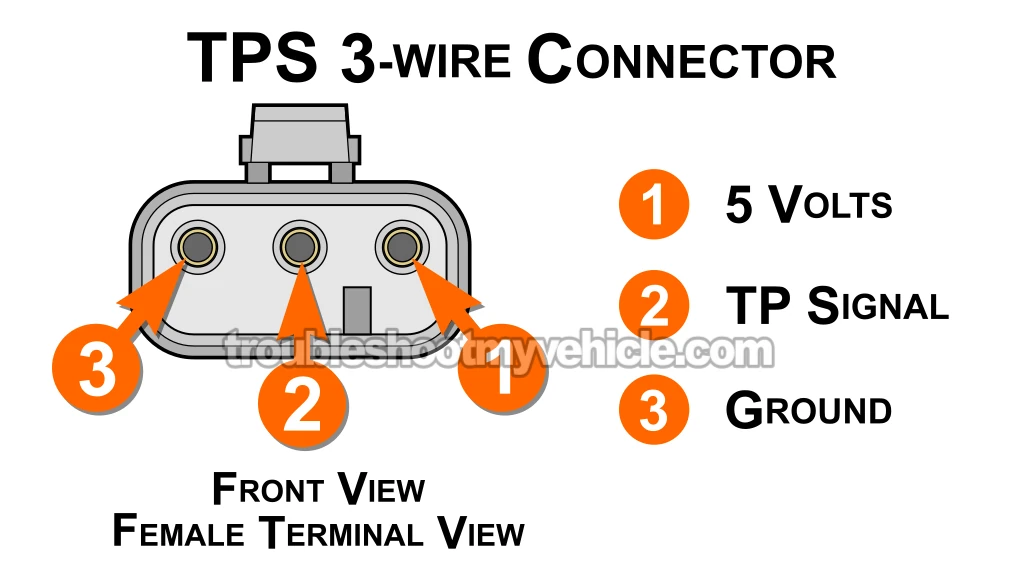
Connect the red multimeter test lead to the middle wire of the connector using a suitable tool (back probe or wire-piercing probe).
NOTE: The TP sensor must remain connected to its electrical connector. - 5
Your multimeter should display a voltage reading between 0.2 to 0.9 Volts DC at this point (with the throttle plate closed).
If your multimeter doesn't show this, don't worry. Continue to the next steps. - 6
Slowly open the throttle by hand from the engine compartment.
- 7
The voltage should increase.
When the throttle plate is fully open, your multimeter should read between 3.5 to 4.5 Volts DC. - 8
Slowly close the throttle plate.
- 9
The voltage should decrease back to its closed throttle value.
- 10
Gently tap the throttle position sensor with a screwdriver handle while you open and close the throttle plate.
If the TPS is faulty, tapping will cause the voltage signal to glitch. On a good TPS, tapping it will not have any effect on its voltage signal output.
Let's examine your test results:
CASE 1: The TPS signal voltage increased/decreased as you opened/closed the throttle plate. This is the correct test result and confirms that the throttle position sensor is functioning properly.
Additionally, this result confirms that the TPS is receiving both power and Ground from the fuel injection system.
CASE 2: The TPS signal voltage STAYED STUCK in one value as you opened/closed the throttle plate. This test result typically indicates that the TPS is faulty.
To confirm whether the TPS is indeed bad, you need to make sure it's receiving both power and Ground. Go to: TEST 2: Making Sure The TPS Is Receiving 5 Volts.
CASE 3: The multimeter DID NOT register any voltage during the test. This result usually suggests the TP sensor is bad.
Before you run out and replace it, you need to make sure it's getting power and Ground. Go to: TEST 2: Making Sure The TPS Is Receiving 5 Volts.
TEST 2: Making Sure The TPS Is Receiving 5 Volts
There is a good chance that the reason that the TP sensor's voltage signal is stuck in one value (TEST 1) is because it's not getting power.
For our second test, we'll check that the violet with white stripe (VIO/WHT) wire of the TP sensor connector supplies a voltage between 4.5 and 5 Volts DC.
The VIO/WHT wire connects to the female terminal labeled number 1 of the sensor's 3-wire connector (see illustration above).
To check that the VIO/WHT wire is delivering 5 Volts, we're gonna do a simple multimeter voltage test on its connector terminal.
These are the test steps:
- 1
Select Volts DC mode on your multimeter.
- 2
Connect the black multimeter test lead to the negative (-) battery terminal.
- 3
Rotate the key to its ON position but don't start the engine.
- 4
Disconnect the TP sensor from its connector.
- 5
With the red multimeter test lead, gently probe terminal 1 of the TP sensor's 3-wire connector.
Confirm that the VIO/WHT connects to terminal number 1.
NOTE: Be careful not to damage the female terminal. - 6
The multimeter should display 4.5 to 5 Volts DC.
Let's interpret your test results:
CASE 1: 4.5 to 5 Volts are present. This means that TPS is getting power and it's what we want to see.
For our final test, we'll check that the TPS is getting Ground. Go to: TEST 3: Making Sure The TPS Is Receiving Ground.
CASE 2: 4.5 to 5 Volts ARE NOT present. Without power, the TP sensor won't generate its variable voltage signal.
The most likely cause of these missing 5 Volts are:
- An open-circuit problem in the wiring connecting the TP sensor 3-wire connector and the fuel injection computer's connector.
- In rare cases, the issue is due to an internal fault in the computer.
Although troubleshooting these missing 5 Volts falls outside this tutorial's scope, you now know the TP sensor itself is OK. Your next step is to resolve the issue causing this voltage to not reach the sensor.
TEST 3: Making Sure The TPS Is Receiving Ground
So far, your previous two test have:
- TEST 1: The TPS voltage signal doesn't increases/decreases when you open/close the throttle plate.
- TEST 2: Power is being delivered to the TP sensor.
In this last test section, we'll confirm that the black with light blue stripe (BLK/LT BLU) wire is delivering Ground to the TP sensor.
The terminal that delivers Ground to the sensor is the one I've labeled with the number 3 in the illustration above.
Terminal number 3 corresponds to the BLK/LT BLU wire of the TP sensor's 3-wire connector.
We'll use a multimeter voltage test to verify that the BLK/LT BLU wire delivers Ground.
NOTE: Ground is provided to the sensor by the fuel injection computer. Be careful not to directly connect this circuit to battery 12 Volts, or you'll fry the computer. The multimeter voltage test I'm suggesting in the instructions is a safe way to check for Ground in this circuit.
These are the test steps:
- 1
Select Volts DC mode on your multimeter.
- 2
Connect the red multimeter test lead to the positive (+) battery terminal.
- 3
Rotate the key to its ON position but don't start the engine.
- 4
Disconnect the TP sensor from its connector.
- 5
With the black multimeter test lead, gently probe terminal 3 of the TP sensor's 3-wire connector.
Confirm that the BLK/LT BLU connects to terminal number 3.
NOTE: Be careful not to damage the female terminal. - 6
The multimeter should display 10 to 12 Volts DC if Ground is present.
Let's interpret your test results:
CASE 1: Ground is present. This is the correct test result.
The TPS is faulty and requires replacement if you confirmed all of these conditions:
- The TP sensor does not generate a voltage signal that changes with throttle plate movement (TEST 1).
- The TP sensor is getting 4.5 to 5 Volts (TEST 2).
- The TP sensor is getting Ground (this test section).
CASE 2: Ground IS NOT present. Verify your connections and check you're testing the correct terminal.
If your multimeter still doesn't read 10 to 12 Volts, the throttle position sensor itself is OK. The reason the sensor is not generating a variable voltage signal is due to this lack of Ground.
Although troubleshooting this missing Ground falls outside this tutorial's scope, you now know the TP sensor itself is OK. Your next step is to resolve the issue causing this lack of Ground.
The most likely causes are:
- An open-circuit problem in the wiring connecting the TP sensor 3-wire connector and the fuel injection computer's connector.
- In rare cases, the issue is due to an internal fault in the computer.
More 3.9L V6 Dodge Ram Van Tutorials
You can find a complete list of 3.9L V6 Dodge Ram van tutorials in this index:
Here's a small sample of the tutorials you'll find in the index:
- How To Test The Engine Compression (1989-2003 3.9L V6 Dodge Ram Van).
- How To Test For A Blown Head Gasket (1989-2003 3.9L V6 Dodge Ram Van).
- How To Test The Fuel Pump (1992-2003 3.9L V6 Dodge Ram Van).
- How To Test The TPS (1989-1990 3.9L V6 Dodge Ram Van.

If this info saved the day, buy me a beer!
