
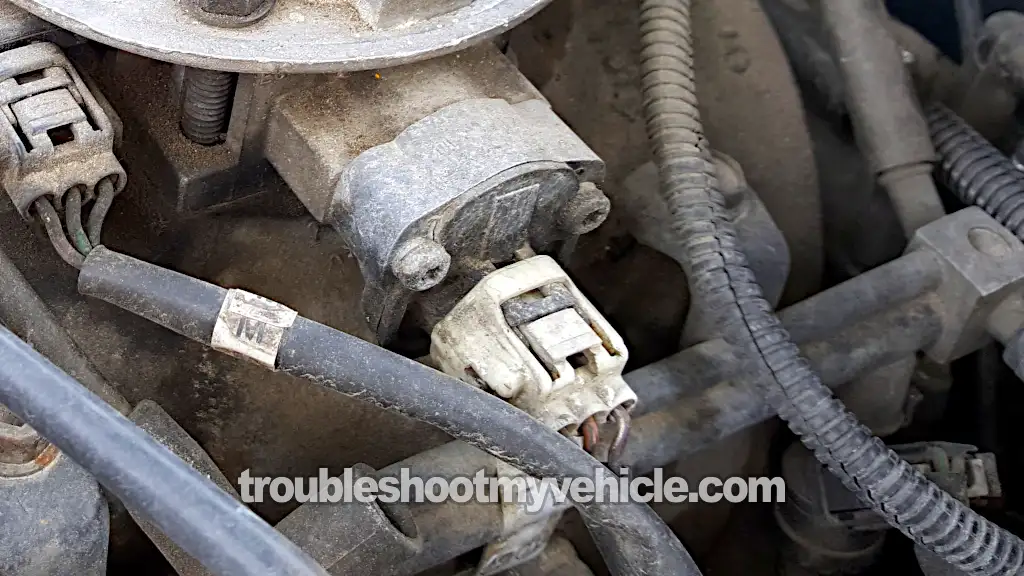
The throttle position sensor (TPS) on your 1997-2003 3.9L V6 Ram van, is probably one of the easiest sensors to test. The best part is that you don't need no fancy scan tool to do it!
In this tutorial, I'm gonna walk you through the entire testing process, step-by-step. It's actually pretty straightforward, and with just three simple tests, you'll quickly figure out if your TPS is working properly or if it's fried.
Contents of this tutorial:
APPLIES TO: This tutorial applies to the following vehicles:
- 3.9L V6 Dodge Ram B1500 Van: 1997, 1998, 1999, 2000, 2001, 2002, 2003.
- 3.9L V6 Dodge Ram B2500 Van: 1997, 1998, 1999, 2000, 2001, 2002, 2003.
OTHER TPS SENSOR TESTS:
- How To Test The TPS (1989-1990 3.9L V6 Dodge Ram Van).
- How To Test The TPS (1991 3.9L V6 Dodge Ram Van).
- How To Test The TPS (1992-1997 3.9L V6 Dodge Ram Van).
Symptoms Of A Bad Throttle Position Sensor
When your TP sensor goes bad, you'll see one or more of the following issues:
- Diagnostic trouble codes (DTCs): You'll see one of these codes triggering the check engine light (CEL):
- P0121: TPS Voltage Does Not Agree With MAP.
- P0122: TPS Voltage Is Too Low.
- P0123: TPS Voltage Is Too High.
- Engine won't start: No matter how long you crank the engine, it doesn't start.
- Hard starting: You need to crank the engine several times before it finally starts.
- Engine hesitation: This is a little pause or stumble that happens when you press the gas pedal, either from a stop or while accelerating at cruising speed.
- Lack of power: When you press the gas pedal, the engine has no power (especially from a stop or during acceleration at cruising speed).
- Poor gas mileage: The fuel injection computer switches into "limp-in" mode to protect your engine. This means it adds more fuel than usual and drastically reduces engine power. Your gas mileage takes a big hit.
How The Throttle Position Sensor Works
As you're already aware, the accelerator pedal actuates the throttle plate via a mechanical cable (known as the accelerator cable).
The throttle plate is simply a type of butterfly valve that whose sole job is to regulate airflow into the engine.
Here's how it works:
- Pressing the accelerator: When you step on the accelerator pedal, the throttle plate opens. This allows more air to enter the engine.
- Releasing the accelerator: When you release the accelerator pedal, the throttle plate automatically closes, reducing airflow.
The fuel injection computer monitors the throttle plate angle in real time through the throttle position sensor (TPS), which tracks the movement of the throttle plate as you step on or off the accelerator pedal.
The TPS produces a DC voltage signal that corresponds to how far the throttle plate is open:
- Closed throttle: The TPS sends a low voltage, typically between 0.3 and 0.9 Volts DC.
- Throttle opening: As the plate opens, the voltage steadily increases.
- Wide Open Throttle (WOT): The TPS usually outputs around 4.5 Volts DC.
- Throttle closing: The voltage drops back down to its closed-throttle value.
Where To Buy The TPS And Save
The following links will help you to comparison shop for the TPS for your 3.9L V6 Dodge Ram van. I think they'll save you a few bucks:


If you're unsure if this TPS is compatible with your specific 3.9L V6 Dodge Ram van, no worries. Once you visit the site, they'll check and ensure it's the right one by asking for more details about your vehicle. If it doesn't fit, they'll help find the correct one.
TEST 1: Testing The TPS Voltage Signal
The first thing that we're gonna do is check the TPS signal voltage as we open and close the the throttle plate.
To read the TPS signal, we'll tap into the middle wire of the 3-wire connector. This wire is the orange with dark blue stripe (ORG/DK BLU) wire.
Simply put, if your TPS isn't working, you won't see a change in the voltage as you open or close the throttle.
NOTE: You'll need a multimeter to be able to test the throttle position sensor. If you don't have one, this is the one I use and recommend: Tekpower TP8268 AC/DC Auto/Manual Range Digital Multimeter (Amazon affiliate link).
IMPORTANT: To read the TPS voltage signal, the sensor must remain plugged into its 3-wire connector. You'll need to back-probe the connector or use a wire-piercing probe to tap into the signal wire while the sensor is still connected. You can find an example of this tool and where to buy it here: Goupchn 4mm Banana to Banana Plug Test Leads Kit, 15PCS Five Colors (Amazon affiliate link).
Here's what you need to do:
- 1
Connect the black multimeter lead to the negative battery terminal.
- 2
Set your multimeter to DC Volts mode.
- 3
Turn the key to the ON position but don't start the engine.
- 4
Connect the red multimeter lead to the orange with dark blue stripe (ORG/DK BLU) wire using the right tool.
The ORG/DK BLU wire is the middle wire of the TP sensor's 3-wire connector.
NOTE: The TP sensor must remain connected to its electrical connector. - 5
You should now see a voltage reading between 0.3 and 0.9 Volts DC with the throttle plate closed.
If you don't see that, don't sweat it —move on to the next step. - 6
Slowly open the throttle by hand.
NOTE: Rotate the throttle plate from the engine compartment, and not by using the accelerator pedal. - 7
As you open the throttle, the voltage reading should increase.
- 8
When the throttle plate is fully open, your multimeter should display a voltage reading between 3.5 and 4.5 Volts DC.
- 9
Now, slowly close the throttle plate.
- 10
The voltage should drop back down to what it was when the throttle was closed.
- 11
Gently but firmly, tap the throttle position sensor with a screwdriver handle while opening and closing the throttle.
If the TPS is working, tapping it shouldn't change the voltage output. But if it's faulty, tapping will make the voltage signal glitch out.
OK, let's break what the results mean:
CASE 1: The TPS signal voltage changed as indicated. That's exactly what we're looking for! It also confirms the TP sensor is functioning correctly.
It also tells us the TPS is getting the power and Ground it needs from the fuel injection computer. Essentially, when it comes to the TP sensor itself and its circuits, everything is functioning as it should.
CASE 2: The TPS signal voltage stayed stuck on the same number. This generally means the sensor itself is faulty.
To confirm this, we need to check if that power and Ground are supplied to the TP sensor. Go to: TEST 2: Making Sure The TPS Is Receiving 5 Volts.
CASE 3: Your multimeter showed no voltage during the test. This usually indicates one of two things, the TP sensor is bad or it's not getting power or Ground.
Our next step is to check it's getting power. Go to: TEST 2: Making Sure The TPS Is Receiving 5 Volts.
TEST 2: Making Sure The TPS Is Receiving 5 Volts
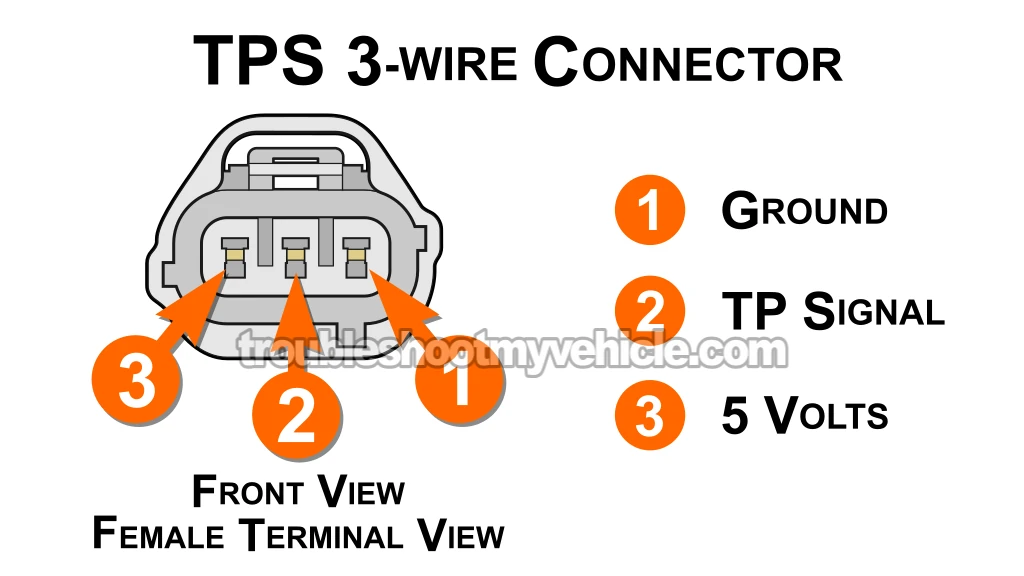
If the TPS voltage signal doesn't change as you open and close the throttle plate, there's a good chance it's not getting power.
For our second test, we'll verify that the purple wire with white stripe (PPL/WHT) is supplying between 4.5 and 5 Volts DC.
In the TPS 3-wire connector illustration above, I've marked the terminal connected to the PPL/WHT wire as terminal 3.
To confirm the PPL/WHT wire is actually delivering 5 Volts, we'll do a simple voltage test with our multimeter.
Let's get right to it!
- 1
Disconnect the TP sensor from its connector.
- 2
Set your multimeter to DC Volts mode.
- 3
Connect the black multimeter test lead to the negative (-) battery terminal.
- 4
Turn the key to the ON position, but don't start the engine.
- 5
Gently probe female terminal 3 of the TP sensor's 3-wire connector with the red multimeter test lead.
NOTE: Make sure that the PPL/WHT wire is the one connected to terminal number 3. - 6
You should see a voltage reading between 4.5 and 5 Volts DC on your multimeter.
OK, let's take a look at your test results.
CASE 1: You're getting between 4.5 and 5 Volts. This tells us the TPS is actually getting power and that's exactly what we need see!
For our final test, we'll check that the TPS is getting Ground. Head over to: TEST 3: Making Sure The TPS Is Receiving Ground.
CASE 2: You're NOT seeing 4.5 to 5 Volts. Without power, your TP sensor just won't produce a variable voltage signal.
So, what's causing this missing voltage? The most common causes are:
- There's an open-circuit problem in the PPL/WHT somewhere between your TP sensor's 3-wire connector and the fuel injection computer's connector.
- In some rare cases, the computer itself has an internal problem.
I don't cover how to actually troubleshoot this in this tutorial. But, you now know the TP sensor itself is working fine. Your job is to figure out what's stopping that voltage from getting to the sensor.
TEST 3: Making Sure The TPS Is Receiving Ground
Based on the last two tests, you've confirmed:
- Opening and closing the throttle plate has no effect on the TPS voltage signal (TEST 1).
- The sensor is getting power (TEST 2).
Now, for this final test, we'll check whether the black with light blue stripe (BLK/LT BLU) wire is supplying Ground to the TPS.
In the illustration above, the terminal labeled with the number 1 is where the BLK/LT BLU wire connects.
We'll do a simple multimeter voltage test to see if the BLK/LT BLU wire is providing Ground.
IMPORTANT: The fuel injection computer supplies Ground to this sensor circuit. Do not, under any circumstances, connect this wire directly to 12 Volts from the battery or you'll fry the computer! The multimeter test I'm outlining in the steps below lets you safely confirm the presence of Ground in the circuit.
Here's how to check for Ground:
- 1
Disconnect the TP sensor from its connector.
- 2
Set your multimeter to DC Volts mode.
- 3
Connect the red multimeter test lead to the positive (+) battery terminal.
- 4
Turn the key to the ON position, but don't start the engine.
- 5
Gently probe female terminal 1 of the TP sensor's 3-wire connector with the red multimeter test lead.
NOTE: Make sure that the BLK/LT BLU wire is the one connected to terminal number 1. - 6
You should see a voltage reading between 10 to 12 Volts DC on your multimeter.
Let's take a look at what your test results mean:
CASE 1: Multimeter read 10 to 12 Volts. This is the correct and expected test result.
The TP sensor is bad if you've checked and confirmed the following conditions:
- The TP sensor's signal doesn't change when you move the throttle plate (TEST 1).
- The TP sensor is receiving 4.5 to 5 Volts (TEST 2).
- The TP sensor is getting Ground (this test section).
CASE 2: You're NOT seeing 10 to 12 Volts. Without Ground, your TP sensor just won't produce a variable voltage signal.
So, what's causing this missing Ground? The most common causes are:
- There's an open-circuit problem in the BLK/LT BLU somewhere between your TP sensor's 3-wire connector and the fuel injection computer's connector.
- In some rare cases, the computer itself has an internal problem.
I don't cover how to actually troubleshoot this in this tutorial. But, you now know the TP sensor itself is working fine. Your job is to figure out what's stopping that Ground from getting to the sensor.
More 3.9L V6 Dodge Ram Van Tutorials
You can find a complete list of 3.9L V6 Dodge Ram van tutorials in this index:
Here's a small sample of the tutorials you'll find in the index:
- How To Test The Engine Compression (1989-2003 3.9L V6 Dodge Ram Van).
- How To Test For A Blown Head Gasket (1989-2003 3.9L V6 Dodge Ram Van).
- How To Test The Fuel Pump (1992-2003 3.9L V6 Dodge Ram Van).
- How To Test The TPS (1989-1990 3.9L V6 Dodge Ram Van.

If this info saved the day, buy me a beer!
