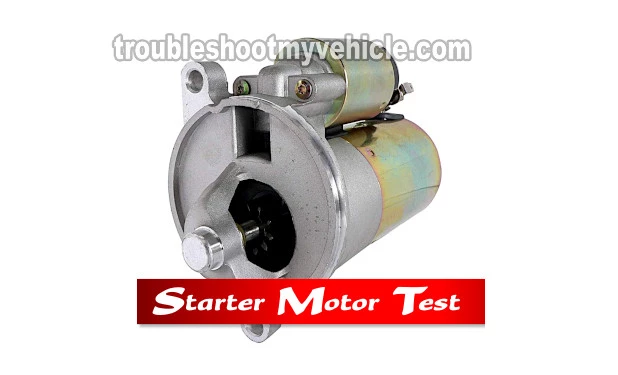
This tutorial will show you how to test the starter motor on your 4.0L Ford Explorer (Aerostar or Mercury Mountaineer) to see if it's the one responsible for your engine's no-crank problem.
The starter motor test is a pretty easy test that requires only a multimeter and a helper. You'll find all of the test instructions explained in a step-by-step manner.
NOTE: You'll notice that the photos I'm using are of the starter motor off of the vehicle. I've done this to make it easier to show you where to make your test connections. You don't need to remove the starter motor from your 4.0L Ford Ranger (Mazda B4000) to follow the test instructions in this tutorial.
Ford Ranger: You can find the 4.0L Ford Ranger (Mazda B4000) starter motor test tutorial here:
- How To Test The Starter Motor (4.0L Ford Ranger And Mazda B4000) (at: easyautodiagnostics.com).
Contents of this tutorial:
ES  You can find this tutorial in Spanish here: Cómo Probar El Motor De Arranque (4.0L Ford) (at: autotecnico-online.com).
APPLIES TO: This tutorial applies to the following vehicles:
- 4.0L V6 Ford Aerostar: 1990, 1991, 1992, 1993, 1994, 1995, 1996, 1997.
- 4.0L V6 Ford Explorer: 1991, 1992, 1993, 1994, 1995, 1996, 1997, 1998, 1999, 2000, 2001, 2002, 2003, 2004, 2005, 2006, 2007, 2008, 2009, 2010.
- 4.0L V6 Mercury Mountaineer: 1998, 1999, 2000, 2001, 2002, 2003, 2004, 2005, 2006, 2007, 2008, 2009, 2010.
Important Testing Tips
The following testing tips will help you test the starter motor without complications:
TIP 1: The battery must have a full charge before starting any of the tests in this tutorial.
TIP 2: The battery cable terminals and the battery posts should be clean and corrosion-free before starting the tests.
TIP 3: Read the entire article first to familiarize yourself with the tests.
TIP 4: Use jack stands for safety. Don't trust the jack alone to keep your vehicle up in the air while you're underneath it!
TIP 5: Take all necessary safety precautions. Use safety glasses while working underneath the vehicle. Be alert and think safety all of the time.
NOTE: This tutorial only applies to a no-crank condition. And there's a big difference between an engine no-start condition and a no-crank condition. The main differences are:
- In an engine no-crank condition, the starter motor isn't turning the engine over.
- In an engine no-start issue, the starter motor is working and turning the engine over. The engine isn't starting due to a fuel system, ignition system issue, or internal mechanical issue.
If you need to troubleshoot an engine no-start problem, see this diagnostic tutorial:
Symptoms Of A Bad Starter Motor
Generally, the engine won't turn over when the starter motor fails (when you turn the key to start it).
Unfortunately, in some cases, the starter motor fails intermittently. When this happens, the starter motor functions most of the time, but now and then, it doesn't.
If your 4.0L Ford Explorer (Aerostar or Mercury Mountaineer) is experiencing an intermittent starter motor failure, you'll need to wait till the starter motor isn't cranking the engine to test it.
Tools Needed To Test The Starter Motor
The starter motor test doesn't require expensive or exotic testing equipment. Most of the tools you'll need you can find inexpensively at your local auto-parts store or online.
Here's a list of what you'll need:
- Jack.
- You'll need to raise your vehicle to gain access to the starter motor.
- Jack stands.
- A remote starter switch.
- If you'd like to see what a remote starter switch looks like, you can follow this link: Innova 3630 Remote Starter Switch (Amazon affiliate link).
- You can either buy this tool online or you can buy it at your local auto parts store (AutoZone, O'Reilly Auto Parts, etc.).
- A multimeter or a 12 Volt automotive test light.
- If you don't have a multimeter or need to upgrade yours, check out my recommendation here: Tekpower TP8268 AC/DC Auto/Manual Range Digital Multimeter (Amazon affiliate link).
- A wire piercing probe.
- This tool is not an 'absolute must-have tool' but I can tell you from experience that it makes it a whole lot easier to probe the 'S' terminal wire for the Start Signal.
- If you'd like to see what this tool looks like, you find out more about it here: Goupchn 4mm Banana to Banana Plug Test Leads Kit (Amazon affiliate link).
- A helper.
Disclosure: As an Amazon Associate, I earn from qualifying purchases. If my tutorials help you, using these links is an easy way to support the site at no extra cost to you. Thank you!
TEST 1: Applying 12 Volts To The 'S' terminal
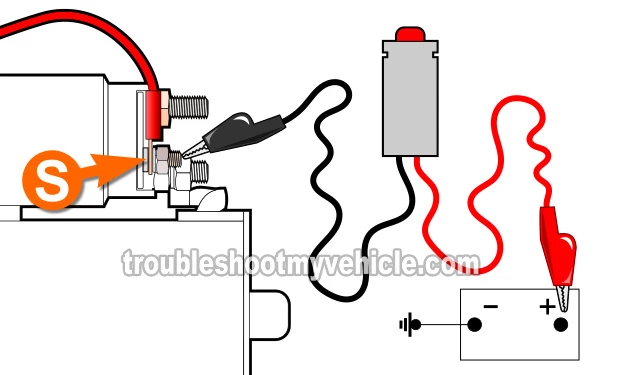
The first test you'll perform is to see if the starter motor activates (and cranks the engine) when you apply 12 Volts to its solenoid's 'S' terminal.
If the starter motor comes to life and cranks the engine, you can conclude that the starter motor itself is functioning correctly and that some other issue is keeping it from cranking the engine. Your next step will be to go to TEST 2.
If the starter motor does not crank the engine, you can generally conclude the starter motor is fried.
IMPORTANT: Remove the key from the ignition switch for this test.
OK, let's get testing:
- 1
Raise your Ford Ranger (Mazda B4000) and place on it jack stands. Remember, the only way to gain access to the starter motor is from underneath the vehicle.
- 2
Disconnect the battery negative (-) terminal.
You'll reconnect it back in one of the following steps, for now, it's a safety precaution as you set up the test. - 3
Attach one end of the remote starter switch to the battery positive (+) post.
- 4
Attach the other end of the remote starter switch to the 'S' terminal of the starter motor solenoid.
This is easier said than done, so take your time and make sure the connection is on the 'S' terminal of the starter motor solenoid.
Also, in case you're wondering, you can leave the starter motor solenoid's 'S' terminal wire connected to the engine's wiring harness connector or not, the test will work either way. - 5
Reconnect the battery negative (-) cable to the battery negative (-) post.
- 6
Apply 12 Volts to the 'S' terminal wire of the starter motor starter solenoid with your remote starter switch.
- 7
You'll get one of two results:
1.) The starter will activate and will turn over the engine.
2.) The starter motor won't do a thing.
Let's take a look at what your test results mean:
CASE 1: The starter motor cranked the engine. This is the correct and expected test result.
You can conclude that the starter motor itself is OK. The next step is to see if the starter motor is getting the 12 Volt Start signal on the 'S' terminal wire. Go to: TEST 2: Verifying The 12 Volt Start Signal.
CASE 2: The starter motor DID NOT crank the engine. This usually means that your starter motor is bad and needs to be rebuilt or replaced.
I suggest you perform two more tests. First, make sure the starter motor is getting its 12 Volt Start signal. Second, voltage drop test the battery cable (that attaches to the starter motor solenoid).
- Go to: TEST 2: Verifying The 12 Volt Start Signal.
- Go to: TEST 3: Voltage Drop Testing The Battery (+) Cable.
TEST 2: Verifying The 12 Volt Start Signal
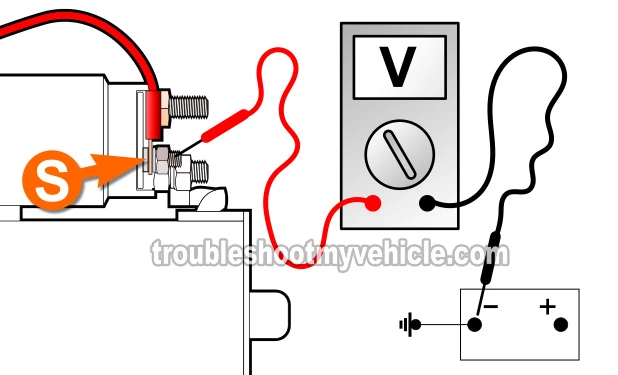
The starter motor needs an activation signal to activate and crank the engine.
This activation signal is delivered to the starter motor by the wire that connects to the 'S' terminal on the starter motor's solenoid.
I've identified the 'S' terminal (of the starter motor solenoid) with the letter S in the illustration above.
What you'll do in this test section is check that the 'S' terminal wire is delivering an activation signal when your helper turns the key to crank the engine.
Let's get testing:
- 1
Raise and place the front vehicle on jack stands (if it isn't already).
- 2
Grab and set your multimeter on Volts DC mode.
- 3
Ground the black multimeter test lead directly on the negative battery terminal using a jump start cable.
You can also Ground it on the engine, if you can find a clean, unpainted and rust-free spot of metal. - 4
Connect the red multimeter test lead to the 'S' terminal wire using an appropriate tool.
Don't know which wire is the 'S' terminal wire? This is the one that connects to the smaller of the three studs on the starter motor solenoid.
The 'S' terminal wire (circuit) is the one that delivers the Start (Crank) signal from the ignition switch. - 5
Have your helper turn the key to crank the engine when the test is setup.
- 6
Your multimeter should read 10 to 12 Volts DC.
OK, let's interpret your test results:
CASE 1: Your multimeter registered 10 to 12 Volts. This is the correct and expected test result and it confirms that the starter motor is receiving its activation signal.
Now, in the majority of the cases, you could stop testing here and replace the starter motor and be done. But, I suggest one more test so that you can be absolutely sure there isn't another issue to deal with.
Your next test is to voltage drop test the battery positive (+) cable. This is a very easy and simple test to do. Go to: TEST 3: Voltage Drop Testing The Battery (+) Cable.
CASE 2: Your multimeter DID NOT register 10 to 12 Volts. This test result lets you know that the starter motor isn't receiving an activation signal.
Although finding out why this activation signal is missing is beyond the scope of this tutorial, the most likely causes are:
- A bad starter motor relay.
- A bad park-neutral safety switch.
- A bad clutch pedal switch.
- A bad ignition switch.
TEST 3: Voltage Drop Testing The Battery (+) Cable
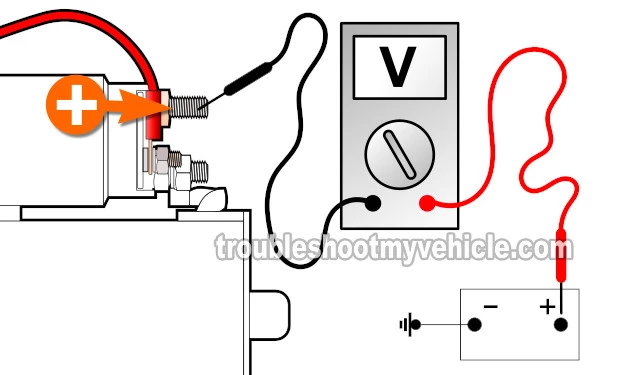
The battery positive (+) wire is the wire that delivers the voltage and amperage starter motor needs to crank the engine.
This wire has to be corrosion-free and securely attached on one end to the battery positive (+) post and the other end to the starter motor solenoid. It won't deliver the battery's total voltage and amperage output if it isn't.
In this test section, you'll ensure that this battery wire delivers all of the battery's output. You'll accomplish this test by doing a simple voltage drop test on the wire.
This is what you need to do:
- 1
Place your multimeter in Volts DC mode.
- 2
Attach the red multimeter test lead to the positive (+) battery post. The positive (+) battery post must be clean and corrosion-free.
You may need two helpers for this test step, since someone will have to hold the red multimeter test lead onto the battery positive (+) terminal bolt and someone else inside the vehicle (to crank it when everything is set up). - 3
Place the black multimeter test lead on the starter motor solenoid stud that connects to the battery positive (+) cable (see illustration above).
The orange arrow with the plus (+) sign, in the illustration above, points to this stud.
Maintain the black multimeter test lead in this position throughout the next step. - 4
When everything is ready, have your helper turn the key to crank the engine.
Although the starter motor won't crank the engine, your helper has to turn the ignition switch to start the engine for the voltage drop test to work. - 5
The multimeter should register 0.5 Volts or less (0.5 V = 0 Volts).
If there's a problem in the wire, your multimeter will register some voltage, usually 5 Volts or more.
Let's take a look at what your results mean:
CASE 1: Your multimeter indicated NO voltage drop (which is 0.5 Volts or less). This is the correct test result and it confirms the starter motor is receiving all of the battery voltage and amperage it needs to crank the engine.
You can conclude that the starter motor is bad and needs replacement if you have:
- Confirmed that the starter motor does not crank the engine (TEST 1).
- Confirmed that the starter motor is receiving an activation signal (TEST 2).
- Confirmed, in this test section, that the battery positive (+) cable does not have a voltage drop issue.
Now, before you remove the starter motor, do one more important thing:
- Turn the engine manually (using a 1/2 ratchet and the appropriate socket on the crankshaft pulley bolt). This will check to see if the engine is mechanically locked up (or not).
If you'd like to bench test the starter motor (after removing it). You can find the step-by-step instructions here:
- How To Bench Test A Starter Motor (Step By Step) (at: easyautodiagnostics.com).
CASE 2: Your multimeter registered 5 Volts or more. This result tells you that a voltage drop does exist in the wire (and it's not a good thing).
This voltage drop will prevent the battery's total amperage output from reaching the starter motor.
You'll need to thoroughly clean both ends of the battery positive (+) cable to solve this problem.
Cleaning the end that attaches to the starter motor solenoid should be done with a small piece of sandpaper. Once both ends of the battery positive cable are clean, reconnect everything and try cranking the engine. If the voltage drop was the cause of the no-crank condition, the starter motor will now crank the engine.
More 4.0L Ford Explorer, Aerostar, And Mercury Mountaineer
You can find more 4.0L V6 Ford Explorer diagnostic tutorials here:
Here's a sample of the tutorials you'll find in the index:
- How To Test For A Blown Head Gasket (1991-2010 4.0L V6 Ford Explorer, Aerostar, And Mercury Mountaineer).
- How To Test The Fuel Pump (1993-2000 4.0L V6 Ford Explorer, Aerostar, And Mercury Mountaineer).
- How To Test Engine Compression (1991-2010 4.0L Ford Explorer, Aerostar, And Mercury Mountaineer).
- FPDM Basic Operating Theory (2004-2010 4.0L V6 Ford Explorer And Mountaineer).

If this info saved the day, buy me a beer!