
In this tutorial, I'm going to show you how to test the mass airflow (MAF) sensor on your 1999-2002 3.3L V6 Nissan Quest.
Specifically, what I'm going to show you how to do is check the MAF sensor's signal voltage output itself, and we're also going to make sure that it's getting power and Ground.
All of these tests are done with a simple multimeter. Yep, that's right —you don't need any expensive diagnostic equipment to do it.
Also, if you do find that the MAF sensor is toast, I'll show you where you can buy it and save a few bucks in the process.
Contents of this tutorial:
- Symptoms Of A Bad MAF Sensor.
- Circuit Descriptions Of The Quest MAF Sensor Connector.
- Basic MAF Sensor Operating Theory.
- TEST 1: Testing The MAF Signal.
- TEST 2: Making Sure The MAF Sensor Is Getting Power.
- TEST 3: Making Sure The MAF Sensor Is Getting Ground.
- More 3.3L V6 Nissan Quest Diagnostic Test Tutorials.
APPLIES TO: This tutorial applies to the following vehicles:
- 3.3L V6 Nissan Quest: 1999, 2000, 2001, 2002.
- 3.3L V6 Mercury Villager: 1999, 2000, 2001, 2002.
MAF SENSOR CIRCUIT DIAGRAM:
1993-1998 MAF SENSOR DIAGNOSTIC TESTS:
- How To Test The MAF Sensor (1993-1995 3.0L V6 Nissan Quest).
- How To Test The MAF Sensor (1996-1998 3.0L V6 Nissan Quest).
Symptoms Of A Bad MAF Sensor
The powertrain control module (PCM) on your 3.3L V6 Nissan Quest or Mercury Villager needs to know exactly how much air is entering the engine —as you step on or step off the gas pedal.
That information is critical for the PCM to be able to figure out just how much fuel to inject into each of the six cylinders of your Nissan Quest or Mercury Villager's V6 engine.
Because the mass airflow sensor plays such a critical role in starting and keeping the engine running, when this bad boy fails, engine performance is going to suffer.
You're going to see one or more of the following symptoms:
- Rough idle or stalling.
- Hard starting, where the engine takes longer than normal to fire up.
- A MAF-related diagnostic trouble code that turns on the check engine light:
- P0100: MAF Sensor Circuit.
- Lean or rich air/fuel mixture trouble codes:
- P0171: Fuel System Too Lean.
- P0172: Fuel System Too Rich.
- Severe lack of power when you accelerate.
- Black smoke coming out of the exhaust.
- Bad gas mileage.
Circuit Descriptions Of The Quest MAF Sensor Connector
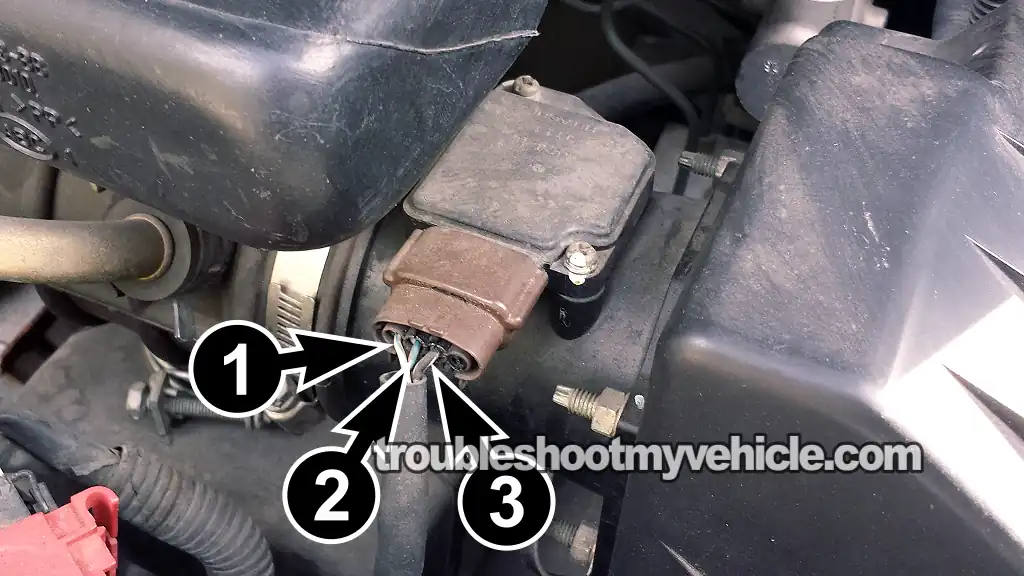
The MAF sensor on your 3.3L V6 Nissan Quest or Mercury Villager has a connector with three wires coming out of it. Each one of those wires (circuits) plays a specific role in how the sensor operates.
In the table below, I've written out a short description of what each circuit does. This circuit information is going to help us diagnose the MAF sensor as good or bad in the tests that follow.
| Terminal | Wire | Description |
|---|---|---|
| 1 | White with blue stripe (WHT/BLU) | MAF Signal |
| 2 | Blue with orange stripe (BLU/ORG) | MAF Signal Ground |
| 3 | Black with white stripe (BLK/WHT) | 12 Volt Input |
Basic MAF Sensor Operating Theory
The one thing that's gonna help you to accurately (and successfully) diagnose the MAF sensor on your minivan as good or bad is to know how it should behave while the engine is running.
To be a bit more specific, we need to know what a good MAF signal voltage output should look like if the sensor is functioning correctly.
When the MAF sensor on your Nissan Quest or Mercury Villager is doing what it should be doing —in other words, it's good— this is what you're going to see:
- At idle (low RPM), the MAF signal voltage stays relatively low —typically right around 0.9 to 1 Volt DC.
- As engine speed increases, like when you step on the gas pedal, the MAF sensor responds by producing a higher voltage signal.
I do want to point out something very important: I don't have a specific number to give you that you should see at a specific RPM value. In other words, we're not chasing an exact voltage number at a specific RPM.
What matters is that the MAF voltage signal increases with an increase in engine RPM and decreases as the engine drops back down to idle RPM.
In the majority of real-world MAF sensor failures, the MAF sensor itself stays stuck producing a voltage signal that's either stuck at one value or is simply zero Volts, no matter how much you rev the engine up or down.
Where To Buy The MAF Sensor And Save
If you do find that the MAF sensor on your Nissan Quest or Mercury Villager is toast and you've got to replace it, I want to recommend the following two sensors.
These two sensors are from known automotive brands —brands that I've been using my entire automotive repair career, and I don't hesitate to recommend them:


Disclosure: As an Amazon Associate, I earn from qualifying purchases. If my tutorials help you, using these links is an easy way to support the site at no extra cost to you. Thank you!
NOTE: The MAF sensors above fit the 1999-2002 3.3L V6 Nissan Quest and Mercury Villager. Still, once you arrive at the site, they'll ask for your vehicle's specific details to make sure it fits. If it doesn't fit, they'll help you find the correct one.
TEST 1: Testing The MAF Signal
OK, to get this show on the road, we're going to check the MAF sensor's signal voltage output and see how that voltage responds as we rev the engine up and down.
Here's what a healthy MAF signal should look like:
- At idle (low RPM), with the engine fully warmed up, the MAF signal voltage should typically fall in the 1.0 to 1.7 Volts DC range.
- As engine speed increases, the signal voltage should rise. Around 2,500 RPM, you'll usually see something close to 1.9 to 2.3 Volts DC.
If the MAF signal voltage is missing or stays stuck at a single value no matter how much you rev the engine up or down, you've got a MAF sensor that isn't doing its job. And if that's the case, then your next step is going to be to make sure that the sensor is getting power and Ground.
Before we get going, there's one thing that I do want to mention. We're going to be tapping into the MAF sensor's signal voltage output wire, which is the white with blue stripe (WHT/BLU) wire of the MAF sensor's 3-wire connector.
In the image above of the mass airflow sensor, I've labeled the WHT/BLU wire with the number 1.
One last thing, the 3-wire MAF sensor connector has to stay plugged into the sensor during the entire MAF signal voltage output test. You can either back-probe the connector or pierce the WHT/BLU wire directly.
I usually use a wire-piercing probe on the wire since it makes the job quicker. If you don't already have one, you can pick one up here: Goupchn 4mm Banana to Banana Plug Test Leads Kit (Amazon affiliate link).
OK, this is what we need to do:
- 1
Place your multimeter in Volts DC mode.
- 2
Connect the black multimeter test lead at the battery negative (-) terminal.
- 3
Connect the red multimeter test lead to the WHT/BLU wire of the MAF sensor connector.
NOTE: The MAF sensor must remain connected to its 3-wire connector. Use a back probe on the connector or a wire-piercing probe on the WHT/BLU wire to access the signal voltage. - 4
Crank and start the engine.
- 5
Note the Volts DC reading on your multimeter as the engine idles. At idle and with a fully warmed up engine, you should see around 1 to 1.7 Volts DC on your multimeter.
This reading may fluctuate a bit, but no matter what the instability in the reading, this will be your base voltage reading. - 6
Manually accelerate the engine. The voltage reading on your multimeter should increase.
At around 2500 RPMs you should see about 1.9 to 2.3 Volts DC on the multimeter. - 7
Let the engine return to idle. The voltage value on the multimeter should return to the base voltage value you recorded in step 5.
This voltage reading may not be the exact same but should be very close. - 8
Repeat this as often as you need to verify that the voltage value increases/decreases when you accelerate/decelerate the engine.
Let's see what your test results mean:
CASE 1: The MAF signal voltage rises and falls as you increase and decrease engine speed. This result confirms that the MAF sensor on your Nissan Quest or Mercury Villager is operating normally.
CASE 2: The MAF signal voltage is missing or stays locked at a single value regardless of RPM. This usually means the MAF sensor has failed and may need to be replaced.
Before calling it junk, we still need to confirm the sensor is receiving power and Ground. To continue our diagnostic, head over to: TEST 2: Making Sure The MAF Sensor Is Getting Power.
TEST 2: Making Sure The MAF Sensor Is Getting Power
At this point of your MAF sensor diagnosis, you've confirmed that the MAF signal voltage is either missing or stuck at a single value, no matter how much you're revving the engine up or down.
Before we officially call the MAF sensor bad, we've got to confirm that it's getting both power and Ground.
In this test section, we're going to make sure that the black with white stripe (BLK/WHT) wire is actually supplying the MAF sensor with 10 to 12 Volts.
This voltage is available with the key in the RUN or START position. For our testing purposes, we're going to make sure that this voltage is available with the key in the ON position but with the engine OFF.
If the BLK/WHT wire is delivering the voltage the MAF sensor needs, then we'll move on to TEST 3 and check that the blue with orange stripe (BLU/ORG) wire is providing Ground.
OK, let's start:
- 1
Disconnect the MAF sensor from its 3-wire connector.
- 2
Turn the key to the ON position but don't crank or start the engine.
- 3
Place your multimeter in Volts DC mode.
- 4
Connect the black multimeter test lead to the battery negative (-) terminal.
- 5
Probe the front of the female terminal that connects to the BLK/WHT wire with the red multimeter test lead.
NOTE: In the photo above, the BLK/WHT wire is labeled with number 3. - 6
Your multimeter should display 10 to 12 Volts DC if the BLK/WHT wire is delivering power.
Let's take a look at what your test results mean:
CASE 1: Your multimeter shows 10 to 12 Volts. This is the correct and expected test result and confirms that the MAF sensor is getting the power it needs to be able to generate a viable MAF signal.
Now, we've got one last thing to check, and that's to make sure that the MAF sensor is getting Ground. For this test, head on over to: TEST 3: Making Sure The MAF Sensor Is Getting Ground.
CASE 2: Your multimeter does not show the specified voltage. Double-check that you're probing the terminal that actually connects to the BLK/WHT wire, and then repeat the test.
If you still don't see 10 to 12 Volts on your multimeter, then we can rule out the MAF sensor itself as the root cause of the MAF sensor trouble code and the engine performance issues your minivan is experiencing. Without power, the MAF sensor can't produce a signal the PCM can work with.
Your next step is to troubleshoot why this voltage is missing and restore it to the BLK/WHT wire. Once the MAF sensor is getting power, it'll work again, and the MAF sensor trouble code and the engine performance issues will go away.
MAF sensor circuit diagram: MAF Sensor Circuit Wiring Diagram (1999-2002 3.3L V6 Nissan Quest).
TEST 3: Making Sure The MAF Sensor Is Getting Ground
So far, you've confirmed two very important things about your minivan's MAF sensor, and that is,
- The MAF sensor signal voltage output is stuck, or just not there, no matter how much you rev the engine up and down.
- The black-white wire is supplying 10 to 12 Volts to the MAF sensor.
Our next step now is to make sure that your minivan's PCM is supplying Ground to the MAF sensor.
Now, this particular Ground, it isn't a chassis Ground. This is a Ground that's supplied directly and internally by your minivan's PCM. As such, the PCM only supplies this Ground to the MAF sensor when the key is either in the ON or START position.
For our Ground test, we're going to check it with the key in the ON position, but with the engine OFF.
The wire that delivers this Ground to the MAF sensor from the PCM is the blue with orange stripe wire (BLU/ORG).
To check for the presence of this PCM-supplied Ground in the BLU/ORG) wire, we're going to do a simple multimeter voltage test.
CAUTION: Be careful when testing the PCM-supplied Ground circuit. Don't connect this wire directly to battery 12 Volts, or you'll fry the PCM. The multimeter voltage test outlined below is a safe way to check for the presence of Ground in the BLU/ORG wire.
OK, these are the test steps:
- 1
Disconnect the MAF sensor from its 3-wire connector.
- 2
Turn the key to the ON position but don't crank or start the engine.
- 3
Place your multimeter in Volts DC mode.
- 4
Connect the red multimeter test lead to the battery positive (+) terminal.
- 5
Probe the front of the female terminal that connects to the BLU/ORG wire with the red multimeter test lead.
NOTE: In the photo above, the BLU/ORG wire is labeled with the number 2 in the image above. - 6
Your multimeter should display 10 to 12 Volts DC if the BLU/ORG wire is delivering Ground from the PCM.
Alright —let's see what this is telling us:
CASE 1: The BLU/ORG wire is providing Ground from the PCM. This is the correct and expected result, and it confirms the MAF sensor on your Nissan Quest or Mercury Villager is receiving the Ground it needs to operate.
At this point, we can confidently call the MAF sensor bad if all of the following conditions are true:
- TEST 1 —The MAF signal voltage is missing or locked at a single value as engine speed changes.
- TEST 2 —The BLK/WHT wire is supplying 10 to 12 Volts.
- TEST 3 —The PCM is providing a proper Ground on the BLU/ORG wire.
When it comes time to replace the MAF sensor on your Quest's 3.3L V6 engine, I recommend sticking with proven brands like Walker Products or Delphi. I've used both throughout my automotive repair career, and they've consistently delivered solid results.
- Walker Products 245-2135 Mass Air Flow Sensor (Amazon affiliate link).
- Delphi AF10134 Mass Air Flow Sensor (Amazon affiliate link).
CASE 2: The BLU/ORG wire is not providing Ground from the PCM. First, double-check that you're probing the correct terminal for the BLU/ORG wire, then repeat the test.
If Ground is still missing, you and I can rule out the MAF sensor itself as the source of the trouble code and drivability issues. Without a proper Ground, the MAF sensor simply can't generate a signal the PCM can use.
Your next move is to track down why this PCM-supplied Ground is missing and repair the circuit. Once Ground is restored, the MAF sensor will begin working again, and the MAF-related trouble code— along with the engine performance problems— should clear.
MAF sensor circuit diagram: MAF Sensor Circuit Wiring Diagram (1999-2002 3.3L V6 Nissan Quest).
More 3.3L V6 Nissan Quest Diagnostic Test Tutorials
You can find a complete list of diagnostic tutorials and wiring diagrams in this index:
Here's a small sample of the tutorials you'll find in the index:
- Common Causes Of Spark Plug Failure (1999-2002 3.3L V6 Nissan Quest).
- How To Test The Fuel Injectors (1999-2002 3.3L V6 Nissan Quest).
- How To Test For A Blown Head Gasket (1999-2002 3.3L V6 Nissan Quest).
- How To Do And Interpret An Engine Compression Test (1999-2002 3.3L V6 Nissan Quest).

If this info saved the day, buy me a beer!
