
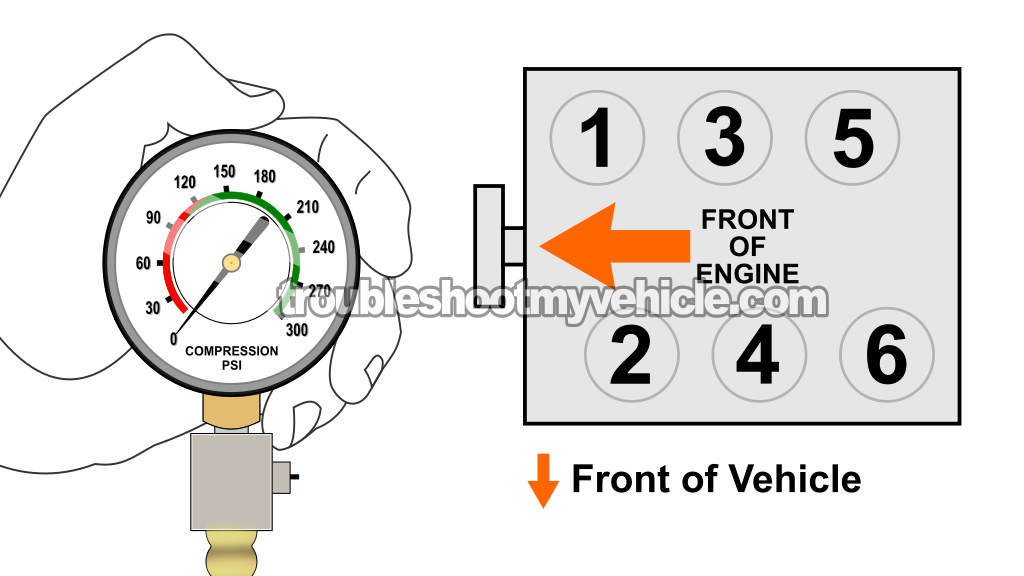
Checking the engine compression on the 1999-2002 3.3L V6 Nissan Quest isn't difficult at all —don't get me wrong, it's a process, but very doable.
In this tutorial, I'm going to explain how to perform an engine compression test on your Nissan Quest or Mercury Villager, and also how to interpret the results.
With your test results, you'll be able to easily figure out if an engine compression problem is behind a cylinder misfire issue or an engine no-start problem. Thanks for reading!
Contents of this tutorial:
APPLIES TO: This tutorial applies to the following vehicles:
- 3.3L V6 Nissan Quest: 1999, 2000, 2001, 2002.
- 3.3L V6 Mercury Villager: 1999, 2000, 2001, 2002.
Symptoms Of Low Or No Engine Compression
Over the years working on cars as an automotive technician, I've noticed that engine compression problems usually cause one of two issues:
- Engine cylinder misfire.
- An engine no-start problem.
As you're probably already aware, each one of the six cylinders in your minivan's 3.3L V6 engine needs fuel, spark, and compression to be able to produce power.
If a cylinder isn't producing enough compression —or has zero compression— that cylinder's going to misfire. And if there are enough cylinders not producing enough, or zero PSI compression, you're going to see one or more of the following engine performance problems:
- Misfire codes (if the vehicle is OBD II equipped) lighting up the check engine light:
- P0300: Random Cylinder Misfire.
- P0301: Cylinder #1 Misfire.
- P0302: Cylinder #2 Misfire.
- P0303: Cylinder #3 Misfire.
- P0304: Cylinder #4 Misfire.
- P0305: Cylinder #5 Misfire.
- P0306: Cylinder #6 Misfire.
- Engine misses at idle.
- Lack of power.
- Blue smoke coming out of the tailpipe at idle and/or when accelerating (this is engine oil burning in the cylinders).
- Engine cranks but won't start.
Which Compression Tester Should I Buy?
If you don't own an engine compression tester, you can either run down to your local auto parts store and borrow one for a small deposit (which they'll return once you bring the tool back), or you can buy one online. The following compression tester kits are reliable, and they don't cost an arm and a leg.


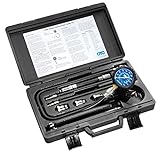
Disclosure: As an Amazon Associate, I earn from qualifying purchases. If my tutorials help you, using these links is an easy way to support the site at no extra cost to you. Thank you!
TEST 1: Dry Engine Compression Test
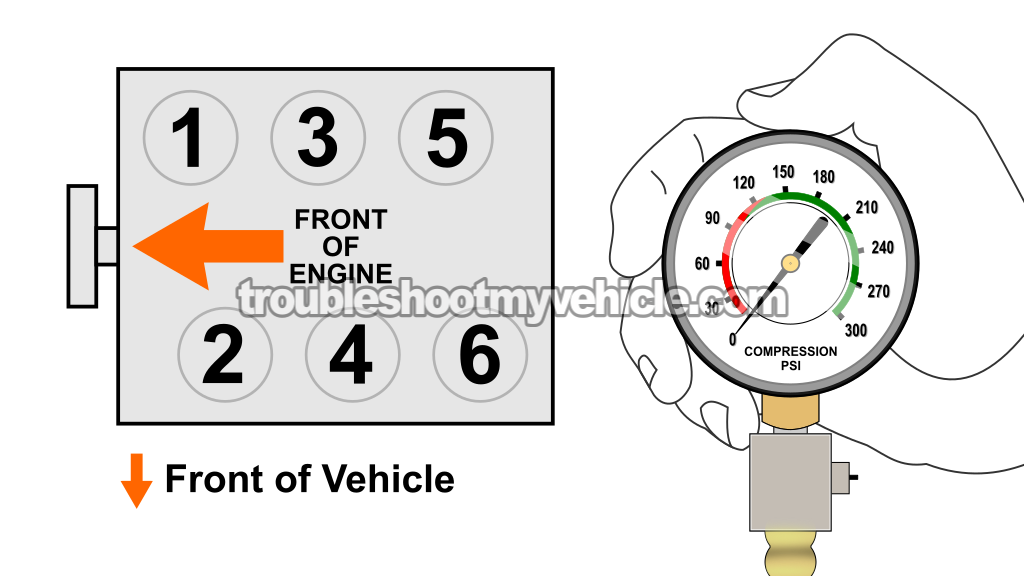
I'm going to recommend that you check the compression of all six cylinders to get the most accurate test results as to the internal health of your Nissan Quest or Mercury Villager's 3.3L V6 engine. Having said that, I do want to point out that you don't have to test all six cylinders.
Let's say you've got a cylinder misfire code that pinpoints a specific cylinder and you need to test just that one. In this scenario, I recommend that you test at least two other cylinders. This is critical, because you'll need data from those other two cylinders to see if the misfiring cylinder's compression is up to par.
Once we've got our compression test results from all the cylinders —or just the ones you're going to test— we'll then do a quick calculation to see if the compression values are within a normal range.
IMPORTANT: You'll be working around a cranking engine, so you have to be careful and stay alert at all times. Think safety all of the time!
Alright, let's get to it:
- 1
Disconnect the distributor from its electrical connector. This is just to make sure that the ignition coil does not fire off spark during the compression testing of the cylinders.
- 2
Disconnect the spark plug wires from the spark plugs.
NOTE: Before you do, be sure to label them so you know which cylinder each one belongs to. This'll make it much easier to reconnect them in the correct firing order once you're done. - 3
Remove all 6 spark plugs.
As your taking them out, be careful and don't drop any of them on the floor, or you could cause the spark plug's ceramic insulator to break, and this will cause a misfire. - 4
Thread the engine compression gauge into the spark plug hole for the number 1 engine cylinder.
Hand tighten the compression gauge only! Do not use any type of tool to get it tight. - 5
Have a helper crank the engine, when the test is set up, as you observe the needle on the compression tester's gauge.
- 6
Once the needle on the gauge stops climbing, have him or her stop cranking the engine.
- 7
Write down the compression test result and the cylinder the test result belongs to.
- 8
Repeat the test in the other 5 cylinders.
OK, let's see what it all means:
CASE 1: You've got one or two cylinders with low or no compression that are not side-by-side. Up to a certain point, and due to the age and mileage of your Nissan's 3.3L V6 engine, it's not uncommon to see compression values that aren't exactly the same between cylinders.
Our next step is to find out if this variation in compression is actually causing a problem. And to do that, we need to do a little math. Head over to: Interpreting Your Compression Test Results.
CASE 2: You've got no compression in all six cylinders. This no-compression result across all six cylinders usually points to a busted timing belt.
Regardless of what's causing this zero-compression condition, you've found the culprit behind your Nissan Quest or Mercury Villager's engine no-start problem. Your next step is to check the condition of the timing belt and make sure it's not broken.
CASE 3: You've got low or no compression in two side-by-side cylinders. This specific compression test result usually tells you that you've got a blown head gasket on your hands.
Having two adjacent cylinders with zero PSI compression typically means the head gasket has failed right between those two cylinders.
Interpreting Your Compression Test Results
It's not uncommon on these 1999-2002 Nissan Quest or Mercury Villager 3.3L V6 engines for the cylinders to produce compression values that vary a bit, and up to a certain point, that variation doesn't cause any issues.
When the difference between cylinders is more than 15%, you're going to see those low-compression cylinders causing engine performance problems —mainly a rough idle or a cylinder misfire.
Thankfully, we can figure out if the compression values you got are within an acceptable range by doing some simple math, and that's exactly what we'll be doing in this section.
There are two easy ways to check this: you can calculate that 15% difference by hand, or you can use my low-compression calculator. You'll find the calculator here: Online Low Engine Compression Calculator (at: easyautodiagnostics.com).
If you want to manually calculate the 15% difference, here's what you'll need to do:
- STEP 1: Multiply the highest compression value by 0.15 (this is the decimal value of 15%).
- STEP 2: Round the result to the nearest one (for example: 25.6 would become 26).
- STEP 3: Subtract the result (the number that was rounded) from the highest compression value.
- ANSWER: The result of this subtraction is the lowest possible compression value any cylinder can have.
Now, let me give you a more specific example: Let's say that I got the following compression readings:
| Cylinder | Pressure |
|---|---|
| #1 | 165 PSI |
| #2 | 95 PSI |
| #3 | 155 PSI |
| #4 | 175 PSI |
| #5 | 160 PSI |
| #6 | 165 PSI |
My next step is to do the following calculation:
- STEP 1: 175 x 0.15 = 26.25.
- STEP 2: 26.25 = 26 (rounded to nearest one).
- STEP 3: 175 - 26 = 149.
- ANSWER: 149 PSI. Any cylinder with this compression (or lower) value will misfire.
Since cylinder #2 is only producing 95 PSI, I can now conclude that it's 'dead' and causing a misfire.
To find out if the lowest compression value you got from your engine compression test is within a good range, you'll need to do the same calculation. Of course, you'll need to use the highest compression value you got and not the one in the example.
Once you've found the 'dead' cylinder, the next step is to find out what's causing the low compression value. For this step, go to: TEST 2: 'Wet' Engine Compression Test.
TEST 2: Wet Engine Compression Test
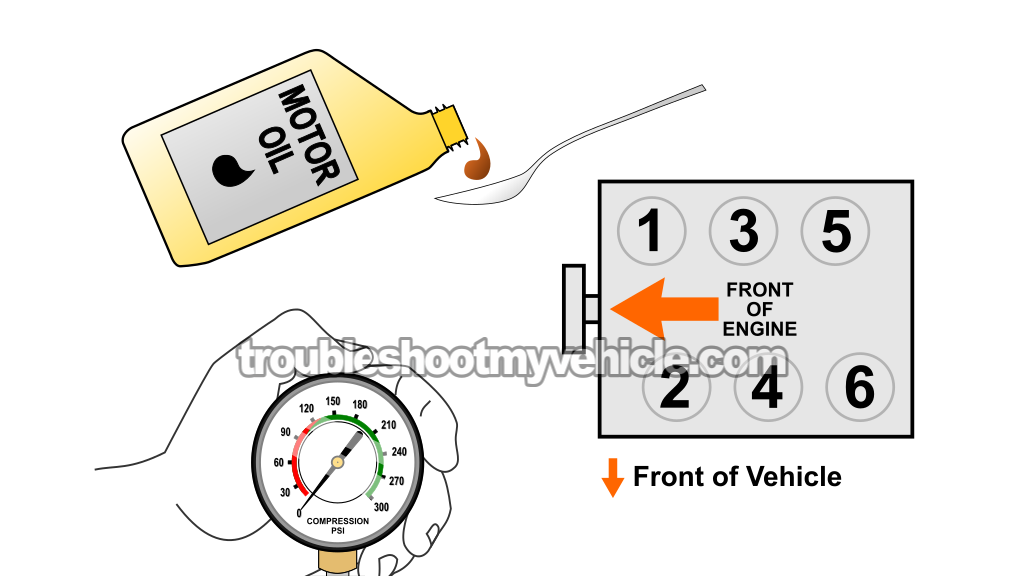
A low or zero compression value is usually caused by one of two things:
- Worn or damaged intake or exhaust valves.
- Worn or damaged piston rings.
The cool thing is, we don't need to tear the engine apart to figure out which one it is. Instead, we can simply add about two tablespoons of engine oil to the cylinder with the compression issue. Once we've got oil in the cylinder, we'll check its compression again. We're going to see one of two things:
- The cylinder's compression value shoots up, which tells us the compression issue is being caused by worn piston rings.
- The compression value doesn't change. This indicates the compression issue is being caused by a problem with the cylinder's intake or exhaust valves.
Alright, here we go:
- 1
Add a small amount of engine oil to the cylinder that reported low compression or no compression in the 'dry' compression test.
The amount should be about 1 to 2 tablespoons of oil. - 2
Install the compression tester onto the cylinder. Do not use any type of tool to tightened the compression tester. Hand tight is fine.
- 3
Crank the engine after you've set up the test.
- 4
You'll get one of two results:
1.) The compression value will go up (from the one you recorded before).
2.) The compression value will stay the same.
Let's analyze your wet compression test results:
CASE 1: The cylinder's compression value shot up. This test result lets you know that the low or no compression value you got in TEST 1 is being caused by an issue with that cylinder's piston rings.
CASE 2: The cylinder's compression value didn't change. This result lets you know that the cylinder's compression problem is being caused by an issue with its intake or exhaust valves.
More 3.3L V6 Nissan Quest Diagnostic Tutorials
You can find a complete list of tutorials and wiring diagrams for the 3.3L V6 Nissan Quest and Mercury Villager in this index:
Here are some of the tutorials you'll find in the index:
- How To Test The MAF Sensor (1999-2002 3.3L V6 Nissan Quest).
- How To Test The Fuel Injectors (1999-2002 3.3L V6 Nissan Quest).
- How To Test For A Blown Head Gasket (1999-2002 3.3L V6 Nissan Quest).
- Common Causes Of Spark Plug Failure (1999-2002 3.3L V6 Nissan Quest).

If this info saved the day, buy me a beer!
